Tech Salaries: Big Tech vs Startup
You're a senior engineer with two offers on your desk. One says "Big Tech, L5" — $200,000 base, 20% target bonus, $80,000/year in RSUs vesting over four years. The other says "Series B startup" — $170,000 base, no bonus structure yet, and 0.1% equity in the form of incentive stock options.
On paper the Big Tech offer adds up to $320,000 a year. The startup is "$170k plus equity." But equity is a slippery word, and a serious comparison needs more than offer-letter math.
This guide walks through the real differences in base, bonus, equity, benefits, liquidity, and risk — so you can decide which offer is actually better for your situation.
The first lie: "total compensation"
When a Big Tech recruiter quotes "$320k TC," they're adding base salary + target bonus + the annual value of your RSU grant.
When a startup quotes equity, they're often giving you a notional value ("0.1% × $50M valuation = $50k") that has almost no relationship to what you'll actually receive.
These two numbers are not comparable. To compare them honestly, you need to understand what each component actually is.
Component 1: Base salary
Base is the only number that's definitely going to hit your bank account next month. It's the floor.
Big Tech senior offer (L5/E5/equivalent): Roughly $180,000-$220,000 in major metros for a senior IC role, with some variation by company and location tier.
Series B startup senior offer: Roughly $150,000-$190,000, often 10-20% below Big Tech base for the same level. Startups close some of the gap with equity.
Base is the part of comp that doesn't depend on company performance, vesting, or a future liquidity event. If the startup fails and the equity is worthless, you'll still have collected the base while you were there. Base also drives the size of every future raise — see Take-Home Pay Calculator for what your net take-home actually looks like at different base levels.
Component 2: Bonus
Big Tech: Most have a target bonus, typically 10-25% of base for senior ICs. It pays out yearly or semi-annually, tied to company and individual performance. You'll usually receive close to target in normal years.
Startups: Most pre-IPO startups don't have a bonus structure. The equity is the bonus. A few well-funded later-stage startups offer modest performance bonuses, but it's the exception.
Big Tech bonuses are also taxed as supplemental income — typically withheld at the IRS's 22% supplemental rate (or 37% for amounts above $1M in a year), though your actual tax liability depends on your full-year income. The Bonus Tax Calculator is useful here if you're trying to estimate net bonus dollars.
Component 3: Equity — the big variable
This is where the two paths diverge most dramatically.
Big Tech RSUs
A Restricted Stock Unit (RSU) is a promise: on each vesting date, the company gives you N shares of its publicly-traded stock. The shares are liquid the day they vest — you can sell them at market price.
The good news: RSUs are dollars. A four-year, $80k/year RSU grant is roughly $80k/year in pre-tax compensation, modulated by stock price moves between grant and vest.
The catch: RSUs are taxed as ordinary income at the moment of vest. If your shares vest at $100 and you keep them, you've already paid income tax on $100/share. If the stock then drops to $60, you owe tax on $100 but the asset is worth $60 — a painful spread.
You can model the after-tax dollars more carefully with RSU Calculator, which factors in vesting schedule and likely withholding behavior.
Startup ISOs
A startup almost always grants Incentive Stock Options (ISOs) — the right to buy shares at a fixed "strike price," vesting over four years with a one-year cliff.
The math at offer time looks something like: "0.1% of a company valued at $50M = $50,000 worth of equity." But that $50,000 number assumes:
- The company successfully exits at the current valuation or higher
- You stay long enough to vest meaningfully (most ISO grants vest over 4 years)
- You can afford to exercise the options when you vest or leave
- The exit happens before the 10-year expiration window on your options
If any of those assumptions break, the expected value drops fast. A reasonable rule of thumb: discount the headline equity number by 60-80% to get an expected value. So that $50,000 in "equity" might be closer to $10,000-$20,000 in expected value — and the variance is enormous (could be $0, could be $500k if you hit a unicorn).
Run different scenarios through Stock Options Calculator to see what your specific grant looks like at different exit valuations.
The AMT trap on ISOs
This is the financial gotcha that catches startup employees off guard. When you exercise ISOs, the spread between the strike price and the current fair market value is an Alternative Minimum Tax (AMT) preference item.
Example: You exercise 10,000 ISOs at a $2 strike when the company is now valued such that the shares are worth $20. Your spread is $180,000. The IRS may assess AMT on that spread even though you haven't sold a single share or received any cash. You could owe $20,000-$40,000 in AMT in April with no liquid shares to pay it.
There's an AMT credit that recovers in later years, but the immediate cash crunch has bankrupted more than a few well-paid startup engineers.
Liquidity matters as much as size
Big Tech RSUs are sellable the day they vest. A $20,000 vest is $20,000 you can pay rent with this month.
Startup options give you nothing until either (1) the company IPOs and a lock-up expires, or (2) the company is acquired and your shares get cashed out. Both events are years away (median time from Series B to IPO is 7+ years, and many companies never IPO at all).
Even when liquidity arrives, your options need to be exercised — meaning you wrote a check at some point — before you can sell. Many startup employees forfeit vested options because they can't afford to exercise.
Component 4: Benefits
The benefits gap is real but often overstated.
| Benefit | Big Tech (typical) | Series B Startup (typical) |
|---|---|---|
| Health insurance | Premium plans, often 100% employer-paid | Solid plans, often employee pays 10-25% of premium |
| 401(k) match | 50-100% match up to ~6% of salary | 0-4% match common, sometimes none |
| Stock purchase plan (ESPP) | 15% discount common | Rare |
| Parental leave | 16-26 weeks | 8-12 weeks common |
| Paid time off | 15-25 days, plus sick | "Unlimited" (usually means people take less) |
| Wellness / commuter stipends | Often $1k-$3k/year | Smaller or none |
Add it all up and Big Tech benefits commonly run $15,000-$30,000/year of additional value beyond the headline TC number. Startup benefits are real but lean.
Component 5: Career trajectory and learning
This is the part the spreadsheet can't tell you.
Big Tech advantages:
- Established mentorship, structured promo paths, training budgets
- Big Tech on your resume opens future doors
- More specialized roles — you can go deep on a narrow domain
- Stable income for years while you figure out what you want next
Startup advantages:
- Broader scope, faster decisions, more impact per engineer
- Direct exposure to founders, fundraising, customers
- The kind of "from zero to one" experience that's hard to get at a big company
- If it works, the equity outcome can be life-changing
For early-career engineers, Big Tech often wins on learning velocity (mostly). For mid-career engineers who already have strong fundamentals, startups often win on growth velocity. Late-career engineers tend to optimize for cash and stability — Big Tech.
Putting it all together: an honest comparison
Let's compare the two offers from the top of this article over a 4-year horizon, using expected values rather than headline numbers.
Big Tech offer (L5 senior)
- Base × 4 years: $800,000
- Bonus (20% target × 4): $160,000
- RSU grant ($80k/yr, assume flat stock price): $320,000
- Benefits / 401k / ESPP value: ~$80,000-$100,000
- 4-year expected total: ~$1,360,000-$1,380,000
Series B startup offer
- Base × 4 years: $680,000
- Bonus (none): $0
- Equity (headline $50k × 4 vest = $200k, discount 60-80% for risk): ~$40,000-$80,000 expected value
- Benefits / 401k / lean: ~$30,000-$50,000
- 4-year expected total: ~$750,000-$810,000
The Big Tech offer is worth roughly $550,000-$600,000 more over four years in expected value.
But — and this is the part the spreadsheet hides — the startup has a fat tail. In the scenarios where it hits, your 0.1% could be worth $1M, $5M, or more. In the scenarios where it doesn't (the majority), you've collected your base and walked away.
If you're risk-averse, have dependents, or are early in your career, the Big Tech math is hard to beat. If you're young, have low fixed expenses, and want a shot at outsized outcomes, the startup is a real bet — just not a "$170k + free money" bet.
What to actually negotiate
If you're sitting with both offers, the levers that matter most:
Big Tech:
- Signing bonus (one-time cash, sometimes $30k-$100k)
- Front-loaded RSUs (some companies vest 33/33/22/12 instead of 25/25/25/25)
- Level / title (every level up is ~20-30% more comp)
Startup:
- More shares (% ownership is the only number that matters; the dollar value is fiction)
- Early exercise rights (lets you start the long-term capital gains clock early)
- Refresh grants on schedule (without it, your equity halves after year 1)
- Acceleration on change of control (you vest if the company is acquired)
For both, use Take-Home Pay Calculator to translate the cash component into actual monthly dollars. That's the part of comp you can plan around.
The bottom line
Big Tech offers higher expected value, faster liquidity, and lower variance. Startups offer higher upside potential, more career velocity, and a fatter tail of outcomes.
Compare the expected value of each offer — not the headline TC — and weight it against your risk tolerance, life stage, and what you actually want to learn over the next four years. The right answer is rarely the higher number on the page.
This article is educational and not personalized financial or tax advice. Equity outcomes vary widely and the examples here are illustrative. Talk to a CPA familiar with equity comp and AMT before making decisions about exercising options or large RSU positions.
Run the numbers
Everything below came out of this site's own Take-Home Pay Calculator. The figures are not quoted from anywhere else: each row is one run of the same calculation the tool page performs, using August 2026 rules. Put the same inputs in and you will get the same output.
How the result moves with salary
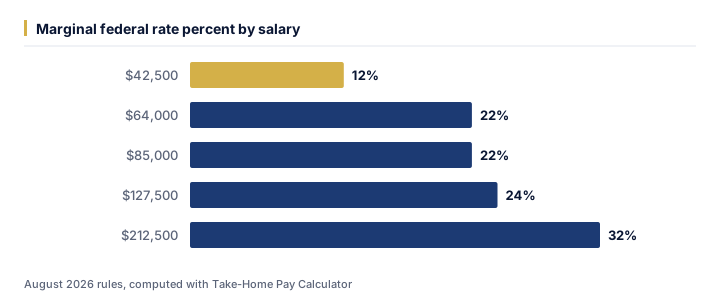
We ran 5 values of salary through the calculator and left every other input at its default. As of August 2026, the output was:
| Salary ($) | Marginal federal rate percent (%) | Effective tax rate percent (%) | Take home annual ($) |
|---|---|---|---|
| 42,500 | 12% | 17.1% | 35,245.07 |
| 64,000 | 22% | 20.4% | 50,950.64 |
| 85,000 | 22% | 24.8% | 63,897.41 |
| 127,500 | 24% | 29.7% | 89,596.16 |
| 212,500 | 32% | 33.4% | 141,456.96 |
Running salary from $42,500 up to $212,500 moves marginal federal rate percent from 12% to 32% — a spread of 20%. That gap is the part a single headline rate never shows.
The same runs seen through effective tax rate percent
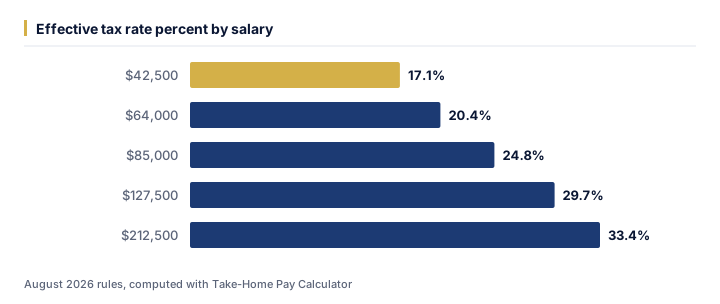
At $42,500, effective tax rate percent works out to 17.1%; at $212,500 it is 33.4%. Looking only at marginal federal rate percent tends to understate how much the outcome shifts across that range.
One example, straight from the API
The middle row above (salary = $85,000) is not a rounded illustration — it is exactly what /api/v1/tools/take-home-pay-calculator/calculate returns for that input, August 2026 rules:
{
    "tool": "take-home-pay-calculator",
    "inputs": {
        "salary": 85000,
        "filing": "single",
        "state": "CA",
        "contrib_pct": 0,
        "other_pre_tax": 0
    },
    "result": {
        "take_home_annual": 63897.41,
        "take_home_monthly": 5324.78,
        "take_home_biweekly": 2457.59,
        "federal_tax": 10541,
        "fica": 6502.5,
        "state_tax": 4059.09,
        "pretax_401k": 0,
        "federal_taxable": 70400,
        "marginal_federal_rate_percent": 22,
        "effective_tax_rate_percent": 24.8
    }
}
Assumptions behind these figures
| Input | Value |
|---|---|
| Salary | $85,000 |
| Filing | Single |
| State | Ca |
| Contrib pct | 0% |
| Other pre tax | $0 |
| As of | August 2026 |
| Method | identical to /tools/take-home-pay-calculator |
Rates, thresholds and typical costs change over time; the numbers above are accurate as of August 2026, not a permanent guarantee. For your own situation, open the Take-Home Pay Calculator and enter your real numbers — the calculator runs the same code that produced every figure on this page.