Remote vs Hybrid vs Office: Comp Comparison
You see a job posted at $160,000. Then you see the same role at a different company posted at $140,000 — remote. Then a third at $175,000 — fully on-site in San Francisco. Which one pays best?
The honest answer: it depends entirely on where you live, what your commute costs, and how each company structures geographic pay. Remote, hybrid, and office jobs each run on different pay philosophies, and a $20,000 gap on the offer letter often disappears (or doubles) once you account for cost of living, state taxes, commute, and the soft savings of working from home.
This guide breaks down the three pay models, shows you what the real take-home difference looks like, and gives you a framework for picking the work arrangement that actually pays best for your situation.
The Three Pay Philosophies
Companies don't all set pay the same way. Roughly speaking, there are three dominant philosophies.
Location-based tiers (most common for remote). The company defines 2-4 geographic tiers and pays the same role differently depending on which tier you live in. A Tier 1 (San Francisco, New York, Seattle) employee might earn 10-20% more than the same role in Tier 3 (smaller metros or rural areas). This is how many large tech employers — Google, Meta, Salesforce among them — structure remote pay.
Single-rate national (less common, but growing). The company pays the same rate regardless of location. This favors employees in lower-cost areas. GitLab and a handful of remote-first companies use this model, but it's still the minority approach.
Metro-anchored (typical for hybrid). The job is technically hybrid, but pay is anchored to the office metro regardless of where the employee lives. If the office is in Boston, you're paid Boston rates whether you live in Boston or commute in from Worcester.
Office-only (in-office roles). Pay is set by the local market, period. No remote adjustment, no flexibility discount.
Knowing which philosophy applies to a job changes the comparison entirely. Always ask the recruiter: "Is base salary adjusted by employee location, or is it set nationally?"
Remote: Location-Based Tiers in Detail
Tier-based remote pay typically follows a structure like this (numbers are illustrative — verify with the specific employer):
- Tier 1: SF Bay Area, NYC, Seattle, sometimes Boston/LA → base index 100%
- Tier 2: Mid-tier metros (Austin, Denver, Chicago, DC, Atlanta) → 85-95% of Tier 1
- Tier 3: Smaller metros and rural areas → 75-85% of Tier 1
A $180,000 Tier 1 base might be offered as $153,000 to a Tier 2 resident or $144,000 to someone in Tier 3. On paper, that looks like a pay cut. In practice, the cost of living and state tax differences usually swamp the gap.
For example, $144,000 in Austin, Texas (no state income tax) often delivers more after-tax purchasing power than $180,000 in San Francisco (13.3% top state rate, much higher housing costs). Run both through Cost of Living Calculator before deciding which pays better.
Hybrid: Pay Anchored to the Office
In a hybrid arrangement, you're expected on-site 2-3 days a week. The company anchors your pay to the office metro because, in their view, you're an office employee who happens to work from home sometimes.
This usually means:
- No discount for being remote some days (you're still paid full metro rate)
- No premium for showing up (you're not paid more for in-office days)
- Commute costs you bear on the days you go in
- Geographic flexibility is limited — you have to live within commuting distance
If you live close to the office, hybrid often delivers the best pay-to-cost ratio. You get metro-rate base salary without paying for housing in the priciest urban core, and you only commute 2-3 days instead of 5.
Office: Highest Cash, Lowest Flexibility
In-office roles still command a premium in some markets, especially senior or executive positions where physical presence is treated as part of the job. Investment banking, biglaw, and certain operational roles still expect 5 days on-site, and they pay for it.
But the all-in cost of an office job extends beyond commute:
- Commute: $3,000-$8,000/year for transit; $5,000-$12,000/year if you drive (gas, parking, vehicle wear)
- Lunches and coffee: $1,500-$4,000/year if you buy out, vs ~$500 if you bring lunch
- Work clothes and dry cleaning: $500-$2,000/year for professional dress code
- Time: A 45-minute each-way commute is 7.5 hours/week, or roughly 375 hours/year. That's 9 weeks of full-time work.
Adding it up, a typical office worker spends $5,000-$15,000/year on costs that a remote worker doesn't have, plus the unpaid time of commuting.
The Remote Savings: Where the $5,000-$12,000 Comes From
When people say "remote work saves you $X per year," here's the typical breakdown:
| Category | Annual savings (remote vs office) |
|---|---|
| Commute (gas, parking, transit) | $3,000-$8,000 |
| Lunches out | $1,000-$3,000 |
| Coffee, snacks | $300-$800 |
| Work clothes, dry cleaning | $500-$1,500 |
| Childcare drop-off/pickup time savings | Variable |
| Total | $5,000-$13,000 |
These savings are post-tax dollars, which makes them more valuable than equivalent gross salary. To replicate $8,000 in post-tax savings with extra salary, you'd need roughly $11,000-$12,000 in additional gross pay at a 30% effective tax rate.
This is the math that makes "lower" remote offers competitive. A $144,000 fully remote salary in Tier 3 territory beats a $160,000 office salary in Tier 1 territory once you net out the $8,000-$10,000 of office overhead and the state tax differences.
A Worked Three-Way Comparison
Let's compare three offers for the same software engineering role:
- Offer A — Remote, Tier 3 (Boise, ID): $144,000 base + $21,600 target bonus (15%) + $60,000 RSU/year
- Offer B — Hybrid, Boston metro: $170,000 base + $25,500 target bonus + $75,000 RSU/year, 3 days on-site
- Offer C — Office, San Francisco: $185,000 base + $27,750 target bonus + $90,000 RSU/year, 5 days on-site
Headline total comp:
- A: $225,600
- B: $270,500
- C: $302,750
After state tax (effective rate estimates):
- A: Idaho ~5.8% on top bracket → roughly $13,000 state tax on top portion
- B: Massachusetts 5% flat → roughly $13,500
- C: California ~9.3-11.3% on top brackets → roughly $25,000+
After cost-of-living adjustment (housing dominates):
- A: Boise rent for a 2BR ~$1,800/month → $21,600/year
- B: Boston-area suburb 2BR ~$2,700/month → $32,400/year
- C: SF 2BR ~$4,400/month → $52,800/year
After commute/lunch/clothes:
- A: $0
- B: $4,000 (3 days commute, lunches half the week)
- C: $9,000 (5 days commute, urban lunches)
When you net everything out, the gap between A and C — which looked like $77,000 on the offer letter — shrinks to closer to $20,000-$25,000. Whether that's worth being on-site five days a week in SF traffic depends on what else you value: career trajectory, mentor access, network density, the feel of an in-person team.
Use Take-Home Pay Calculator and Cost of Living Calculator to run the same exercise on your own three offers.
When Remote Wins
Remote tends to win on total real comp when:
- You live (or want to live) in a low-cost state with low income tax
- Your role doesn't require physical infrastructure or in-person collaboration
- You have caregiving responsibilities or other obligations that benefit from schedule flexibility
- The employer uses a single-rate national pay model
When Hybrid Wins
Hybrid tends to win when:
- You live in a metro with strong tech/finance/professional services jobs but high housing costs
- You can afford to live close enough to the office that commute days don't dominate your life
- You're early-career and benefit from in-person mentorship a few days a week
- The employer anchors pay to the metro (you get full metro rate while spending half your days at home)
When Office Wins
Office tends to win when:
- Your career path depends on visibility (sales, executive track, deal-making roles)
- Your role is inherently in-person (lab work, medicine, trades, hospitality)
- You're optimizing for raw cash and the metro premium is large enough to offset costs
- You actively prefer in-office work for productivity or social reasons
Pitfalls in the Comparison
Don't forget state income tax. A $20,000 base difference between offers can vanish entirely once you factor in moving from a 9% state tax to a 0% state tax.
Don't undervalue commute time. Two hours of commuting per day is unpaid labor. If you value your time at $50/hour, that's $25,000/year in unpaid time you'd never see on a payslip.
Don't assume remote is permanent. Companies have walked back remote policies repeatedly since 2022. If you accept a job because it's fully remote, get the policy in writing and understand what happens if they change it.
Don't ignore the equity geographic adjustment. Some employers apply tier-based discounts to equity grants too, not just base salary. Read the offer letter carefully.
The Bottom Line
The "remote vs hybrid vs office" choice isn't a pay choice. It's a lifestyle choice with significant pay consequences in both directions. The right comparison isn't headline base salary — it's after-tax, after-cost-of-living, after-commute, after-lunches purchasing power.
Run all three offers through the same framework. The cheapest-looking offer often wins. The most expensive-looking offer sometimes loses badly. The only way to know is to do the math.
Run the numbers
Everything below came out of this site's own Salary to Hourly Converter. The figures are not quoted from anywhere else: each row is one run of the same calculation the tool page performs, using August 2026 rules. Put the same inputs in and you will get the same output.
How the result moves with salary
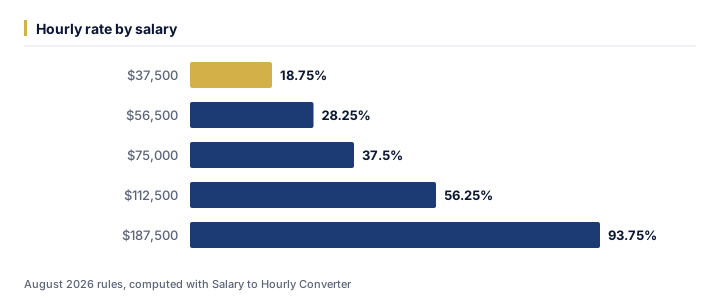
We ran 5 values of salary through the calculator and left every other input at its default. As of August 2026, the output was:
| Salary ($) | Hourly rate (%) | Monthly pay ($) | Biweekly pay ($) |
|---|---|---|---|
| 37,500 | 18.75% | 3,125 | 1,442.31 |
| 56,500 | 28.25% | 4,708.33 | 2,173.08 |
| 75,000 | 37.5% | 6,250 | 2,884.62 |
| 112,500 | 56.25% | 9,375 | 4,326.92 |
| 187,500 | 93.75% | 15,625 | 7,211.54 |
Running salary from $37,500 up to $187,500 moves hourly rate from 18.75% to 93.75% — a spread of 75%. That gap is the part a single headline rate never shows.
The same runs seen through monthly pay
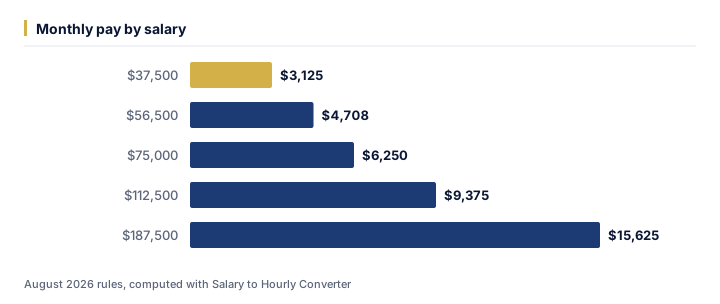
At $37,500, monthly pay works out to $3,125; at $187,500 it is $15,625. Looking only at hourly rate tends to understate how much the outcome shifts across that range.
One example, straight from the API
The middle row above (salary = $75,000) is not a rounded illustration — it is exactly what /api/v1/tools/salary-to-hourly-converter/calculate returns for that input, August 2026 rules:
{
    "tool": "salary-to-hourly-converter",
    "inputs": {
        "salary": 75000,
        "hoursPerWeek": 40,
        "weeksPerYear": 50
    },
    "result": {
        "hourly_rate": 37.5,
        "monthly_pay": 6250,
        "biweekly_pay": 2884.62,
        "weekly_pay": 1442.31,
        "daily_pay": 300,
        "hours_per_year": 2000
    }
}
Assumptions behind these figures
| Input | Value |
|---|---|
| Salary | $75,000 |
| Hours per week | $40 |
| Weeks per year | 50 years |
| As of | August 2026 |
| Method | identical to /tools/salary-to-hourly-converter |
Rates, thresholds and typical costs change over time; the numbers above are accurate as of August 2026, not a permanent guarantee. For your own situation, open the Salary to Hourly Converter and enter your real numbers — the calculator runs the same code that produced every figure on this page.