1099 vs W-2: Real Income Comparison
Recruiter pings you with a 1099 contract at $130,000. Your current W-2 job pays $100,000. The 30% bump looks obvious — until you do the math. Once you factor in self-employment tax, health insurance, paid time off, and benefits, that gap shrinks fast. Sometimes it disappears. Sometimes the W-2 is the better deal.
This article walks through the real side-by-side comparison so you can answer the question that matters: how much money do I actually keep at the end of the year?
What "1099" and "W-2" actually mean
Quick refresher:
- W-2 employee. Hired by a company. They withhold taxes, pay half your FICA, and usually offer benefits. You get a W-2 form in January.
- 1099 contractor. Self-employed. The hiring company pays you gross, withholds nothing, and sends you a 1099-NEC. You handle your own taxes, benefits, and retirement.
Legally, you don't get to choose — the IRS and DOL have a multi-factor test for whether a worker is genuinely independent. But for many roles, the same person could be hired either way, and the question becomes which offer to accept.
The hidden cost of being your own employer
W-2 paychecks look small partly because your employer is silently spending another 25-40% on top of your salary for things you don't see:
- Employer-side FICA: 7.65% (the half they pay so you don't pay 15.3%)
- Health insurance: $7,000-$15,000+ for individual coverage, much more for family
- Retirement match: typically 3-6% of salary
- PTO and holidays: 3-5 weeks of paid time off, at full salary
- Disability, life insurance, dental, vision: a few thousand dollars
- Unemployment insurance, workers' comp: ~1-3% of salary
- Office, equipment, internet stipend: variable, real
When you go 1099, every one of those becomes your bill. They don't disappear — they just move onto your line item.
A side-by-side example
Let's compare two offers that, at first glance, look like 1099 is a clear winner.
- W-2 offer: $100,000 salary, full benefits, 4 weeks PTO, 6% 401(k) match
- 1099 offer: $130,000 contract (gross), no benefits, no PTO, no match
Single filer, no kids, residing in Texas (no state income tax to keep the math clean).
W-2 calculation
| Line item | Amount |
|---|---|
| Gross salary | $100,000 |
| Employee FICA (7.65%) | -$7,650 |
| Federal income tax (estimated) | -$13,840 |
| 401(k) contribution (8%, optional) | -$8,000 |
| Health insurance employee share | -$2,400 |
| Take-home cash | ~$68,110 |
| Employer 401(k) match (6%, $6,000) | +$6,000 (retirement) |
| Employer pays health insurance | (worth ~$8,000) |
| Total economic value | ~$82,110 |
1099 calculation
| Line item | Amount |
|---|---|
| Gross contract | $130,000 |
| Self-employment tax (15.3% on 92.35% of net) | -$18,373 |
| Half of SE tax (deductible above-line) | recovered partially in federal tax |
| Federal income tax (estimated, after SE deduction and QBI) | -$17,500 |
| Health insurance (marketplace plan) | -$10,000 |
| Retirement (Solo 401(k), match equivalent) | -$8,000 (your decision) |
| No PTO (4 weeks unpaid, lost income at $2,500/week × 4) | -$10,000 opportunity cost |
| Business expenses, accounting, tools | -$3,000 |
| Take-home cash, after retirement saving and lost PTO | ~$63,127 |
The $30,000 gross premium evaporated. The 1099 contractor actually has less cash in hand at the end of the year in this scenario, despite a higher headline number.
The 1099 vs W-2 Income Calculator runs this comparison with your real numbers.
Where the W-2 wins
In the example above, several costs hit the 1099 worker that the W-2 worker didn't see:
Self-employment tax (the big one)
SE tax is the killer line item most new contractors underestimate. As a W-2 employee, you pay 7.65% of your wages for Social Security and Medicare, and your employer pays the matching 7.65%. As a 1099 contractor, you pay both halves — 15.3% on net earnings up to the Social Security wage base ($176,100 for 2026), then 2.9% Medicare with no cap (plus 0.9% Additional Medicare on high incomes).
You do deduct half of SE tax on your federal return, so the effective cost is closer to 12-13% after factoring in income tax savings — but it's still a meaningful drag on every dollar earned.
Health insurance
Employer health insurance is often the most valuable benefit you have. A typical mid-tier individual plan paid mostly by an employer might cost the employer $7,000-$10,000 per year. The employee share is often just $1,500-$3,000.
Buy that same insurance on the marketplace as a self-employed individual and you might pay $8,000-$15,000 per year for similar coverage. Family plans can easily double that. ACA subsidies help below certain income thresholds, but a $130,000 1099 worker almost certainly doesn't qualify.
Self-employed health insurance premiums are deductible above the line (no need to itemize), which softens the impact — but only after you've cut the check.
PTO and holidays
W-2 employees with 4 weeks PTO + 10 holidays effectively get paid for ~6 weeks they don't work. A 1099 contractor billing $130,000 over 50 weeks earns nothing during those 6 weeks of time off. To match the W-2's effective hourly pay, the 1099 rate has to be higher.
Stability and ramp time
Most 1099 contracts have an end date. Between contracts, your income is zero. Plan for 4-8 weeks of bench time per year, plus the time to land each new contract. A W-2 paycheck arrives whether the company has billable work for you that week or not.
Where the 1099 wins
It's not all downside. Several big advantages can flip the comparison if you set things up right.
Solo 401(k) and SEP-IRA
A W-2 employee can contribute up to $23,000 to a 401(k) for 2026 (employee deferral), plus an employer match capped by plan design (commonly $5,000-$15,000). Total often lands in the $30,000-$40,000 range.
A 1099 contractor with a Solo 401(k) can contribute:
- The same $23,000 employee deferral
- Plus up to 20% of net self-employment earnings as the employer contribution
- Combined cap of $69,000 for 2026
For high earners, that's potentially $30,000+ more in tax-deferred retirement savings per year than a typical W-2 plan allows. That alone can pay for several years of higher health insurance premiums.
Business deductions
Real, legitimate business expenses come off the top:
- Home office (a portion of rent, utilities, internet)
- Equipment (laptop, monitors, phone)
- Software and subscriptions
- Travel for client work
- Professional development, certifications, conferences
- Health insurance premiums (self-employed)
- Half of SE tax
A W-2 employee can deduct almost none of these (job expense deductions for W-2 workers were largely eliminated by the 2017 tax law). For a 1099 worker, $10,000-$20,000 of legitimate business expenses per year is normal.
QBI deduction
The Qualified Business Income deduction lets pass-through business owners (including most sole proprietors) deduct up to 20% of qualified business income, subject to income phase-outs and trade-or-business limitations. For service businesses (consultants, freelancers), the deduction phases out at higher income levels, but at moderate incomes it's a real benefit.
Flexibility and control
Harder to put in a spreadsheet but real: you set your own hours, choose your clients, decline projects, work from anywhere. For some people that's worth a 10-20% pay cut. For others it's worth nothing if they value structure and benefits.
When the math tips one way or the other
Some rough rules of thumb after running this comparison many times:
1099 typically wins when:
- Your gross 1099 rate is at least 30-50% above the comparable W-2 salary
- You can sustain high billable utilization (most weeks booked)
- You have an existing solo retirement plan and can max contributions
- You have spouse-provided health insurance or you're young/healthy enough to take a high-deductible plan
- You have real business expenses that aren't lifestyle creep
- You value the flexibility and intend to stay independent long-term
W-2 typically wins when:
- The gross premium is small (less than 20-25% above W-2)
- You'd buy individual health insurance otherwise
- You value PTO, paid sick time, and parental leave benefits
- You're earlier in your career and the employer match is significant relative to your salary
- You want predictable income with no business admin overhead
Hybrid play: S-corp election
Once you're regularly earning real money as a 1099 contractor (say $80,000+ in net earnings), forming an S-corp and electing to be taxed as one can save thousands per year in self-employment tax. The mechanics:
- You become an employee of your own S-corp.
- The S-corp pays you a "reasonable salary" via W-2 (subject to FICA).
- Remaining profit is distributed to you as an owner distribution, not subject to SE tax.
Savings are typically $3,000-$10,000+ per year depending on income, minus the cost of payroll, an extra tax return, and added accounting complexity. Most CPAs recommend the conversation once net SE earnings hit $80,000-$100,000.
This is a real planning decision, not a side hack — talk to a CPA before electing.
The right rate to compare
A reasonable rule of thumb: a 1099 contract needs to gross 35-50% more than the comparable W-2 salary just to match take-home and benefits. The exact multiplier depends on:
- Your state's income tax
- Your health insurance situation
- How much you can deduct in legitimate business expenses
- Whether you're S-corp vs sole prop
- Your target retirement contribution
The Freelance Rate Calculator computes the floor — what you need to gross to hit a specific take-home target. Comparing that floor to a W-2 offer tells you which side wins.
What to ask before signing a 1099 contract
If you're considering a 1099 offer that "sounds like a raise," ask yourself:
- What's the gross-up multiplier? Run the Take-Home Pay Calculator on both numbers.
- What's the contract length? A 12-month contract has zero income on month 13 if it isn't renewed.
- Is there a benefits package, or is the rate fully loaded? Some "1099" arrangements via staffing agencies include health insurance — read the contract.
- What's the worker classification risk? A W-2 job dressed up as 1099 is illegal and creates back-tax exposure when audited.
- Can I afford a 30-60 day gap between contracts? If not, the predictability of a W-2 may be worth more than the gross premium.
A 1099 offer at $130,000 might be a great move or a quiet pay cut depending on your situation. The dollar gap matters less than the after-everything math. Run the numbers before you accept.
This article is general information for U.S. workers and is not tax, legal, or financial advice. Self-employment taxation is complex and varies by state and circumstances; consult a CPA before making the W-2 vs 1099 decision based on tax math alone.
Run the numbers
Everything below came out of this site's own Take-Home Pay Calculator. The figures are not quoted from anywhere else: each row is one run of the same calculation the tool page performs, using August 2026 rules. Put the same inputs in and you will get the same output.
How the result moves with salary
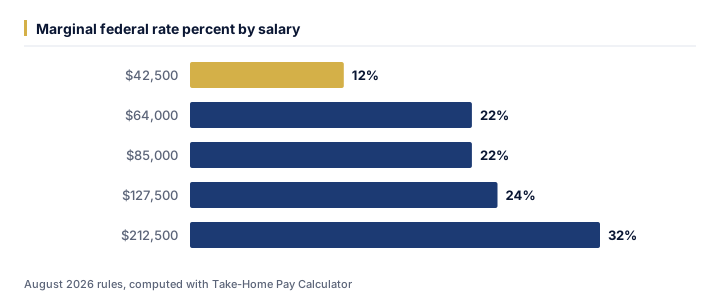
We ran 5 values of salary through the calculator and left every other input at its default. As of August 2026, the output was:
| Salary ($) | Marginal federal rate percent (%) | Effective tax rate percent (%) | Take home annual ($) |
|---|---|---|---|
| 42,500 | 12% | 17.1% | 35,245.07 |
| 64,000 | 22% | 20.4% | 50,950.64 |
| 85,000 | 22% | 24.8% | 63,897.41 |
| 127,500 | 24% | 29.7% | 89,596.16 |
| 212,500 | 32% | 33.4% | 141,456.96 |
Running salary from $42,500 up to $212,500 moves marginal federal rate percent from 12% to 32% — a spread of 20%. That gap is the part a single headline rate never shows.
The same runs seen through effective tax rate percent
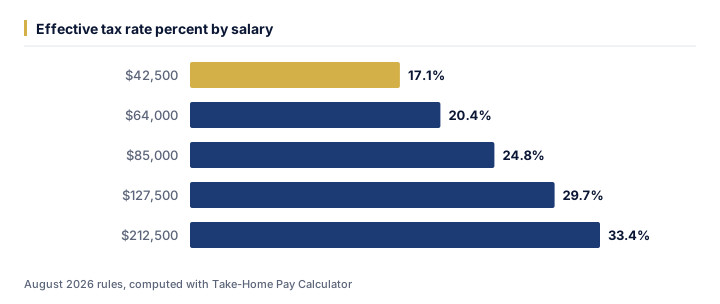
At $42,500, effective tax rate percent works out to 17.1%; at $212,500 it is 33.4%. Looking only at marginal federal rate percent tends to understate how much the outcome shifts across that range.
One example, straight from the API
The middle row above (salary = $85,000) is not a rounded illustration — it is exactly what /api/v1/tools/take-home-pay-calculator/calculate returns for that input, August 2026 rules:
{
    "tool": "take-home-pay-calculator",
    "inputs": {
        "salary": 85000,
        "filing": "single",
        "state": "CA",
        "contrib_pct": 0,
        "other_pre_tax": 0
    },
    "result": {
        "take_home_annual": 63897.41,
        "take_home_monthly": 5324.78,
        "take_home_biweekly": 2457.59,
        "federal_tax": 10541,
        "fica": 6502.5,
        "state_tax": 4059.09,
        "pretax_401k": 0,
        "federal_taxable": 70400,
        "marginal_federal_rate_percent": 22,
        "effective_tax_rate_percent": 24.8
    }
}
Assumptions behind these figures
| Input | Value |
|---|---|
| Salary | $85,000 |
| Filing | Single |
| State | Ca |
| Contrib pct | 0% |
| Other pre tax | $0 |
| As of | August 2026 |
| Method | identical to /tools/take-home-pay-calculator |
Rates, thresholds and typical costs change over time; the numbers above are accurate as of August 2026, not a permanent guarantee. For your own situation, open the Take-Home Pay Calculator and enter your real numbers — the calculator runs the same code that produced every figure on this page.