Living in NYC vs SF: Real Salary Comparison
You got an offer in San Francisco for $250,000. A recruiter in Manhattan is dangling the same number. Both cities feel expensive in the abstract — but which one actually leaves more money in your pocket at the end of the year?
The honest answer is: it's closer than most people think, but the gap is real, and it doesn't favor the city most expect. This guide walks through the real math at $250k — federal taxes, state taxes, city taxes, FICA, rent, groceries, and the small line items that quietly add up — so you can compare offers without guessing.
The headline number isn't the take-home number
A $250,000 salary in either city is in the top tier of U.S. earners. But by the time the IRS, your state, your city, and Social Security take their cuts, the cash hitting your bank account is dramatically less than $250k.
You can run the exact figures with Take-Home Pay Calculator, but here's the back-of-the-envelope version for both cities, assuming a single filer with no dependents claiming the standard deduction.
Federal tax (identical in both cities)
Federal tax doesn't care which coast you live on. For a single filer earning $250,000 with the 2026 standard deduction of $14,600, you're taxed on $235,400 of income. That puts you well into the 32% bracket (which starts at $197,300 for single filers in 2026), with the 22% bracket starting at $47,150 doing most of the heavy lifting.
Estimated federal income tax: roughly $54,000-$56,000 depending on deductions and adjustments.
FICA (also identical)
- Social Security: 6.2% up to the 2026 wage base of $176,100 = $10,918
- Medicare: 1.45% on all wages = $3,625
- Additional Medicare: 0.9% on income above $200,000 = $450
FICA total: about $15,000.
So both cities start with the same ~$69,000-$71,000 in federal taxes before state and city pile on.
San Francisco: California's progressive state tax
California has the most progressive state income tax in the country, and at $250,000 you feel it.
The brackets that matter
California's top bracket of 12.3% kicks in above $698,271 for single filers, so you won't hit that on $250k. But the marginal rate climbs steeply through the middle brackets:
- 9.3% starts around $73,000
- 10.3% starts around $375,000
For a single filer at $250,000, your effective California state tax rate lands around 8.5-9%, or roughly $21,000-$23,000.
There's also California's State Disability Insurance (SDI), which in 2026 has no wage cap — 1.1% on all wages. On $250k that's another $2,750.
San Francisco city tax
Here's the good news for SF: there is no city income tax for employees. San Francisco has a Gross Receipts Tax on businesses, but as a W-2 employee you're not paying a separate city tax line.
SF total deductions estimate
- Federal income tax: ~$55,000
- FICA: ~$15,000
- California state tax: ~$22,000
- California SDI: ~$2,750
- Total: ~$94,750
- Take-home: ~$155,250
New York City: state + city stacked
New York is more complicated because you pay both state and city income tax. But the state rates are lower than California's at this income level.
New York State tax
For a single filer at $250,000, NY state's marginal rate is 6.85% (the bracket from $215,400 to $1,077,550). Your effective state rate lands around 5.5-6%, or roughly $14,000-$15,000.
NYC city tax
This is where the New York math gets uncomfortable. NYC has its own progressive income tax on top of state. At $250k single, you're in the top NYC bracket of about 3.876%, with an effective rate around 3.5% — roughly $8,500-$9,000.
New York doesn't have a separate SDI line at this income
NY has a small disability insurance contribution capped at $0.60/week — essentially negligible.
NYC total deductions estimate
- Federal income tax: ~$55,000
- FICA: ~$15,000
- New York state tax: ~$14,500
- NYC city tax: ~$8,800
- Total: ~$93,300
- Take-home: ~$156,700
Side-by-side
| Line item | San Francisco | New York City |
|---|---|---|
| Gross salary | $250,000 | $250,000 |
| Federal income tax | ~$55,000 | ~$55,000 |
| FICA | ~$15,000 | ~$15,000 |
| State income tax | ~$22,000 | ~$14,500 |
| Local / city tax | $0 | ~$8,800 |
| State disability | ~$2,750 | ~$30 |
| Total tax | ~$94,750 | ~$93,330 |
| Net take-home | ~$155,250 | ~$156,670 |
The difference at $250k: about $1,400/year in NYC's favor. That's roughly $27/week. Not nothing — but probably not the deciding factor in your decision.
But what about the rent?
Tax is half the story. Housing is the other half, and at $250k household income it dominates almost every other budget line.
Median rent at the high end
Both cities are among the most expensive rental markets in the U.S. As of early 2026, according to widely-cited rental indices:
- Manhattan one-bedroom: roughly $4,200-$4,800/month
- Brooklyn (Williamsburg / Park Slope) one-bedroom: $3,200-$3,800/month
- San Francisco one-bedroom: $3,500-$4,200/month
- SF Bay Area (Mission / SOMA): $3,700-$4,500/month
For comparable apartments in comparable neighborhoods, Manhattan tends to run slightly higher than SF proper, though SF tech-heavy zip codes can match it.
What that does to your monthly budget
Take a $4,000/month rent. That's $48,000/year — about 31% of your $156k take-home. Most personal finance rules of thumb recommend keeping housing under 30% of net pay, and at $250k in either city you're brushing against that ceiling unless you go further out or share a place.
Use Cost of Living Calculator to model the full picture: rent, transit, groceries, dining out, and the per-city quirks (NYC subway pass, SF Muni, parking costs in both).
The smaller line items that swing the comparison
Transportation
NYC has a real advantage here. A monthly subway pass is about $132. Most Manhattan and inner-Brooklyn residents don't own a car. SF has Muni and BART, but the city is more car-dependent once you head south or east, and parking averages $300-$500/month if you garage one.
Edge: NYC, by $200-$500/month if you'd otherwise own a car.
Groceries and dining
Both cities are 15-25% above the national average. NYC tends to run slightly higher on grocery prices; SF tends to be slightly higher on restaurant entrées. Functionally a wash.
Utilities
SF mild climate = low heating/cooling bills. NYC has cold winters and hot summers, so utilities run higher. Edge: SF by $50-$100/month.
State income tax on bonuses and RSUs
This is where the gap widens for high-comp tech workers. If your $250k base is supplemented by $100k in RSU vests, California taxes that RSU income at the same 9-10% marginal rate, while New York State taxes it around 6.85% plus NYC city tax around 3.9%. Combined, NYC and CA end up close — but CA is slightly heavier on equity-heavy comp.
For a fuller picture of equity tax impact, Take-Home Pay Calculator lets you add RSU income on top of base.
So which city wins on take-home?
At $250k base, New York City nets about $1,400 more per year than San Francisco, despite NYC having a city tax that SF doesn't.
Why? California's state tax rate at this income is higher than NY state's, and that 8.5-9% effective state rate outweighs the 3.9% NYC city tax stacked on top of NY's 5.5-6% state rate.
But that gap is small enough to be erased by:
- One bad month of rent (a SF apartment that's $300/month cheaper)
- Owning a car in SF vs not in NYC (a $400/month swing)
- A bigger bonus structure in one offer versus the other
The pre-tax decision factors that actually matter
If take-home is close, focus on the things that aren't on the pay stub:
- Commute and lifestyle: NYC walkability and transit vs SF weather and proximity to nature
- Industry density: SF for AI/ML and infrastructure tech, NYC for fintech and AdTech
- Equity upside: SF-based companies tend to offer more equity-weighted comp, NYC tends toward higher cash and bonus
- Career mobility: Both have deep job markets, but NYC's is more diversified across industries
- Family planning: Public school quality, daycare costs, and proximity to family
If you want a quick gut-check on what your hourly equivalent is at either offer, Salary to Hourly Converter will translate $250k into a per-hour number — useful when comparing against contract or consulting rates you might also be considering.
The bottom line
At $250,000 single in 2026:
- Take-home is nearly identical: NYC at ~$156,700 vs SF at ~$155,250
- Housing is similarly punishing in both, with NYC running slightly higher in Manhattan and SF matching it in tech-heavy zip codes
- Transit costs favor NYC by a wide margin if you'd otherwise own a car in SF
- California's progressive state tax is the biggest deduction difference, but NYC's stacked state + city taxes close most of the gap
The right decision rarely comes down to $1,400/year. It comes down to where your career, your relationships, and your life work best. The pay stub is a tiebreaker — not the question.
This article is educational and reflects 2026 federal and state tax brackets as known at publication. Tax law and city rates change; verify current rates with the IRS, California FTB, and New York State / NYC tax authorities before making major financial decisions. For personalized guidance, talk to a licensed tax professional.
Run the numbers
Everything below came out of this site's own Salary to Hourly Converter. The figures are not quoted from anywhere else: each row is one run of the same calculation the tool page performs, using August 2026 rules. Put the same inputs in and you will get the same output.
How the result moves with salary
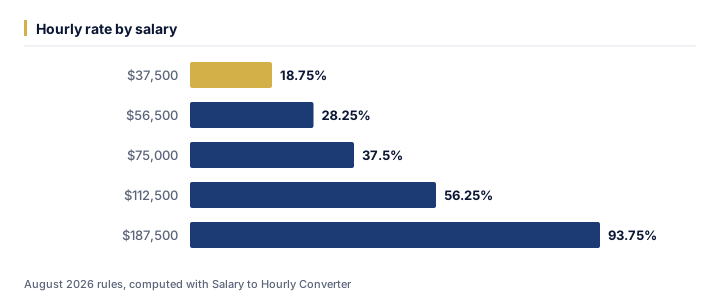
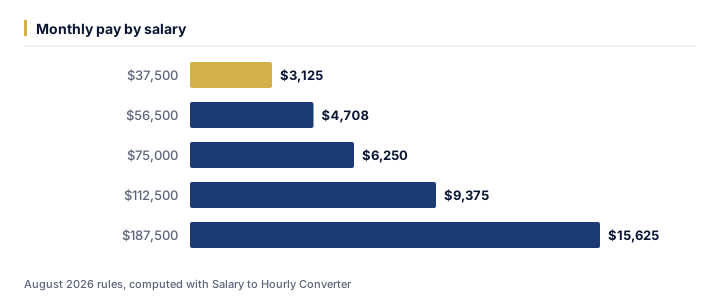
We ran 5 values of salary through the calculator and left every other input at its default. As of August 2026, the output was:
| Salary ($) | Hourly rate (%) | Monthly pay ($) | Biweekly pay ($) |
|---|---|---|---|
| 37,500 | 18.75% | 3,125 | 1,442.31 |
| 56,500 | 28.25% | 4,708.33 | 2,173.08 |
| 75,000 | 37.5% | 6,250 | 2,884.62 |
| 112,500 | 56.25% | 9,375 | 4,326.92 |
| 187,500 | 93.75% | 15,625 | 7,211.54 |
Running salary from $37,500 up to $187,500 moves hourly rate from 18.75% to 93.75% — a spread of 75%. That gap is the part a single headline rate never shows.
The same runs seen through monthly pay
At $37,500, monthly pay works out to $3,125; at $187,500 it is $15,625. Looking only at hourly rate tends to understate how much the outcome shifts across that range.
One example, straight from the API
The middle row above (salary = $75,000) is not a rounded illustration — it is exactly what /api/v1/tools/salary-to-hourly-converter/calculate returns for that input, August 2026 rules:
{
    "tool": "salary-to-hourly-converter",
    "inputs": {
        "salary": 75000,
        "hoursPerWeek": 40,
        "weeksPerYear": 50
    },
    "result": {
        "hourly_rate": 37.5,
        "monthly_pay": 6250,
        "biweekly_pay": 2884.62,
        "weekly_pay": 1442.31,
        "daily_pay": 300,
        "hours_per_year": 2000
    }
}
Assumptions behind these figures
| Input | Value |
|---|---|
| Salary | $75,000 |
| Hours per week | $40 |
| Weeks per year | 50 years |
| As of | August 2026 |
| Method | identical to /tools/salary-to-hourly-converter |
Rates, thresholds and typical costs change over time; the numbers above are accurate as of August 2026, not a permanent guarantee. For your own situation, open the Salary to Hourly Converter and enter your real numbers — the calculator runs the same code that produced every figure on this page.