Take-Home Pay: Everything You Need to Know
You see your salary on the offer letter. You see your take-home in your bank account. The two numbers rarely match — and the gap can be 25%, 35%, or even more.
This guide walks through every deduction between gross and net pay, with 2026 figures where they apply. By the end, you'll know exactly why your paycheck looks the way it does and which levers you can pull.
The Basic Equation
Take-home pay is your net pay after these deductions:
- Federal income tax (withholding)
- State income tax (in most states)
- Local / city income tax (in some cities)
- FICA — Social Security tax (6.2%)
- FICA — Medicare tax (1.45%, plus 0.9% additional above thresholds)
- Pre-tax deductions (401(k), health insurance premiums, HSA, FSA, commuter)
- Post-tax deductions (Roth 401(k), garnishments, voluntary benefits)
Each of these has its own rules, and the order matters because pre-tax items shrink your taxable income before federal tax is calculated.
Use Take-Home Pay Calculator to model your specific numbers.
Federal Income Tax Withholding
The IRS uses a progressive bracket system — your income is sliced into chunks, and each chunk is taxed at a different rate. Only the income in the highest bracket gets the top rate.
For 2026, the federal brackets remain in seven tiers: 10%, 12%, 22%, 24%, 32%, 35%, and 37%. Each filing status (single, married filing jointly, married filing separately, head of household) has its own bracket thresholds.
The big picture
| Filing status | Standard deduction (approx., adjusted annually for inflation) |
|---|---|
| Single | Around $14,600-$15,000+ |
| Married Filing Jointly | Around $29,200-$30,000+ |
| Head of Household | Around $21,900-$22,500+ |
Standard deduction reduces your taxable income before brackets apply. If your itemized deductions exceed the standard, you itemize instead.
A simplified example
A single filer earning $80,000:
- Subtract standard deduction (about $14,600) → taxable income around $65,400
- The 10% bracket applies to the first slice
- The 12% bracket applies to the next slice
- The 22% bracket applies to the slice above roughly $47,150
- The blended (effective) rate is much lower than the top "marginal" rate of 22%
Your marginal rate is the rate on your next dollar. Your effective rate is total federal tax divided by total income. Most workers confuse the two and over-estimate their tax burden.
FICA: Social Security and Medicare
FICA is the flat payroll tax split between you and your employer.
Social Security (OASDI)
- Employee rate: 6.2%
- 2026 wage base: $176,100 (income above this is not taxed for Social Security)
- Employer also pays: 6.2%
If you earn $300,000, you stop paying Social Security tax after the first $176,100. That's why high earners see a small mid-year paycheck bump.
Medicare
- Employee rate: 1.45% on all wages (no cap)
- Additional Medicare: 0.9% on wages above $200,000 (single) or $250,000 (married filing jointly)
- Employer also pays: 1.45% (does not pay the 0.9% additional)
So most workers see 7.65% disappear into FICA every paycheck (6.2% + 1.45%). High earners eventually drop to 1.45% for Social Security once they cross the wage base, then add 0.9% above the Medicare thresholds.
This is why bonuses, RSU vesting, and end-of-year pay sometimes hit weird FICA math. The Bonus Tax Calculator handles supplemental wage withholding correctly.
State Income Tax: A 50-State Story
State income tax varies wildly. Here's the high-level map for 2026:
Nine states with no income tax on wages
- Alaska
- Florida
- Nevada
- New Hampshire (taxes only investment income, ending soon)
- South Dakota
- Tennessee
- Texas
- Washington
- Wyoming
If you live and work in these states, your state income tax line is zero. You still owe federal and FICA.
Flat-rate states (one percentage on all wages)
A handful of states charge a single rate regardless of income. Examples include Colorado, Illinois, Indiana, Kentucky, Massachusetts (mostly), Michigan, North Carolina, Pennsylvania, and Utah. Pennsylvania, for example, applies a flat rate to wages but doesn't allow most federal-style deductions.
Progressive states
Most states (and DC) use progressive brackets like the federal system. California has the highest top bracket (above 13% including the mental health services tax surcharge); Hawaii, New York, New Jersey, Oregon, and Minnesota also have high top rates.
Local and city taxes
Some cities layer income tax on top of state tax — most notably:
- New York City: 3-4% additional on residents
- Philadelphia: roughly 3.75% on residents, slightly lower on non-residents
- Detroit, Cleveland, Pittsburgh: local wage taxes
- San Francisco, Seattle: payroll-related taxes on employers, generally not employees
Always check both state and city when modeling take-home pay.
Pre-Tax Deductions: The Biggest Lever You Control
Pre-tax deductions come out before federal income tax is calculated. They reduce your taxable income AND your FICA wages in some cases. These are the highest-impact levers in your paycheck.
Traditional 401(k)
Contributions reduce federal and (in most states) state taxable income. They don't reduce FICA wages — Social Security and Medicare still apply to your full salary.
2026 employee contribution limit is significantly higher than 2024's $23,000 baseline due to annual cost-of-living adjustments. Catch-up contributions (age 50+) add a separate amount.
Health insurance premiums (Section 125 cafeteria plan)
Employer-sponsored health insurance premiums are typically pre-tax. They reduce federal, state, AND FICA wages — a triple benefit.
HSA (Health Savings Account)
If you have a high-deductible health plan, HSA contributions are pre-tax federally and reduce FICA wages when made through payroll. The HSA is the most tax-advantaged account in the U.S. — money goes in pre-tax, grows tax-free, and comes out tax-free for qualified medical expenses.
FSA (Flexible Spending Account)
Healthcare FSA and dependent care FSA contributions reduce federal, state, and FICA wages. Watch the "use it or lose it" rule.
Commuter benefits
Pre-tax transit and parking benefits up to monthly limits set by the IRS. Reduce all three (federal, state, FICA).
Post-Tax Deductions
These come out after taxes. They don't reduce your taxable income, but they have other benefits.
- Roth 401(k) / Roth IRA contributions — Pay tax now, withdraw tax-free in retirement.
- Disability and life insurance premiums — If paid post-tax, benefits are tax-free if you ever need them.
- Garnishments — Court-ordered deductions for child support, debts.
- Voluntary benefits — Critical illness, accident, pet insurance.
Putting It Together: A Sample Paycheck
A single filer in Texas earning $80,000/year, paid biweekly (26 paychecks), contributing 6% to traditional 401(k) and $200/month to health insurance pre-tax:
| Line | Per paycheck (approx.) |
|---|---|
| Gross pay | $3,077 |
| 401(k) pre-tax (6%) | -$185 |
| Health insurance pre-tax | -$92 |
| Federal income tax withholding | -$280 to $340 |
| Social Security (6.2%) | -$185 |
| Medicare (1.45%) | -$43 |
| State income tax (TX) | $0 |
| Net take-home | ≈ $2,180-$2,290 |
That's roughly 71-74% of gross. Living in a no-tax state with modest pre-tax contributions is one of the better-case scenarios.
For a single filer in California at the same gross with the same deductions, state income tax would carve off another $150-200 per paycheck. Net falls closer to 65-68% of gross.
You can model your exact numbers with Take-Home Pay Calculator or convert salary to hourly with Salary to Hourly Converter.
The Dollar Value of Employee Benefits
Take-home pay is only one piece. Benefits often add 25-40% on top of base salary:
- Employer 401(k) match: A 6% match on $80,000 is $4,800/year — free money, fully vested or vesting on schedule.
- Health insurance employer contribution: Often $8,000-$15,000/year for family coverage.
- HSA employer contributions: $500-$2,000/year at some employers.
- Equity / RSUs: Highly variable.
- PTO and holidays: A salaried employee with 20 PTO days and 10 holidays is paid for 30 days they don't work — about 12% of the year.
- Disability and life insurance: Several hundred to several thousand in annual value.
- Tuition reimbursement, ESPP discount, gym subsidies: Often overlooked.
When you compare offers, calculate total compensation, not just base salary.
Why Your Paycheck Might Surprise You
A few common gotchas:
- Bonus and supplemental wages are withheld at a flat federal rate (currently 22% for amounts under $1 million in a year). Your actual tax liability may be lower, with the difference refunded at tax time.
- Multiple jobs or working spouses can cause under-withholding because each employer assumes your other income is zero.
- State withholding lag — moving mid-year often means messy state withholding.
- Year-end RSU vesting can push you into the Additional Medicare 0.9% bracket for just that paycheck.
Final Thoughts
Take-home pay is just gross minus everything in between. Once you understand the components — federal brackets, FICA caps, state rates, and pre-tax deductions — you can predict your paycheck almost exactly and spot opportunities to keep more of what you earn.
The biggest levers most workers can pull: maximize pre-tax accounts, take the full 401(k) match, and choose your state carefully when remote work is on the table.
This article is for educational purposes only and is not tax or financial advice. Consult a tax professional or CPA for your specific situation. 2026 figures are based on IRS-published guidelines and may be updated mid-year.
Run the numbers
Everything below came out of this site's own Salary to Hourly Converter. The figures are not quoted from anywhere else: each row is one run of the same calculation the tool page performs, using August 2026 rules. Put the same inputs in and you will get the same output.
How the result moves with salary
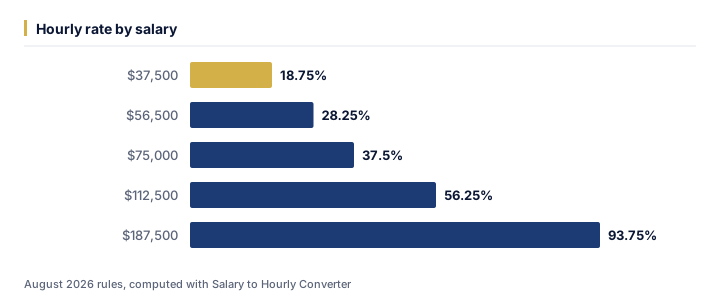
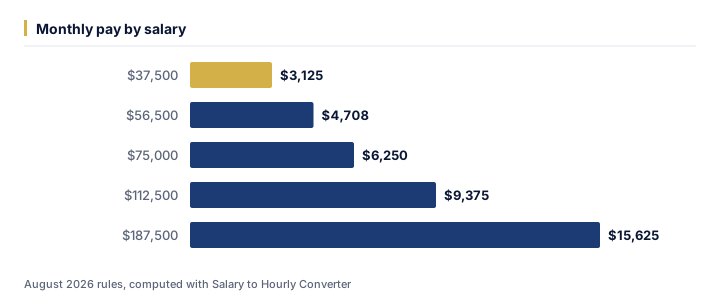
We ran 5 values of salary through the calculator and left every other input at its default. As of August 2026, the output was:
| Salary ($) | Hourly rate (%) | Monthly pay ($) | Biweekly pay ($) |
|---|---|---|---|
| 37,500 | 18.75% | 3,125 | 1,442.31 |
| 56,500 | 28.25% | 4,708.33 | 2,173.08 |
| 75,000 | 37.5% | 6,250 | 2,884.62 |
| 112,500 | 56.25% | 9,375 | 4,326.92 |
| 187,500 | 93.75% | 15,625 | 7,211.54 |
Running salary from $37,500 up to $187,500 moves hourly rate from 18.75% to 93.75% — a spread of 75%. That gap is the part a single headline rate never shows.
The same runs seen through monthly pay
At $37,500, monthly pay works out to $3,125; at $187,500 it is $15,625. Looking only at hourly rate tends to understate how much the outcome shifts across that range.
One example, straight from the API
The middle row above (salary = $75,000) is not a rounded illustration — it is exactly what /api/v1/tools/salary-to-hourly-converter/calculate returns for that input, August 2026 rules:
{
    "tool": "salary-to-hourly-converter",
    "inputs": {
        "salary": 75000,
        "hoursPerWeek": 40,
        "weeksPerYear": 50
    },
    "result": {
        "hourly_rate": 37.5,
        "monthly_pay": 6250,
        "biweekly_pay": 2884.62,
        "weekly_pay": 1442.31,
        "daily_pay": 300,
        "hours_per_year": 2000
    }
}
Assumptions behind these figures
| Input | Value |
|---|---|
| Salary | $75,000 |
| Hours per week | $40 |
| Weeks per year | 50 years |
| As of | August 2026 |
| Method | identical to /tools/salary-to-hourly-converter |
Rates, thresholds and typical costs change over time; the numbers above are accurate as of August 2026, not a permanent guarantee. For your own situation, open the Salary to Hourly Converter and enter your real numbers — the calculator runs the same code that produced every figure on this page.