Salary vs Hourly: Pros and Cons
A friend takes a salaried job at $65,000 and feels like she leveled up. Another friend stays hourly at $30/hour, works 45 hours a week with overtime, and quietly out-earns her. So who actually wins?
The honest answer: it depends on the role, the company, your hours, your benefits, and what you value in a job. This guide breaks down salary vs. hourly compensation across the dimensions that actually matter, with real math so you can compare apples to apples.
The Legal Definitions
Before pros and cons, it helps to know what each label legally means in the United States.
Salaried (typically "exempt")
A salaried employee is paid a fixed amount each pay period regardless of hours worked. Most salaried workers are classified as exempt under the Fair Labor Standards Act (FLSA), meaning they are exempt from overtime pay.
To be legally exempt, an employee must:
- Be paid on a salary basis (a guaranteed minimum weekly amount).
- Meet a salary threshold set by the Department of Labor (this floor is updated periodically).
- Pass a duties test — generally executive, administrative, professional, computer, or outside sales work.
If a salaried employee doesn't meet all three, they may legally be non-exempt and entitled to overtime — even with a "salary."
Hourly (typically "non-exempt")
Hourly employees are paid for actual hours worked. Under FLSA, non-exempt workers must receive overtime at 1.5x their regular rate for hours over 40 in a workweek. Some states (notably California and Alaska) require daily overtime for hours above 8 in a single day.
Salaried doesn't automatically mean exempt, and hourly doesn't automatically mean low-skill. Skilled trades, nurses, contractors, and many tech roles can be hourly with strong earnings.
Use Salary to Hourly Converter or Hourly to Annual Salary Converter to compare offers between the two structures.
The Real Comparison
1. Predictability of pay
Salary wins. Your paycheck is the same every period regardless of holidays, sick days, snow days, or quiet weeks. Budgeting is simpler. Mortgage applications are smoother. Banks like fixed pay stubs.
Hourly loses on predictability, especially if shifts vary. A short workweek hits your paycheck immediately. A holiday without pay reduces income. PTO usage may not be required if your hours fluctuate.
2. Overtime potential
Hourly wins, often by a lot. A non-exempt hourly worker at $30/hour earns $45/hour after 40 hours per week. If you regularly hit 45-50 hours, that overtime compounds fast.
Salaried (exempt) typically loses. A salaried employee at $65,000 earns the same whether they work 40, 50, or 60 hours. That's $31/hour if they work 40 hours — and only $25/hour if they work 50.
Quick math: a salaried worker logging 50 hours a week is effectively giving the company 10 free hours weekly. Over a year, that's 520 unpaid hours — about 13 unpaid 40-hour weeks.
3. Benefits availability
Salary tends to win, but the gap is narrowing. Salaried roles historically came with full benefits packages: health insurance, 401(k) match, paid time off, parental leave, disability, life insurance.
Hourly roles increasingly offer benefits, especially full-time hourly positions, but eligibility thresholds and waiting periods are common. Part-time hourly roles often offer little beyond statutory requirements.
When comparing offers, assign a dollar value to benefits. Employer-paid health insurance alone is often worth $8,000-$15,000 annually.
4. Unpaid hours expectations
Salary loses here. "We work hard but we play hard" usually translates to: you work whatever it takes to ship. Email at 9 PM, weekend Slack messages, on-call rotations without extra pay — these are common in salaried roles.
Hourly wins on boundaries. When you're paid by the hour, every hour worked is an hour paid. Cultures around hourly work tend to be more clock-in / clock-out, which has both advantages (work-life separation) and disadvantages (less flexibility on personal time during the workday).
5. Career trajectory and advancement
Salaried roles traditionally come with promotion ladders, performance reviews, equity opportunities, and clearer paths upward. Many "knowledge worker" careers are structured exclusively around salary.
Hourly roles can absolutely lead to high-paying careers — skilled trades, healthcare, manufacturing, and many tech contractor paths can pay six figures. But the cultural and structural support for "moving up" is often less formalized.
6. Flexibility and autonomy
This one cuts both ways:
- Salary often comes with more flexibility on when you work but less flexibility on whether you work. You can run an errand at 2 PM but you may be expected to answer email at 10 PM.
- Hourly typically gives strict schedules but cleaner boundaries when you're off.
7. Tax treatment
Both salary and hourly W-2 wages are taxed the same way. There's no inherent tax advantage to either structure. The differences appear when comparing W-2 employment to 1099 contractor work — see 1099 vs W-2 Income Calculator for that comparison.
A Real Take-Home Comparison
Let's put numbers to it. Two workers, similar roles, different structures.
Worker A — Salaried, $65,000/year
- Gross pay: $65,000
- Typical hours: 45 hours/week (no overtime pay)
- Benefits: Full health, $4,000 employer 401(k) match, 15 days PTO, 10 holidays
- Effective hourly rate (45-hr week): about $27.78/hour
- Federal + FICA + state (no-tax state): roughly 22-25% combined
- Net take-home: about $48,000-$50,000
Plus benefits valued conservatively at $12,000-$18,000.
Total comp value: roughly $60,000-$68,000.
Worker B — Hourly, $30/hour
- Gross pay (40 hrs): $62,400
- Overtime potential: 5 hours/week at $45/hour = $11,700/year extra
- Annual gross with OT: about $74,100
- Benefits: Partial health (worker pays 40%), 401(k) with smaller match, 10 days PTO
- Federal + FICA + state (no-tax state): roughly 22-25% combined
- Net take-home with OT: about $56,000-$58,000
Plus benefits valued conservatively at $6,000-$10,000.
Total comp value: roughly $62,000-$68,000.
In this example, they're roughly equal in total compensation — but Worker B is being paid for every extra hour, while Worker A is donating those hours to the company.
The math flips dramatically when:
- Worker A's hours drop to 40/week → salary is the better deal per hour
- Worker A's hours climb to 55/week → hourly with overtime crushes salary
- Worker A's benefits package is exceptional (Big Tech-level) → salary often wins
- Worker B has unpredictable hours and frequent short weeks → salary wins
When Salary Is Almost Always the Right Choice
- Knowledge-worker roles (software, finance, marketing, design) where the work is project-based, not hour-based.
- Roles where benefits are exceptional and would cost a fortune to buy individually.
- Career-track positions where promotions and equity are real.
- Roles where you control your own schedule and can avoid serial overtime.
- Industries where the cultural norm is salaried — being hourly may signal a less senior role.
When Hourly Is Often Better
- Skilled trades and licensed professions (electricians, nurses, paramedics) where overtime is routine and well-compensated.
- Roles where you'd otherwise work 50-60 hours salaried without compensation.
- Flexible / gig structures where you want clear boundaries.
- Earlier in a career path where you're building experience and want to be paid for every hour.
- Industries where strong unions or labor protections ensure good hourly conditions.
How to Decide Between Two Offers
- Convert both offers to an annual gross. Use Hourly to Annual Salary Converter for the hourly side.
- Assume realistic hours. For salaried, ask current employees what hours they actually work. For hourly, estimate overtime conservatively.
- Value the benefits package. Employer health contribution, 401(k) match, PTO, paid holidays, disability — add a dollar value.
- Subtract realistic taxes. Use Take-Home Pay Calculator for both scenarios in your state.
- Adjust for predictability. A predictable smaller paycheck might be worth more than a larger, lumpy one — especially if you have a mortgage.
- Consider trajectory. Where will you be three years from now in each role?
Common Misconceptions Worth Clearing Up
A few myths about salary and hourly work that come up constantly:
"Salaried jobs always pay better." Not true. Skilled tradespeople, certain healthcare roles, and experienced contractors regularly out-earn salaried managers — especially when overtime is involved. Headline annual numbers can be misleading.
"Hourly means no benefits." Increasingly false. Many full-time hourly roles offer health insurance, 401(k) with match, paid time off, and even equity in some industries. The benefits gap has narrowed considerably over the past decade.
"Exempt means no overtime ever." Sometimes false. Federal exemption rules require both a salary threshold and a duties test. If your duties don't qualify (or your employer misclassified you), you may legally be entitled to overtime even with a "salary." Lawsuits over this are common in misclassified roles.
"Hourly workers have no career growth." Plenty of hourly tracks lead to management, ownership, or specialized expertise that commands premium rates. The trades especially offer strong long-term earnings paths that often outperform salaried entry-level office work.
Understanding what each label actually means — legally, culturally, and financially — beats assuming the title alone tells the story.
The Hidden Variable: Stress and Time
A purely financial comparison misses the most important variable for many people: how the job feels.
A 40-hour hourly job with predictable boundaries and decent pay may leave you happier than a 55-hour salaried job that pays slightly more on paper. Time is the one resource you can't earn back.
When you finish the math, ask yourself: Would the version of me three years from now thank me for this choice?
That question often decides the right answer faster than any spreadsheet.
Final Thoughts
Salary vs. hourly isn't a universal "one is better than the other." It's a comparison framework. Understand the legal definitions, value the benefits package honestly, model realistic hours, and compute total compensation — not just the headline number.
Once you have those four pieces, choosing between offers becomes a clearer decision instead of a gut call.
This article is for general education and not financial or legal advice. Employment classifications and wage rules vary by state and industry — when in doubt, consult an employment attorney or your state labor department.
Run the numbers
Everything below came out of this site's own Salary to Hourly Converter. The figures are not quoted from anywhere else: each row is one run of the same calculation the tool page performs, using August 2026 rules. Put the same inputs in and you will get the same output.
How the result moves with salary
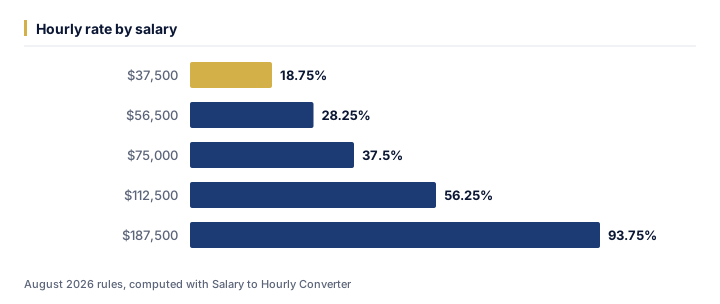
We ran 5 values of salary through the calculator and left every other input at its default. As of August 2026, the output was:
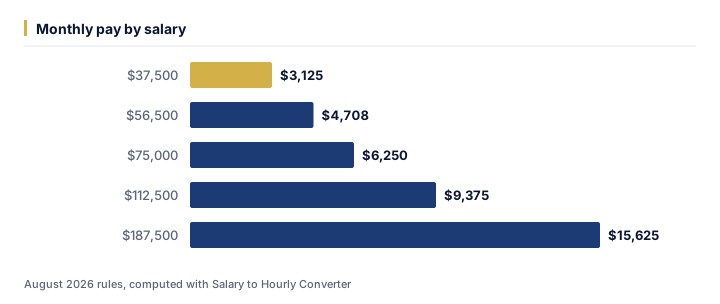
| Salary ($) | Hourly rate (%) | Monthly pay ($) | Biweekly pay ($) |
|---|---|---|---|
| 37,500 | 18.75% | 3,125 | 1,442.31 |
| 56,500 | 28.25% | 4,708.33 | 2,173.08 |
| 75,000 | 37.5% | 6,250 | 2,884.62 |
| 112,500 | 56.25% | 9,375 | 4,326.92 |
| 187,500 | 93.75% | 15,625 | 7,211.54 |
Running salary from $37,500 up to $187,500 moves hourly rate from 18.75% to 93.75% — a spread of 75%. That gap is the part a single headline rate never shows.
The same runs seen through monthly pay
At $37,500, monthly pay works out to $3,125; at $187,500 it is $15,625. Looking only at hourly rate tends to understate how much the outcome shifts across that range.
One example, straight from the API
The middle row above (salary = $75,000) is not a rounded illustration — it is exactly what /api/v1/tools/salary-to-hourly-converter/calculate returns for that input, August 2026 rules:
{
    "tool": "salary-to-hourly-converter",
    "inputs": {
        "salary": 75000,
        "hoursPerWeek": 40,
        "weeksPerYear": 50
    },
    "result": {
        "hourly_rate": 37.5,
        "monthly_pay": 6250,
        "biweekly_pay": 2884.62,
        "weekly_pay": 1442.31,
        "daily_pay": 300,
        "hours_per_year": 2000
    }
}
Assumptions behind these figures
| Input | Value |
|---|---|
| Salary | $75,000 |
| Hours per week | $40 |
| Weeks per year | 50 years |
| As of | August 2026 |
| Method | identical to /tools/salary-to-hourly-converter |
Rates, thresholds and typical costs change over time; the numbers above are accurate as of August 2026, not a permanent guarantee. For your own situation, open the Salary to Hourly Converter and enter your real numbers — the calculator runs the same code that produced every figure on this page.