Equity Compensation 101 for Tech Workers
Your offer letter says "150,000 shares" or "$200,000 in RSUs over four years" or "10,000 options at a strike price of $4.50." Then somebody mentions a "cliff" and an "ESPP" and an "83(b) election" and your eyes glaze over.
Equity compensation is the single biggest source of wealth — and confusion — in tech careers. Understanding the structures behind those offer-letter numbers is the difference between a paper fortune that evaporates and a real one that funds a house, a sabbatical, or an early retirement.
This guide is the long version of what every tech employee should know before signing. It's not legal or tax advice; it's the conceptual map so you can ask the right questions of a CPA who specializes in equity.
Why companies offer equity in the first place
Equity is a tool with two purposes: it conserves cash for a company that doesn't have much yet, and it ties your financial outcomes to the company's. Both purposes only work if the equity vests over time and only pays off if the company succeeds.
Public companies use equity (mostly RSUs) to compete for talent and to align long-tenure incentives. Private companies use it (mostly options) because they literally don't have the cash to match big-tech salaries.
The cost to you for accepting equity instead of cash is real: you're trading a known thing (salary) for an uncertain thing (future stock value). Equity comp should pay you a premium for that uncertainty, not a discount.
The four-year vest with a one-year cliff
The standard vesting schedule at almost every tech company is:
- 4-year total vest
- 1-year cliff (you get nothing if you leave in the first 12 months)
- Monthly vesting thereafter (1/48th of the grant each month for the next 36 months)
- Sometimes quarterly vesting, less commonly weekly
So if you're granted 4,800 RSUs on your start date:
- Day 1 through Day 364: you have 0 vested
- Day 365: you get 1,200 (25% — the cliff payment)
- Each month after: 100 more vest (1/48th)
- Year 4 anniversary: all 4,800 are vested
Why this matters: The cliff is brutal. Leaving at month 11 means walking away from the entire equity package. Some companies are moving to faster cliffs (6 months, or no cliff with 1/48 monthly vesting from day one), but the 1-year cliff is still standard.
Variations to watch for:
- Backloaded vesting: Some big-tech firms now use schedules like 15%/20%/30%/35% over four years. The total is the same, but you keep less if you leave at year 2.
- Refresh grants: After your initial grant, you typically get smaller "refresher" grants annually that also vest over four years. The healthy career math counts these heavily.
Stock options: ISOs and NSOs
A stock option is the right to buy a share at a fixed strike price, regardless of the future market price. If the market price climbs, you exercise (buy at the strike) and either hold or sell at the higher price. If the market price stays below strike, the option is worthless.
There are two flavors with very different tax treatment.
Incentive Stock Options (ISOs)
Only available to employees (not contractors), with a $100,000 per-year vesting limit on grants. The advantage: when you exercise, you don't owe regular federal income tax on the spread between strike and fair market value — at least not at exercise.
The catch is the Alternative Minimum Tax (AMT), and it's a big one.
When you exercise ISOs and hold the shares (don't immediately sell), the spread between strike price and fair market value is an "AMT preference item." This can trigger AMT in the year of exercise, sometimes producing a tax bill of tens or hundreds of thousands of dollars on shares you haven't sold and may never be able to sell.
The classic AMT trap: An employee at a private company exercises ISOs at the year-1 cliff because the company looks promising. The FMV is $20, strike is $1. The spread of $19/share × 4,000 shares = $76,000 of AMT income. The employee owes AMT in April. Then the company tanks before any liquidity event. The employee paid real tax on theoretical gains that never materialized.
The AMT trap is the single most damaging equity mistake junior-to-mid-career employees make. Before exercising ISOs at a private company, talk to a CPA who specializes in equity. Always.
To get the favorable long-term capital gains treatment on the full spread when you sell, you need to hold ISOs for at least 2 years from grant date AND at least 1 year from exercise date. Selling earlier ("disqualifying disposition") converts the spread to ordinary income.
Non-Qualified Stock Options (NSOs)
Simpler taxation, no AMT issues, but no preferential treatment either. When you exercise NSOs, the spread between strike and FMV is immediately taxed as ordinary income (and subject to payroll tax). Future appreciation after exercise is then capital gains.
NSOs are common at public companies and for non-employee grants (contractors, board members).
If your offer involves options, Stock Options Calculator gives you a sense of breakeven scenarios and the impact of strike price assumptions.
Restricted Stock Units (RSUs)
RSUs are the standard at public companies (Google, Meta, Amazon, Apple, Microsoft, etc.) and at late-stage privates. They're simpler than options because there's no exercise step and no strike price to worry about.
You're granted a number of "units." As each unit vests, the company gives you actual shares of stock and treats the FMV of those shares as ordinary income on your W-2 in the year of vesting.
Tax mechanics:
- At vest: ordinary income equal to (number of shares vested × FMV on vest date). Reported on your W-2.
- Employer withholds taxes, usually by selling-to-cover (selling roughly 22-40% of your vesting shares to cover withholding).
- After vest: the shares are yours. Any gain or loss from vest-day FMV is a capital gain or loss when you eventually sell.
The withholding gap: Most employers withhold at the supplemental flat 22% federal rate. If your actual marginal rate is 32% or 37%, that 22% under-withholds, and you owe a big tax bill in April. High-income RSU employees should consider quarterly estimated payments to avoid underpayment penalties.
RSU Calculator helps with the gross-to-net math at vest events.
The concentration risk: If a big chunk of your net worth is in your employer's stock, you're double-exposed — your paycheck and your portfolio depend on the same company. A common rule of thumb: sell RSUs at vest, reinvest the proceeds in a diversified index. The "stock has only gone up, why would I sell?" thinking is exactly how concentrated bets go wrong.
Employee Stock Purchase Plans (ESPPs)
A qualified ESPP (Section 423) lets you buy company stock at up to a 15% discount, with a lookback feature that uses the lower of the price at the start of the offering period or at the purchase date.
The math: you contribute up to 15% of salary (often capped by IRS at $25,000/year in stock purchases). At the end of each 6-month "offering period," the company buys shares for you at 85% of the lower of two prices.
Why this is sometimes called "free money": If you sell immediately, you lock in roughly an 18% gain (the discount is from the buy price, so a $100 stock bought at $85 is a $15/$85 = 17.6% gain) minus ordinary income tax on the discount. Even at a 32% federal + 7.65% FICA + 5% state rate (~45%), you still net around 10% on the contribution.
The catch: you're tying up payroll for 6 months at a time, and concentrated stock risk applies here too. ESPPs are best for employees confident the company will be around and who have surplus cash to lock up.
Equity in private vs. public companies
The biggest mental shift is between pre-IPO and post-IPO equity.
Public companies:
- RSUs vest, shares appear in your brokerage account, you can sell tomorrow.
- Tax treatment is straightforward and timed: ordinary income at vest, capital gains at sale.
- Liquidity is essentially guaranteed.
Private companies:
- You might have options or RSUs, but you generally can't sell. There's no public market.
- "Liquidity events" — IPO, acquisition, or a tender offer — convert paper to real money. Between events, your equity is illiquid.
- ISO AMT exposure if you exercise early in a high-FMV company.
- Private RSUs often have "double-trigger" vesting: shares only become real when both the time-vest condition AND a liquidity event happen. You can be "vested" on paper but own nothing until the company IPOs or sells.
A private-company offer with 0.5% equity is meaningless without knowing:
- The current preferred-equity preference stack (how much VC capital sits ahead of you in a sale)
- The likely exit timing
- The dilution from future funding rounds
Dilution: the slowly leaking bucket
Every funding round issues new shares, which means your fixed share count represents a smaller percentage of the company.
Example: You join at Series A with 1% ownership (10,000 shares of 1,000,000). The company raises Series B (issues 250,000 new shares), Series C (300,000 new shares), and Series D (400,000 new shares). After all rounds, total shares are 1,950,000. Your 10,000 shares are now 0.51% — half your starting stake.
Refresh grants partially offset this. Asking about expected refresh policy is a legitimate offer-stage question.
Questions to ask before signing
When evaluating a tech offer with equity, these are the questions that produce real answers:
- What's the four-year RSU value at the offer-date stock price? (Or grant value of options at the latest 409A valuation, for private companies.)
- What's the vesting schedule? (Standard 4-year/1-year-cliff or something different?)
- What's the refresh policy? (Annual top-up grants? At what percentage of original?)
- What's the post-termination exercise window for vested options? (Standard is 90 days, but some companies offer 10 years. The difference is huge.)
- For private companies: what's the current 409A? What's the preferred-equity preference stack? When does the board expect a liquidity event?
- Is there double-trigger vesting on RSUs? (Common at private companies, important to understand.)
When comparing offers, Take-Home Pay Calculator gives you the cash-comp side, and the equity calculators above let you sketch out scenarios for the rest.
The biggest equity mistakes to avoid
- Ignoring AMT before ISO exercise: The classic six-figure surprise tax bill on stock that later goes to zero.
- Holding 100% of RSUs: Concentrated risk is invisible until it isn't. Diversify.
- Counting paper wealth as cash: Private equity is not money in the bank.
- Skipping the cliff math: Leaving at month 11 means zero. Leaving at month 13 means 25%+.
- Not asking about extended exercise windows: A 90-day window after termination forces you to come up with exercise cash + potential tax. A 10-year window doesn't.
Equity is the most powerful wealth-building tool in tech, and the most misunderstood. Spend the time to learn the structure of your specific grants, and when the stakes are high, hire someone who specializes in this for a one-hour consult. That hour can be worth six figures.
Run the numbers
Everything below came out of this site's own Take-Home Pay Calculator. The figures are not quoted from anywhere else: each row is one run of the same calculation the tool page performs, using August 2026 rules. Put the same inputs in and you will get the same output.
How the result moves with salary
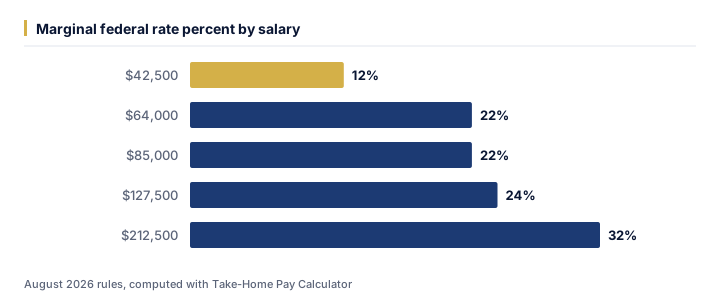
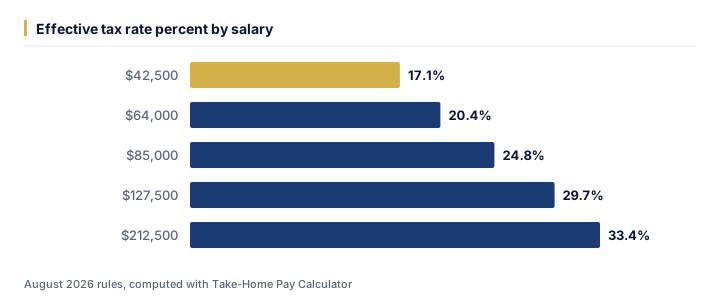
We ran 5 values of salary through the calculator and left every other input at its default. As of August 2026, the output was:
| Salary ($) | Marginal federal rate percent (%) | Effective tax rate percent (%) | Take home annual ($) |
|---|---|---|---|
| 42,500 | 12% | 17.1% | 35,245.07 |
| 64,000 | 22% | 20.4% | 50,950.64 |
| 85,000 | 22% | 24.8% | 63,897.41 |
| 127,500 | 24% | 29.7% | 89,596.16 |
| 212,500 | 32% | 33.4% | 141,456.96 |
Running salary from $42,500 up to $212,500 moves marginal federal rate percent from 12% to 32% — a spread of 20%. That gap is the part a single headline rate never shows.
The same runs seen through effective tax rate percent
At $42,500, effective tax rate percent works out to 17.1%; at $212,500 it is 33.4%. Looking only at marginal federal rate percent tends to understate how much the outcome shifts across that range.
One example, straight from the API
The middle row above (salary = $85,000) is not a rounded illustration — it is exactly what /api/v1/tools/take-home-pay-calculator/calculate returns for that input, August 2026 rules:
{
    "tool": "take-home-pay-calculator",
    "inputs": {
        "salary": 85000,
        "filing": "single",
        "state": "CA",
        "contrib_pct": 0,
        "other_pre_tax": 0
    },
    "result": {
        "take_home_annual": 63897.41,
        "take_home_monthly": 5324.78,
        "take_home_biweekly": 2457.59,
        "federal_tax": 10541,
        "fica": 6502.5,
        "state_tax": 4059.09,
        "pretax_401k": 0,
        "federal_taxable": 70400,
        "marginal_federal_rate_percent": 22,
        "effective_tax_rate_percent": 24.8
    }
}
Assumptions behind these figures
| Input | Value |
|---|---|
| Salary | $85,000 |
| Filing | Single |
| State | Ca |
| Contrib pct | 0% |
| Other pre tax | $0 |
| As of | August 2026 |
| Method | identical to /tools/take-home-pay-calculator |
Rates, thresholds and typical costs change over time; the numbers above are accurate as of August 2026, not a permanent guarantee. For your own situation, open the Take-Home Pay Calculator and enter your real numbers — the calculator runs the same code that produced every figure on this page.