The Complete Salary Negotiation Guide for 2026
Most workers leave money on the table. Not because they're unqualified, but because they never asked — or asked the wrong way. Career economists estimate that workers who skip negotiation lose between $500,000 and $1 million over a 40-year career, mostly because every future raise compounds on a smaller base.
The good news: salary negotiation is a learnable skill, not a personality trait. This guide walks you through the entire process for 2026 — researching your market value, building the conversation, handling counteroffers, and reading the legal landscape that's quietly shifting in your favor.
Why 2026 Is a Different Negotiation Year
Three trends are reshaping how Americans negotiate pay this year:
- Pay transparency laws are spreading. As of early 2026, more than a dozen states and major cities require employers to post salary ranges on job listings. That data is gold for negotiation.
- Remote and hybrid roles distort traditional comp bands. Companies still benchmark to metros, but workers can sometimes negotiate location-flexible bands.
- AI is compressing some roles and inflating others. If your job description includes "AI-assisted" work, your benchmark may have shifted upward — or downward — fast.
Knowing where your role sits in this shifting market is the first negotiation lever.
Step 1: Research Your Market Value
Before you say a number, you need three numbers: the floor (what someone with your skills can reasonably expect), the target (a fair market rate for your specific role and location), and the ceiling (what top performers in your role earn).
Where to look
- Levels.fyi — Best for tech roles. Self-reported with offer details, equity, and bonuses. Filter by company, level, and metro.
- Glassdoor and Salary.com — Broader coverage of non-tech roles. Salaries skew slightly low because reports come from the median, not the offer letter.
- BLS Occupational Employment Statistics — The U.S. Bureau of Labor Statistics publishes median wages by occupation and metro. Free, comprehensive, and conservative.
- State pay transparency postings — In states like California, Colorado, New York, Washington, and Illinois, job listings must include pay ranges. Search openings at your target companies even if you're not applying.
- LinkedIn Salary Insights — Filter by experience, location, and industry.
- Your network — One quiet conversation with a peer at a similar company is worth ten data points online.
Build your range
Once you have at least five data points, throw out the extremes and use the middle three to set your range. Your target should sit at the 60th-75th percentile of your researched data — confident, but defensible.
You can use Salary to Hourly Converter to translate ranges between salary and hourly rates if you're comparing offers across pay structures.
Step 2: Compute What You're Actually Worth Today
Market rate is one input. The other is your specific value to this employer.
Ask yourself:
- What revenue do I generate, save, or unlock?
- What problems would my departure create?
- What unique skills or relationships do I bring?
- Do I have credentials, certifications, or domain expertise that are scarce?
Write down three concrete examples for each. You'll use these in the conversation.
Then compute your total compensation — not just base. A $120,000 base with a 15% target bonus, $40,000 in annual RSU vesting, and a 6% 401(k) match is closer to $180,000 in total comp. Negotiating only on base ignores the rest of the package.
Use Take-Home Pay Calculator to see what each compensation scenario actually deposits in your bank account after taxes.
Step 3: Choose the Right Timing
Timing is leverage. The strongest moments to negotiate are:
- At a new offer. This is the single best leverage point of your career. The company has decided they want you and has invested time in the hire.
- After a major win. A successful product launch, a closed deal, or a project delivered on time.
- During performance reviews. Most companies set raise budgets in Q4 for the following year. Ask in October or November, not January.
- When you receive a competing offer. Approach this carefully — bluffing rarely works, but a real competing offer changes the math.
The worst times: right after layoffs, during a hiring freeze, right after a missed quarter, or when your manager is buried in a crisis.
Step 4: The Conversation
Most negotiations stall because people improvise. Don't. Practice the script.
Opening — for a new offer
"Thank you for the offer. I'm genuinely excited about the role and the team. I've done some research on the market for [role] in [location], and based on my experience with [specific skill or accomplishment], I was hoping we could get to [target number]. Is there flexibility in the offer?"
Three things this script does well: it expresses enthusiasm, anchors with research, ties to specifics, and ends with an open question.
Opening — for a raise at your current job
"I wanted to talk about my compensation. Over the past year, I've [specific outcome 1], [specific outcome 2], and [specific outcome 3]. Based on market data for my role and these results, I'd like to discuss moving my base to [target number]. What would it take to get there?"
The silence rule
After you state your number, stop talking. Let silence do the work. Most people lose negotiations by filling the quiet with concessions before the other side has even responded.
Handle the pushback
You'll hear one of these:
- "That's above our band." — Ask what the top of the band is, and how someone moves to the next band.
- "We can't do base, but we can do a sign-on." — Sign-ons are nice but don't compound. Push back on base first.
- "Let me check with HR / the hiring committee." — Good. Silence is your friend. Don't refill it with concessions.
- "What would it take to get you to sign today?" — Resist same-day pressure. "I'd like 48 hours to think it over" is a complete sentence.
Step 5: Negotiate the Whole Package, Not Just Base
If base is genuinely stuck, look at the levers around it:
- Sign-on bonus — One-time cash, often easier to approve than base.
- Equity / RSUs — Especially at growth-stage companies. Refresh grants matter long-term.
- Bonus target percentage — A 15% target on $120k beats 10% on $125k in many cases.
- PTO and flexibility — Extra days, remote work, four-day weeks.
- Title — Sometimes the next level is worth more in your next job than $5k now.
- 401(k) match acceleration — Some firms negotiate vesting.
- Professional development budget — Conferences, certifications, tuition.
- Review timing — Negotiate an early review (6 months instead of 12) if base is stuck.
Use Raise / Promotion Calculator to compare scenarios across base, bonus, and equity tradeoffs.
Step 6: When They Say No
A "no" is information, not a verdict. Ask:
- "What would I need to demonstrate to get to that number in the next 6-12 months?"
- "If we can't get to the number, can we revisit at a 6-month checkpoint?"
- "Is the constraint a budget approval or a band ceiling?"
If the answer is final and the offer is below your floor, walking away is a valid move. But weigh the full picture — culture, growth, total comp, and your alternatives — before you decline.
State Pay Transparency Laws: Know Your Rights
As of 2026, the following jurisdictions require pay range disclosure on most job listings (rules vary by employer size and industry):
| State / City | Coverage |
|---|---|
| California | Statewide, employers with 15+ workers |
| Colorado | Statewide, all employers |
| New York State | Statewide, employers with 4+ workers |
| New York City | All postings |
| Washington | Statewide, employers with 15+ workers |
| Illinois | Statewide, employers with 15+ workers |
| Hawaii | Statewide, employers with 50+ workers |
| Maryland | Statewide |
| Connecticut | On request and at offer |
| Rhode Island | On request |
| Nevada, Cincinnati, Toledo, Jersey City, Washington D.C. | Various rules |
Several more states are considering similar laws. If you're applying in a transparency state, the range is a starting point — companies still negotiate within the band. Always aim for the upper half.
Common Negotiation Mistakes to Avoid
- Naming the first number. Whenever possible, let the employer go first. If pressed, give a range with your target at the bottom.
- Negotiating over text or email after a verbal offer. Get to a phone or video call. Tone matters.
- Apologizing. "I'm sorry to ask, but..." undermines you instantly. Cut it.
- Comparing to coworkers. Bring market data, not internal gossip. The latter rarely helps.
- Negotiating only base. Total comp is the real number.
- Accepting same-day. Take time. Reputable employers respect this.
- Threatening to leave. Unless you have a real offer and are prepared to take it.
A Realistic Negotiation Outcome
Here's a typical successful 2026 negotiation for a mid-career software engineer in a transparency state:
- Initial offer: $145,000 base, $25,000 sign-on, $60,000/year RSUs over 4 years
- Research showed: Market range $150-175k base for the role and level
- Counter: $165,000 base, $30,000 sign-on, $80,000/year RSUs
- Final: $158,000 base, $30,000 sign-on, $75,000/year RSUs, early 6-month review
Total comp moved from approximately $185,000/year to $213,000/year. That delta — $28,000 — compounds across every future raise.
Final Thoughts
Negotiation isn't about being aggressive. It's about being prepared, specific, and patient. Do the research, name a defensible number, stop talking, and treat "no" as a starting point rather than an ending.
You're not asking for a favor. You're agreeing on the value of your work. Treat it that way and the conversation gets easier every time.
This article is educational and not a substitute for legal or financial advice. For employment-specific questions, consult a qualified attorney or career coach.
Run the numbers
Everything below came out of this site's own Salary to Hourly Converter. The figures are not quoted from anywhere else: each row is one run of the same calculation the tool page performs, using August 2026 rules. Put the same inputs in and you will get the same output.
How the result moves with salary
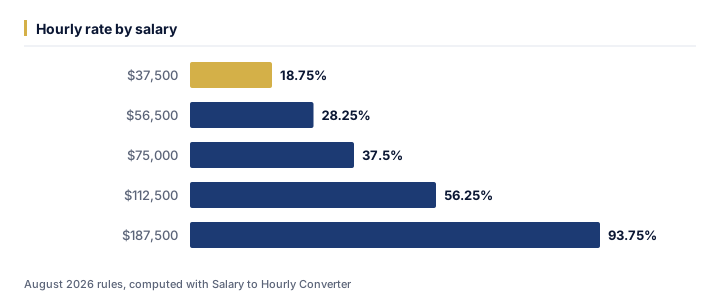
We ran 5 values of salary through the calculator and left every other input at its default. As of August 2026, the output was:
| Salary ($) | Hourly rate (%) | Monthly pay ($) | Biweekly pay ($) |
|---|---|---|---|
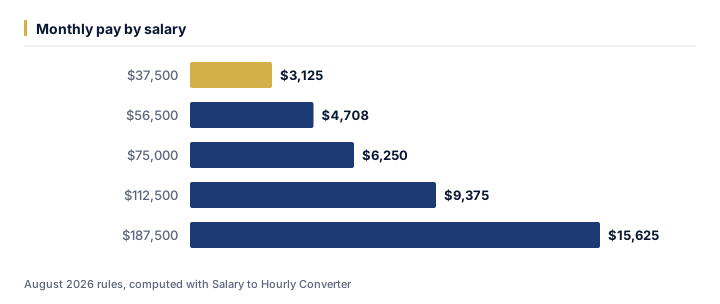
| 37,500 | 18.75% | 3,125 | 1,442.31 |
| 56,500 | 28.25% | 4,708.33 | 2,173.08 |
| 75,000 | 37.5% | 6,250 | 2,884.62 |
| 112,500 | 56.25% | 9,375 | 4,326.92 |
| 187,500 | 93.75% | 15,625 | 7,211.54 |
Running salary from $37,500 up to $187,500 moves hourly rate from 18.75% to 93.75% — a spread of 75%. That gap is the part a single headline rate never shows.
The same runs seen through monthly pay
At $37,500, monthly pay works out to $3,125; at $187,500 it is $15,625. Looking only at hourly rate tends to understate how much the outcome shifts across that range.
One example, straight from the API
The middle row above (salary = $75,000) is not a rounded illustration — it is exactly what /api/v1/tools/salary-to-hourly-converter/calculate returns for that input, August 2026 rules:
{
    "tool": "salary-to-hourly-converter",
    "inputs": {
        "salary": 75000,
        "hoursPerWeek": 40,
        "weeksPerYear": 50
    },
    "result": {
        "hourly_rate": 37.5,
        "monthly_pay": 6250,
        "biweekly_pay": 2884.62,
        "weekly_pay": 1442.31,
        "daily_pay": 300,
        "hours_per_year": 2000
    }
}
Assumptions behind these figures
| Input | Value |
|---|---|
| Salary | $75,000 |
| Hours per week | $40 |
| Weeks per year | 50 years |
| As of | August 2026 |
| Method | identical to /tools/salary-to-hourly-converter |
Rates, thresholds and typical costs change over time; the numbers above are accurate as of August 2026, not a permanent guarantee. For your own situation, open the Salary to Hourly Converter and enter your real numbers — the calculator runs the same code that produced every figure on this page.