Stock Options vs RSUs: Compensation Decoded
Equity compensation is where job offers stop making intuitive sense. Two offers — one with "$200,000 in stock options," another with "$200,000 in RSUs" — can produce wildly different take-home pay over four years. The difference comes down to three letters: ISO, NSO, and RSU.
This guide breaks down how each works, when each makes sense, and the tax traps that quietly eat thousands from offers that looked equivalent on paper.
The three equity types you'll see
Almost every U.S. equity grant falls into one of three buckets:
- ISO — Incentive Stock Option. A right to buy stock at a fixed price. Tax-favored if you hold long enough.
- NSO (or NQSO) — Non-Qualified Stock Option. Same idea, fewer tax benefits.
- RSU — Restricted Stock Unit. A promise to give you shares (not buy them) on a future date.
Startups lean heavily on options (ISOs especially). Public companies and late-stage startups mostly grant RSUs. Knowing which you've been offered is step one — and yes, the offer letter sometimes buries this detail.
How stock options work
A stock option grants you the right to buy shares at a fixed price (the "strike" or "exercise" price), usually for ten years. The bet: the stock will be worth more than the strike when you exercise.
Vesting
You don't get the options on day one. A standard schedule is four years with a one-year cliff: nothing for the first 12 months, then 25% vests at month 12, and the remainder vests monthly or quarterly after that. Leave before the cliff and you walk away with nothing.
Exercising
When you exercise, you write a check to the company for (strike price × shares). In return you get actual stock. You then choose whether to hold or sell.
If the stock is private, "selling" might not be possible — you're stuck holding shares with no liquidity until the company exits via IPO or acquisition. That's where the math gets dangerous.
ISO vs NSO: the tax difference
Both let you buy at the strike price. The taxation differs at two moments:
At exercise:
- NSO: The spread (current value minus strike) is taxed as ordinary income immediately, even if you don't sell. Your employer withholds taxes.
- ISO: No regular tax at exercise. But the spread is an Alternative Minimum Tax (AMT) preference item — meaning it can trigger AMT even though no regular tax is due.
At sale:
- NSO: Any gain above the value at exercise is a capital gain (long-term if held >1 year after exercise).
- ISO: If you hold the shares at least 2 years from grant and 1 year from exercise, the entire gain over the strike price is long-term capital gain — no ordinary income, ever. Miss that holding period and the ISO is treated like an NSO ("disqualifying disposition").
That long-term capital gains treatment on ISOs is the holy grail of equity comp. It's also where the AMT trap lives.
The AMT trap on ISOs
AMT is a parallel tax system designed to make sure high-income filers can't deduct their way to zero tax. ISO bargain spread is one of its triggers.
Concrete example. You exercise 10,000 ISOs at a $5 strike when the stock is at $50. Your bargain spread is $450,000. You wrote a $50,000 check and got stock worth $500,000 — and you haven't sold a thing.
- Regular tax: $0 (ISOs aren't taxed at exercise for regular purposes)
- AMT: that $450,000 is an AMT preference. The 2026 AMT exemption is $88,100 for single filers, phasing out at higher income. You could owe $80,000-$120,000+ in AMT for the year, with no shares sold to cover it.
If the stock then crashes before you can sell, you've paid AMT on phantom gains. There's an AMT credit you recover in later years, but that's cold comfort when you owe $100,000 in April and your stock is suddenly worth less than your strike.
The Stock Options Calculator will run the AMT estimate alongside the regular-tax exercise cost so you can stress-test before you write the check.
When options make sense
- Early-stage startup: low strike, big upside if it works. The whole point of options is leverage on growth.
- You can afford to exercise and hold: enough liquid savings to write the exercise check and pay any AMT without selling.
- You believe in the company: the option is worthless if the stock never rises. Options are an asymmetric bet — limited downside (you lose the exercise cost), unlimited upside.
When they don't:
- You can't afford the exercise: pre-IPO companies often have multi-six-figure exercise costs. Forced to sell at exit, you may convert to a disqualifying disposition.
- You're late-stage or post-IPO: by then the strike may be close to fair market value, and options behave more like RSUs without the simplicity.
How RSUs work
An RSU is a promise. The company says: "On this vesting date, we will give you N shares of stock — no purchase required."
Vesting and taxation at vest
Vesting schedules look similar to options (four-year vest, one-year cliff is common at public companies). But the tax moment is different.
At vest, the fair market value of the shares is ordinary income. Your employer withholds federal, state, FICA, and Medicare — usually by selling some shares ("sell-to-cover"). The remaining net shares land in your brokerage account, and your tax basis in those shares equals the value at vest.
Example: 1,000 RSUs vest on a day the stock closes at $80. That's $80,000 of W-2 income. Federal withholding (often 22% flat) plus state plus FICA is roughly $25,000-$35,000 depending on your state. You end up with shares worth about $50,000 net.
Post-vest: it's just stock
Once vested, your RSUs are no different from any other shares. Sell within a year of vest and any further gain is short-term capital gain (taxed as ordinary income). Hold over a year and it's long-term (0%, 15%, or 20% depending on income).
Most public-company employees sell at vest to diversify. Holding a giant concentrated position in your employer's stock is a double risk — your job and your savings tied to the same outcome.
The RSU Calculator estimates net shares after withholding and lets you model different vest prices.
When RSUs make sense
- Public or late-stage private company: liquidity is real, the share value is observable, and you don't need to write a check.
- You want predictability: RSUs are essentially deferred salary in stock form. They're worth something as long as the stock is worth something.
- You're tax-averse to AMT surprises: RSUs are taxed simply as ordinary income at vest, no AMT complications.
Where RSUs disappoint
- You can't time the tax: vest dates are fixed, and your tax bill is fixed by the price on that day. A vest at the stock's all-time high creates a tax bill that doesn't shrink if the stock then falls.
- Withholding can be underwithheld: 22% federal flat withholding may be far below your actual marginal rate if you're high-income. Plan for a top-up at tax time.
Comparing offers: don't trust the headline number
Two offers, both quoting "$200,000 in equity over four years":
Offer A — Late-stage startup, ISOs. 50,000 options, $4 strike, current 409A value $8. Notional value $200,000.
Offer B — Public company, RSUs. 2,500 RSUs vesting over 4 years at today's $80 share price. Notional value $200,000.
These are not equivalent.
| Factor | Offer A (ISOs) | Offer B (RSUs) |
|---|---|---|
| Cost to receive shares | $200,000 (exercise) | $0 |
| Tax at exercise/vest | Possible AMT | Ordinary income (~30-40% withheld) |
| Long-term holding pays off | Yes — qualifying ISO becomes LTCG | Limited — only future appreciation |
| Liquidity | Need exit event | Sell at vest |
| Downside if company stalls | Options expire worthless | Shares still have some value |
Offer A is a leveraged bet with capital-gains upside. Offer B is delayed salary with limited upside but real downside protection. The right choice depends on your risk tolerance, your liquid savings, and your belief in the company.
A useful overlay: combine the equity model with your salary in the Take-Home Pay Calculator to see what your actual annual cash flow looks like once equity vests and gets taxed.
A few other gotchas
83(b) elections (early-exercise ISOs)
If your grant lets you "early exercise" unvested options, an 83(b) election within 30 days lets you pay tax on the (tiny) current spread instead of the (potentially huge) spread at vest. For early startup employees with near-zero strike prices, this can save a fortune. Miss the 30-day window and the election is gone.
Post-termination exercise window
Most options expire 90 days after you leave. If you can't afford to exercise within that window, the options vanish. Some companies extend to 7-10 years for employees with tenure — worth checking.
Single-trigger vs double-trigger RSUs
At private companies, RSUs are often "double-trigger": they vest both by time AND by a liquidity event (IPO, acquisition). You won't owe tax until both happen — but when they do, multiple years of vesting may hit your W-2 in a single year, potentially pushing you into top brackets.
State residency at vest
The state where you live when RSUs vest gets to tax that income. People who moved from California to Texas after a grant but before vests have learned the hard way that California still wants its cut on the California-earned portion. Plan moves carefully.
How to think about it
Equity is part of compensation, but it's not the same as cash salary. It comes with timing risk, tax complexity, and concentration risk. A simple framework:
- Treat the base salary as your floor. It pays your bills. Equity is upside.
- Estimate the equity at the current value, not the dream value. A $200,000 grant is $200,000 today, not $2 million if the stock 10x's.
- Plan for the tax bill before exercising or selling. ISOs especially can create taxes due before you have cash to pay them.
- Diversify when you can. Selling at vest, or steadily over time, prevents one company's bad year from torpedoing your savings.
Equity comp can be life-changing or quietly disappointing depending on company outcomes and your own choices around timing and taxes. Knowing the difference between ISO, NSO, and RSU — and modeling the after-tax picture for your specific situation — turns a confusing offer letter into a number you can actually evaluate.
This article is general information for U.S. employees and is not tax, legal, or investment advice. AMT, capital gains, and equity-comp rules are complex; consult a CPA or financial advisor before exercising options or making large equity decisions.
Run the numbers
Everything below came out of this site's own Take-Home Pay Calculator. The figures are not quoted from anywhere else: each row is one run of the same calculation the tool page performs, using August 2026 rules. Put the same inputs in and you will get the same output.
How the result moves with salary
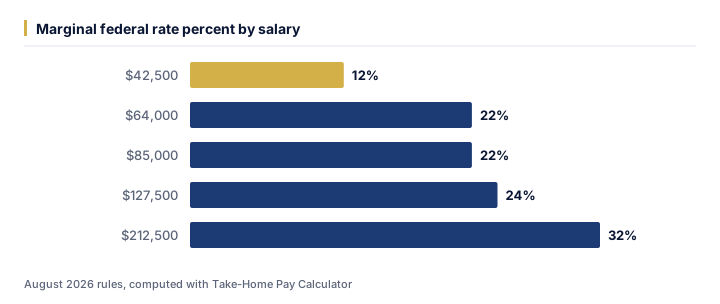
We ran 5 values of salary through the calculator and left every other input at its default. As of August 2026, the output was:
| Salary ($) | Marginal federal rate percent (%) | Effective tax rate percent (%) | Take home annual ($) |
|---|---|---|---|
| 42,500 | 12% | 17.1% | 35,245.07 |
| 64,000 | 22% | 20.4% | 50,950.64 |
| 85,000 | 22% | 24.8% | 63,897.41 |
| 127,500 | 24% | 29.7% | 89,596.16 |
| 212,500 | 32% | 33.4% | 141,456.96 |
Running salary from $42,500 up to $212,500 moves marginal federal rate percent from 12% to 32% — a spread of 20%. That gap is the part a single headline rate never shows.
The same runs seen through effective tax rate percent
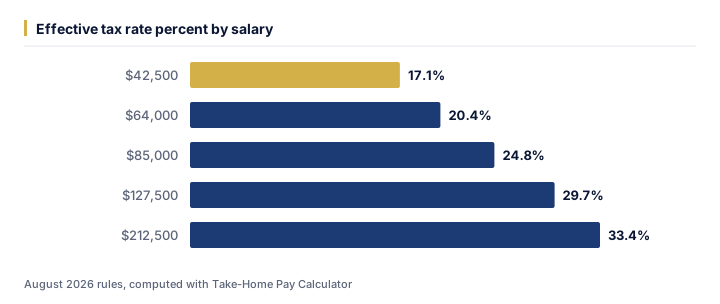
At $42,500, effective tax rate percent works out to 17.1%; at $212,500 it is 33.4%. Looking only at marginal federal rate percent tends to understate how much the outcome shifts across that range.
One example, straight from the API
The middle row above (salary = $85,000) is not a rounded illustration — it is exactly what /api/v1/tools/take-home-pay-calculator/calculate returns for that input, August 2026 rules:
{
    "tool": "take-home-pay-calculator",
    "inputs": {
        "salary": 85000,
        "filing": "single",
        "state": "CA",
        "contrib_pct": 0,
        "other_pre_tax": 0
    },
    "result": {
        "take_home_annual": 63897.41,
        "take_home_monthly": 5324.78,
        "take_home_biweekly": 2457.59,
        "federal_tax": 10541,
        "fica": 6502.5,
        "state_tax": 4059.09,
        "pretax_401k": 0,
        "federal_taxable": 70400,
        "marginal_federal_rate_percent": 22,
        "effective_tax_rate_percent": 24.8
    }
}
Assumptions behind these figures
| Input | Value |
|---|---|
| Salary | $85,000 |
| Filing | Single |
| State | Ca |
| Contrib pct | 0% |
| Other pre tax | $0 |
| As of | August 2026 |
| Method | identical to /tools/take-home-pay-calculator |
Rates, thresholds and typical costs change over time; the numbers above are accurate as of August 2026, not a permanent guarantee. For your own situation, open the Take-Home Pay Calculator and enter your real numbers — the calculator runs the same code that produced every figure on this page.