Sign-On Bonus: Tax and Negotiation
Sign-on bonuses are the most negotiable piece of a job offer, the worst-understood for taxes, and the most likely to come back and bite you in the form of a clawback. They are also, in 2026, more common than they used to be — companies that froze base salaries during tight quarters often unfroze sign-on budgets because the cash hits one quarter instead of forever.
Here is how they actually work, what to ask for, and what the IRS will keep when the deposit hits.
Why companies offer them
A sign-on bonus solves a specific math problem for the employer: it gets a candidate to accept without permanently raising the salary band for the role. From the company's perspective:
- It is a one-time expense, not a recurring cost.
- It does not anchor your future raises (every raise compounds off your base, not your sign-on).
- It does not affect internal pay equity — they can pay one person a $20,000 sign-on without raising every other engineer's salary.
- It often closes the gap between their salary cap for the level and what you were demanding.
That last point is why sign-ons are easier to negotiate than base. The recruiter who cannot give you another $10,000 of salary often can give you a $15,000 sign-on, because the second one comes out of a different budget and does not require approval up the chain.
It is also commonly used to:
- Buy out unvested equity at your current employer.
- Cover relocation costs without itemizing them.
- Compensate for a delayed start of an annual bonus cycle (you won't be eligible for the next bonus until year-end of year two).
Typical amounts in 2026
There is no single benchmark, but observed ranges:
| Role / Industry | Typical sign-on range |
|---|---|
| Entry-level (most industries) | $0 – $5,000 |
| Mid-level software engineer | $10,000 – $30,000 |
| Senior software engineer | $25,000 – $75,000 |
| Big-tech principal / staff | $50,000 – $200,000+ |
| MBA / consulting hire | $25,000 – $50,000 |
| Investment banking analyst | $10,000 – $20,000 |
| Healthcare (specialty physicians, nurses with shortage premiums) | $10,000 – $50,000 |
| Sales (with quota ramp) | $5,000 – $25,000 |
| Executive ($300K+ base) | Often 25%–50% of base |
These are rough — geography, the strength of your competing offer, and how much the employer needs to fill the role move the number a lot.
How a sign-on bonus is taxed
This is where most people get a surprise. The check is not what you negotiated.
The IRS treats sign-on bonuses as supplemental wages. There are two acceptable withholding methods, and the one your employer uses depends on payroll setup:
- Flat-rate method (most common for stand-alone bonus payments). Federal income tax is withheld at a flat 22% on supplemental wages up to $1 million, and 37% above. This is withholding, not your final tax — at filing time your actual liability is computed based on your total income.
- Aggregate method. The bonus is added to your most recent regular paycheck, and tax is withheld as if that were your normal pay. This tends to withhold more than 22% for high earners and less for low earners.
On top of federal income-tax withholding:
- FICA: Social Security 6.2% up to the $176,100 wage base, then 0%.
- FICA: Medicare 1.45%, no cap, plus an extra 0.9% above $200,000 of wages.
- State income tax in most states, with its own supplemental rate (CA uses 10.23% for bonuses, for example).
Concrete example
You negotiate a $30,000 sign-on. You live in a no-state-tax state. The employer uses the flat-rate method.
- Federal withholding: $30,000 × 22% = $6,600
- Social Security: $30,000 × 6.2% = $1,860
- Medicare: $30,000 × 1.45% = $435
- Net check: about $21,105
That is a 30% haircut you may not have planned for. If your marginal federal bracket is actually 24% or 32%, you will owe additional tax at filing time — the 22% withholding is the floor, not the final answer. Bonus Tax Calculator lets you plug in your full salary picture and state to see what you actually keep, and Take-Home Pay Calculator handles the broader yearly math.
Why you cannot get the gross amount
People sometimes ask, "Can the company just pay me the full $30,000 net?" The answer is no — the company must withhold and remit payroll taxes. What they can do is offer a "gross-up" where they increase the gross bonus so the net comes out to the number you wanted. Gross-ups are unusual outside of relocation packages.
Clawback clauses: the part that ruins it
Almost every sign-on bonus comes with a clawback clause. Two patterns dominate:
All-or-nothing (cliff) clawback
If you leave before a specified date — usually 12 months, sometimes 24 — you owe the entire bonus back. Day 364: pay back $30,000. Day 366: keep it all.
Pro-rata clawback
You earn the bonus monthly over the vesting period. Leave after eight months of a 12-month clawback period and you owe back 4/12 of the gross amount.
Pro-rata is friendlier; cliff is more common in tech and finance.
The tax double-bind
If a clawback fires, you are repaying a gross amount that you received as a net check. You received $21,000 of cash and you owe back $30,000.
You can usually recover the FICA the employer withheld. The federal income-tax piece is more complicated:
- Same calendar year. The employer reverses the wages on your W-2; the tax withheld is restored to you through normal filing.
- Different calendar year. You generally cannot amend the prior year's return. Depending on the amount and your situation, you may have a Section 1341 "claim of right" credit or a deduction. This is unpleasant and almost always worth consulting a CPA.
The practical takeaway: never spend the sign-on bonus until the clawback period has expired. Hold it in a high-yield savings account, mark the date on your calendar, and only treat it as yours after the clawback risk is gone.
What to ask for in negotiation
Sign-on bonuses are easier to negotiate than base salary, easier than RSUs, and easier than title. They are usually the recruiter's largest discretionary lever.
Things that work:
- A specific competing offer. "Company X is offering $X total. To match, I'd need a $20,000 sign-on." This is more powerful than vague pressure.
- A specific cost. "I have $25,000 of unvested RSUs I'd be walking away from. Can you make me whole on that?"
- A specific gap. "Your base is $10,000 below my current. I understand the band is what it is — can we close the gap with a $20,000 sign-on?"
- Asking late in the process. Once they have made the verbal offer and you are mid-paperwork, the recruiter has invested effort and is more motivated to close.
Things to also negotiate alongside the cash:
- Shorter clawback period (12 → 6 months) or pro-rata vesting (instead of cliff).
- Termination-for-no-cause carve-out — if they lay you off in month 8, you should not have to repay.
- Death/disability carve-out — the bonus should not be clawed back from your estate.
- Payment timing — first paycheck vs. 30/60/90 days in. First-paycheck is better; some employers will agree.
- Whether the bonus counts toward 401(k) eligibility — usually yes by default, but worth checking if you are trying to hit the $23,500 employee contribution limit early.
Things to avoid:
- Asking before you have the offer. Wait for the formal offer; then negotiate.
- Lying about competing offers. Recruiters call each other. The world is small.
- Taking the bonus and immediately job-hopping. Beyond the clawback, the reputational hit in your industry can outlast the cash.
When a higher base is better than a sign-on
A sign-on is one-time. A base-salary increase compounds. The crossover math depends on how long you expect to stay.
Suppose you can choose between:
- $5,000 higher base for the same role, or
- $15,000 sign-on bonus.
In year one, the sign-on wins by $10,000.
By year three, base has produced $15,000, matching the sign-on. After that, base pulls ahead — and every future raise compounds off the higher base.
Quick decision rule: if you expect to stay less than 3 years, take the sign-on. If you expect to stay more than 3 years, push for the base. If you can get both, take both — and that is often what works in practice.
Use Raise / Promotion Calculator to model how the base-vs-sign-on choice plays out across your expected tenure with compounding raises.
Checklist for a sign-on you should sign
- You understand the gross amount and the net you'll see after federal withholding, FICA, and state tax.
- The clawback period is in writing, with the exact dollar amount and the exact date.
- The clawback is pro-rata, not cliff (or you've explicitly accepted the cliff risk).
- There is a termination-without-cause carve-out so you don't owe back if they lay you off.
- The bonus is in the offer letter, not just verbal.
- You can leave the net amount untouched for the full clawback period.
- You've checked whether the bonus pushes you into Additional Medicare Tax territory (above $200,000 wages combined with the rest of your year).
Sign-on bonuses are real money and a real lever. They are also a contract with strings attached. Take the time to read the strings.
Run the numbers
Everything below came out of this site's own Take-Home Pay Calculator. The figures are not quoted from anywhere else: each row is one run of the same calculation the tool page performs, using August 2026 rules. Put the same inputs in and you will get the same output.
How the result moves with salary
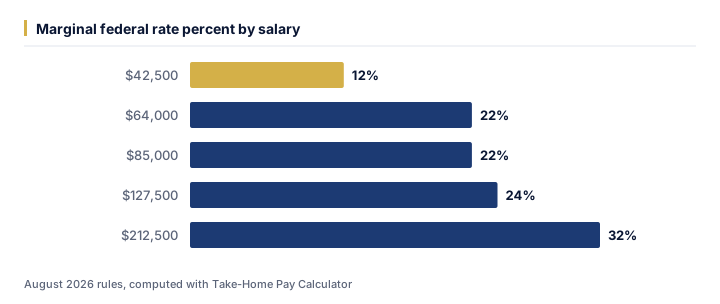
We ran 5 values of salary through the calculator and left every other input at its default. As of August 2026, the output was:
| Salary ($) | Marginal federal rate percent (%) | Effective tax rate percent (%) | Take home annual ($) |
|---|---|---|---|
| 42,500 | 12% | 17.1% | 35,245.07 |
| 64,000 | 22% | 20.4% | 50,950.64 |
| 85,000 | 22% | 24.8% | 63,897.41 |
| 127,500 | 24% | 29.7% | 89,596.16 |
| 212,500 | 32% | 33.4% | 141,456.96 |
Running salary from $42,500 up to $212,500 moves marginal federal rate percent from 12% to 32% — a spread of 20%. That gap is the part a single headline rate never shows.
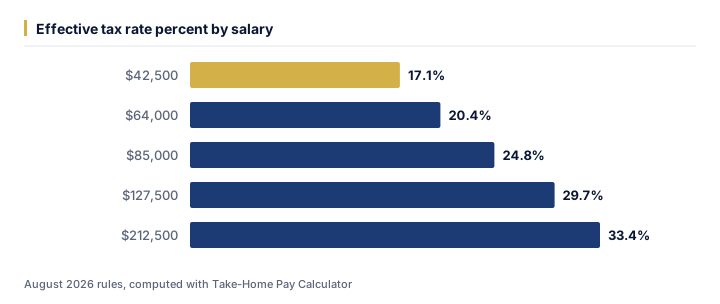
The same runs seen through effective tax rate percent
At $42,500, effective tax rate percent works out to 17.1%; at $212,500 it is 33.4%. Looking only at marginal federal rate percent tends to understate how much the outcome shifts across that range.
One example, straight from the API
The middle row above (salary = $85,000) is not a rounded illustration — it is exactly what /api/v1/tools/take-home-pay-calculator/calculate returns for that input, August 2026 rules:
{
    "tool": "take-home-pay-calculator",
    "inputs": {
        "salary": 85000,
        "filing": "single",
        "state": "CA",
        "contrib_pct": 0,
        "other_pre_tax": 0
    },
    "result": {
        "take_home_annual": 63897.41,
        "take_home_monthly": 5324.78,
        "take_home_biweekly": 2457.59,
        "federal_tax": 10541,
        "fica": 6502.5,
        "state_tax": 4059.09,
        "pretax_401k": 0,
        "federal_taxable": 70400,
        "marginal_federal_rate_percent": 22,
        "effective_tax_rate_percent": 24.8
    }
}
Assumptions behind these figures
| Input | Value |
|---|---|
| Salary | $85,000 |
| Filing | Single |
| State | Ca |
| Contrib pct | 0% |
| Other pre tax | $0 |
| As of | August 2026 |
| Method | identical to /tools/take-home-pay-calculator |
Rates, thresholds and typical costs change over time; the numbers above are accurate as of August 2026, not a permanent guarantee. For your own situation, open the Take-Home Pay Calculator and enter your real numbers — the calculator runs the same code that produced every figure on this page.