Severance Packages: What to Expect
The phone call or calendar invite that ends your job is rarely a surprise once you have read the news, but the document you sign on the way out almost always is. Severance packages in the US are not legally required in most situations — they exist because the employer wants something specific from you in exchange. Knowing what that something is, and what a reasonable offer looks like, makes the difference between leaving with a soft landing and leaving with regrets.
This guide walks through what "typical" looks like in 2026, what is genuinely negotiable, how the tax math actually plays out, and the traps that catch people who sign too quickly.
What severance actually is
A severance package is a contract. The employer offers cash, continued benefits, and sometimes other terms; in return, you waive your right to sue them and usually agree to a few promises (non-disparagement, non-disclosure, sometimes non-compete).
The federal Worker Adjustment and Retraining Notification (WARN) Act requires 60 days' notice for some larger layoffs at companies with 100+ employees, but it does not require a payout. Many states layer their own rules on top — California's mini-WARN is broader, New York's is stricter on small employers. Severance on top of what is legally required is voluntary, which is exactly why it is negotiable.
The typical formula
The most common starting point in the US is:
One to two weeks of base pay per year of service, capped at 26 weeks (sometimes 52).
That is a starting point, not a rule. What you actually see varies wildly by:
- Company size and policy. Large public companies usually have written severance policies they apply uniformly. Startups improvise.
- Tenure. Long-tenured employees often get richer formulas (two weeks per year vs. one).
- Level. Executives commonly get six to 12 months guaranteed; rank-and-file get the formula.
- Reason for separation. A layoff (no-cause) almost always pays. A termination "for cause" typically does not.
- Industry. Tech and finance trend more generous; retail and hospitality lean minimal.
A worker with eight years of service at a mid-size tech company being laid off might see an offer of 12 to 16 weeks of pay, three months of subsidized COBRA, accelerated vesting of equity scheduled in the next 90 days, and outplacement services.
What is in the package besides cash
The base-pay number is the headline, but several other items are often on the table — and can be worth more than negotiating the cash up.
- Continued health benefits. Some employers pay the COBRA premium for two to six months. Family COBRA can run $2,000+/month, so this is real money.
- Equity acceleration. Unvested RSUs or options that would have vested in the next quarter can sometimes be accelerated. If you have any unvested equity, this is the highest-leverage ask.
- Bonus pro-ration. If your bonus year is partway done, ask for the pro-rata bonus.
- Outplacement / career coaching. Often offered, usually low cost to the employer, occasionally useful to you.
- References. A written, agreed-upon reference letter or talking points the employer will provide to future callers.
- Non-disparagement (mutual). They usually want you to agree not to badmouth them. Push for mutual — they cannot badmouth you either.
- Treatment of restrictive covenants. If you signed a non-compete, the severance is sometimes contingent on enforcement of that non-compete. You can negotiate it down or away in exchange for tighter non-disparagement.
- Vacation / PTO payout. In some states (CA, CO, IL) accrued PTO must be paid out by law. Confirm it appears as a separate line and is not double-counted against the severance.
What is negotiable (more than you think)
Most people assume the initial offer is final. It rarely is. Companies running layoffs have built padding into the formula precisely because they expect some pushback.
What tends to move:
- Weeks of pay, especially if you can point to comparable peers at higher amounts.
- COBRA coverage duration. Going from three months paid to six is a common ask.
- Equity acceleration, particularly for vests within 60 to 90 days.
- Removal of overbroad non-competes.
What tends not to move:
- The basic formula applied across a big layoff (the lawyers want consistency).
- Anything that requires changing the underlying separation agreement template.
- Asks made after you have signed.
Tactics that work:
- Ask in writing, briefly, and once. "Given my eight years and the fact that I'm being asked to sign a non-disparagement clause, I'd like to request 20 weeks instead of 12, plus six months of COBRA." That is more effective than a phone call where you can be talked down.
- Use the review period. Federal age-discrimination law (the OWBPA) gives workers 40+ at least 21 days to review and 7 days to revoke. Use that time.
- Get a lawyer for any package above ~$50,000 or with non-compete language. Employment attorneys often work on a flat fee or contingency for review. Worth it.
The tax treatment that surprises people
Severance is taxable wages. It is not a gift, it is not capital gains, and it does not get any special treatment for being "involuntary."
Here is what actually happens:
- Federal withholding is usually applied at the 22% supplemental rate if the severance is paid as a separate lump sum, the same flat rate used for bonuses. That is withholding, not your final tax. If your marginal rate is higher (24%, 32%, 35%), you will owe more at filing time.
- FICA (Social Security 6.2% up to the $176,100 wage base, Medicare 1.45%) applies to severance.
- State income tax is withheld where applicable.
- State unemployment-insurance contributions are NOT withheld from your check — but the severance can affect your unemployment claim (see below).
A $40,000 lump-sum severance for a single filer in a no-state-tax state nets roughly:
- $40,000 × 22% federal withholding = $8,800
- $40,000 × 7.65% FICA = $3,060
- Net check: about $28,140
That is the withholding — your actual liability is settled at filing. Use Bonus Tax Calculator to run the math for your salary and state, since the calculator handles the supplemental-withholding mechanics the same way. For your overall tax picture for the year (including the severance month plus any normal earnings), run Take-Home Pay Calculator.
Lump sum vs. salary continuation
Some employers offer a choice between:
- Lump sum. All cash, one check, taxed at the supplemental rate.
- Salary continuation. They keep you on payroll for 12 to 26 weeks, paying you as if you still worked there.
The pros and cons:
| Option | Pros | Cons |
|---|---|---|
| Lump sum | Faster cash, no risk of company changing terms, employment officially ends now | Big tax hit in one year, may push you into higher bracket, may delay unemployment eligibility |
| Salary continuation | Spreads income over two tax years (if it crosses Jan 1), keeps health benefits active, employer-of-record continues | If you find a new job, you may have to forfeit the remainder, unemployment may be unavailable while continuation runs |
If you expect to be unemployed across a year boundary, salary continuation is usually better for total tax. If you expect to find a new job in weeks, lump sum is cleaner.
Severance and unemployment insurance
This trips up almost everyone. The rules vary by state:
- In most states, severance paid as salary continuation is treated as wages and delays your unemployment claim until the continuation period ends.
- In many states, a lump-sum severance does not delay UI — you can file the day after separation.
- A few states treat lump sums as wages anyway, allocating them across the weeks they "represent."
If you have any significant severance, check your state's UI website or call before assuming. Filing late can cost weeks of benefits.
The release you are actually signing
The cash is what the employer gives. The release is what they get. Read it carefully. Standard inclusions:
- General release of claims. You agree not to sue for anything that happened before signing. This is broad — wage claims, discrimination, harassment, retaliation, the whole list.
- Confidentiality. Often required for the terms of the severance itself; sometimes broader.
- Non-disparagement. Usually one-way (you don't trash them). Ask for it mutual.
- Non-solicitation. You may not be able to recruit former colleagues for 6 to 12 months.
- Cooperation clause. You agree to help with any future litigation, depositions, etc. Push to scope this narrowly.
- Return of property. Standard.
The OWBPA (Older Workers Benefit Protection Act) gives anyone 40+ specific protections: 21-day review period, 7-day revocation right, written notice of the protected-class breakdown of the layoff group. If those are missing for a 40+ worker, the release is unenforceable as to age-discrimination claims.
Common pitfalls
- Signing on the spot. Almost never required. Take the review period.
- Forgetting to negotiate equity. A six-figure equity grant scheduled to vest in 60 days is often the biggest item in the package, and people focus on the cash.
- Not getting it in writing. Verbal promises from HR are not enforceable. Get it on the term sheet.
- Confusing severance with what you are owed. Earned-but-unpaid wages, accrued PTO, expense reimbursements, and the last regular paycheck are owed regardless of whether you sign a severance agreement. Make sure those appear separately.
- Skipping the impact on your retirement and equity comp. A separation can trigger 90-day exercise windows on options, accelerate or kill RSU vesting, and change your 401(k) loan repayment terms. If you're trying to model what an offer plus a new role's compensation looks like together, Raise / Promotion Calculator is useful for the salary side.
Quick checklist before you sign
- Confirm the weeks of pay and how they will be paid (lump vs. continuation).
- Verify COBRA terms — duration and what the company subsidizes.
- Check equity treatment in writing — what accelerates, what is forfeited, what is the exercise window for options.
- Audit the release scope — is it general, mutual on non-disparagement, narrow on cooperation?
- Confirm PTO payout is separate, not netted against severance.
- Ask about unemployment timing in your state.
- Use the full review period — there is no prize for signing early.
Severance is the last contract you sign with your employer, and unlike the offer letter, you usually have leverage. Use it.
Run the numbers
Everything below came out of this site's own Take-Home Pay Calculator. The figures are not quoted from anywhere else: each row is one run of the same calculation the tool page performs, using August 2026 rules. Put the same inputs in and you will get the same output.
How the result moves with salary
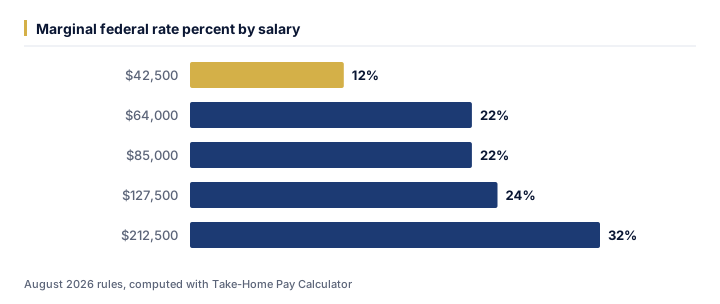
We ran 5 values of salary through the calculator and left every other input at its default. As of August 2026, the output was:
| Salary ($) | Marginal federal rate percent (%) | Effective tax rate percent (%) | Take home annual ($) |
|---|---|---|---|
| 42,500 | 12% | 17.1% | 35,245.07 |
| 64,000 | 22% | 20.4% | 50,950.64 |
| 85,000 | 22% | 24.8% | 63,897.41 |
| 127,500 | 24% | 29.7% | 89,596.16 |
| 212,500 | 32% | 33.4% | 141,456.96 |
Running salary from $42,500 up to $212,500 moves marginal federal rate percent from 12% to 32% — a spread of 20%. That gap is the part a single headline rate never shows.
The same runs seen through effective tax rate percent
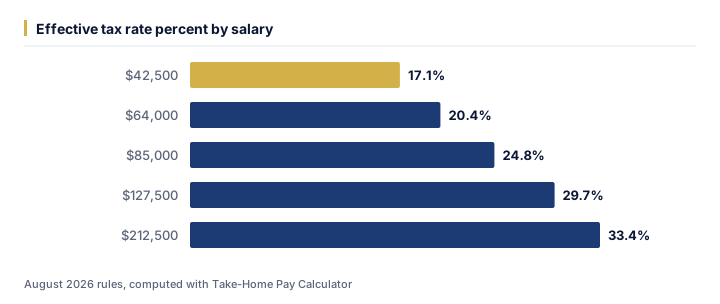
At $42,500, effective tax rate percent works out to 17.1%; at $212,500 it is 33.4%. Looking only at marginal federal rate percent tends to understate how much the outcome shifts across that range.
One example, straight from the API
The middle row above (salary = $85,000) is not a rounded illustration — it is exactly what /api/v1/tools/take-home-pay-calculator/calculate returns for that input, August 2026 rules:
{
    "tool": "take-home-pay-calculator",
    "inputs": {
        "salary": 85000,
        "filing": "single",
        "state": "CA",
        "contrib_pct": 0,
        "other_pre_tax": 0
    },
    "result": {
        "take_home_annual": 63897.41,
        "take_home_monthly": 5324.78,
        "take_home_biweekly": 2457.59,
        "federal_tax": 10541,
        "fica": 6502.5,
        "state_tax": 4059.09,
        "pretax_401k": 0,
        "federal_taxable": 70400,
        "marginal_federal_rate_percent": 22,
        "effective_tax_rate_percent": 24.8
    }
}
Assumptions behind these figures
| Input | Value |
|---|---|
| Salary | $85,000 |
| Filing | Single |
| State | Ca |
| Contrib pct | 0% |
| Other pre tax | $0 |
| As of | August 2026 |
| Method | identical to /tools/take-home-pay-calculator |
Rates, thresholds and typical costs change over time; the numbers above are accurate as of August 2026, not a permanent guarantee. For your own situation, open the Take-Home Pay Calculator and enter your real numbers — the calculator runs the same code that produced every figure on this page.