Remote Work and Salary Adjustments
You got a remote job offer. The recruiter mentions "geographic pay adjustments." Your friend in San Francisco makes $180,000 for the same role you'd be doing from Austin, but the company is offering you $145,000. Is that fair? Is it a pay cut, or is it actually a raise once you account for what you keep?
The honest answer is "it depends, and the math is more interesting than you think." Pay tiers, state taxes, cost of living, and the hidden expenses of in-office work all combine to reshape your real take-home. This guide walks through how tech and other remote-friendly companies set geographic salary bands, then runs three worked relocations to show what actually lands in your bank account.
How geographic pay tiers work
Most companies that hire remote workers across the US group locations into three or four tiers. The exact bands vary, but the pattern is consistent:
- Tier 1 (T1): San Francisco Bay Area, New York City metro, Seattle. Base = 100% of the pay band.
- Tier 2 (T2): Los Angeles, Boston, Washington DC, Chicago, Denver, Austin, San Diego. Base = 90-95% of T1.
- Tier 3 (T3): Most other major metros — Atlanta, Dallas, Phoenix, Portland, Miami, Nashville. Base = 80-90% of T1.
- Tier 4 (T4) (when used): Smaller cities, rural areas, lower cost-of-living states. Base = 70-80% of T1.
A senior software engineer role might be banded as $200k T1, $185k T2, $170k T3. The same job, same scope, different label depending on your ZIP code.
Not every employer does this. Some pay flat nationally (Reddit, Airbnb, GitLab have done this in various forms). Some only use two tiers. Some negotiate case-by-case. But when an offer mentions a "geographic differential" or "location-based pay," this is what they mean.
What actually changes when you relocate
Three things shift at once when you move:
- Gross salary (if your employer adjusts by tier)
- State and local income tax (huge variation: 0% to 13.3%)
- Cost of living (housing dominates, but groceries, transit, childcare all matter)
A fourth, often-ignored factor: the cost of not commuting. If you go fully remote and skip a downtown office, you typically save $5,000-$12,000 per year on commuting, lunches, work clothes, and miscellaneous in-office expenses. We'll quantify this below.
Worked example 1: San Francisco to Austin
You're a senior engineer earning $200,000 in San Francisco. You move to Austin, and your employer drops you from T1 to T2, paying $185,000.
Gross change: -$15,000 (7.5% pay cut)
But look at what happens next:
| Item | San Francisco | Austin |
|---|---|---|
| Gross salary | $200,000 | $185,000 |
| State income tax | ~$17,400 (CA) | $0 (TX) |
| Federal + FICA (est.) | $52,000 | $47,500 |
| Take-home (est.) | ~$130,600 | ~$137,500 |
Texas has no state income tax. California's top marginal rate is 9.3% (kicks in around $76k single), with 10.3-13.3% for high earners. That alone makes up most of the gross-pay reduction.
Now layer cost of living. Per ACCRA composite indexes (2025):
- SF housing index: ~280
- Austin housing index: ~135
A two-bedroom that rents for $4,200 in SF rents for around $2,100 in Austin — a $25,000/year delta. Groceries are about 15% cheaper. Healthcare is similar. Restaurants and entertainment are 20-30% cheaper.
Conservative annual cost-of-living savings: $20,000-30,000.
Now add the remote work bonus. If you were commuting into a San Francisco office, you were spending:
- Transit/parking: $200/month = $2,400/year
- Lunches out: $15/day x 220 days = $3,300/year
- Work clothes/dry cleaning: $1,000-1,500/year
- Coffee/incidentals: $1,500/year
That's roughly $8,000-9,000/year you no longer spend when working from home.
Net real-purchasing-power outcome: You took a 7.5% pay cut on paper and ended up roughly $30,000-40,000 ahead in real annual spending power. Run your own numbers with Cost of Living Calculator and Take-Home Pay Calculator.
Worked example 2: New York City to Miami
You earn $160,000 in Manhattan as a marketing director. You move to Miami; the employer keeps you at $150,000 (a small T1-to-T2 shift).
Gross change: -$10,000
State and local tax picture:
| Item | New York City | Miami |
|---|---|---|
| Gross salary | $160,000 | $150,000 |
| NY state tax (~6.49% effective) | ~$10,400 | $0 |
| NYC city tax (~3.5% effective) | ~$5,600 | $0 |
| Federal + FICA (est.) | $36,000 | $33,500 |
| Take-home (est.) | ~$108,000 | ~$116,500 |
NYC residents pay both state and city income tax — together about 9-10% effective at this income level. Florida has no state income tax. The combined savings is roughly $16,000/year, which more than offsets the $10,000 gross reduction.
Cost of living is more nuanced. Miami housing has caught up with — and in some cases passed — secondary NYC neighborhoods, so housing savings are smaller than you'd expect. But:
- No subway pass (~$1,500/year savings, but you may now need a car)
- Restaurant prices 20-25% lower
- Childcare and services meaningfully cheaper
Realistic annual cost-of-living savings: $8,000-15,000 (highly dependent on neighborhood).
Remote work savings: If you were commuting from Brooklyn or Queens into Midtown, you were spending $3,000-4,000/year on transit plus $3,500-5,000 on lunches. Call it $7,000-9,000/year recovered.
Net real-purchasing-power outcome: A nominal $10,000 pay cut translates to roughly $25,000-30,000 more real spending power. The state-tax savings alone is the headline.
Worked example 3: Seattle to Denver
Software engineer earning $190,000 in Seattle moves to Denver. The employer reduces salary to $175,000 (T1 to T2).
Gross change: -$15,000
This one is more interesting because Washington has no state income tax, while Colorado has a flat 4.4% tax:
| Item | Seattle | Denver |
|---|---|---|
| Gross salary | $190,000 | $175,000 |
| State income tax | $0 (WA) | ~$7,200 (CO, 4.4% flat) |
| Federal + FICA (est.) | $48,000 | $44,000 |
| Take-home (est.) | ~$142,000 | ~$123,800 |
Here, the relocation adds a state tax burden. Combined with the gross reduction, take-home drops by about $18,000.
Cost of living offsets some of that. Seattle housing is roughly 20-30% more expensive than Denver. A $3,200 Seattle apartment is closer to $2,400 in Denver — about $9,600/year saved. Restaurants and services are 10-15% cheaper.
Realistic annual cost-of-living savings: $10,000-15,000.
Remote work savings: If your Seattle job required occasional office time at the South Lake Union campus, going fully remote in Denver still saves a few thousand on transit and lunches, call it $4,000-6,000.
Net real-purchasing-power outcome: Close to break-even. You give up the rare "no income tax + tech salaries" combo Seattle offers. Denver is a lifestyle move, not a financial one.
State tax matters more than you think
Notice the pattern across all three examples: state income tax often outweighs the geographic pay differential. Nine states have no income tax: Alaska, Florida, Nevada, New Hampshire (interest/dividends only), South Dakota, Tennessee, Texas, Washington, Wyoming.
At a $150,000 salary in a 7% state, you're paying around $10,000 a year in state income tax. That's the entire size of a typical T1-to-T2 cut. If you can move to a no-tax state and only drop one tier, you almost always come out ahead.
The commute/lunch/clothes savings nobody quantifies
Surveys from FlexJobs, Owl Labs, and Global Workplace Analytics consistently estimate $5,000-12,000/year in personal savings from full remote work. The breakdown for a typical office worker:
- Commuting (gas, parking, transit, vehicle wear): $2,000-5,000
- Lunches out 4-5 days/week: $2,000-4,000
- Work clothes, dry cleaning, grooming: $500-1,500
- Coffee and incidentals: $500-1,500
This isn't taxed money — it's after-tax spending you no longer do. So $8,000 in remote-work savings is equivalent to about a $11,000-12,000 gross raise.
The residency tax trap
One often-overlooked factor: when you move mid-year, you usually owe income tax in both the state you left and the state you arrived in, prorated. If you leave California in June and land in Texas, California will tax the income you earned January through June (and may try to claim more if your "domicile" is ambiguous). California in particular is aggressive about residency audits for high earners who leave.
To establish residency cleanly in your new state:
- Update your driver's license and voter registration within 30-60 days.
- Move primary bank accounts and credit card billing addresses.
- Spend at least 183 days in the new state in the move year.
- File a part-year return in your old state showing the move date.
- Avoid maintaining a home in the old state for longer than necessary.
If you keep a foothold in your former state — a house, family, even a gym membership — auditors can argue you never truly left. A few high-profile California-to-Nevada and California-to-Texas residency cases have ended with hundreds of thousands in back taxes owed. If the relocation is happening to a high-stakes state, talk to a CPA before the move, not after.
When you stay put: negotiating against a downward adjustment
What if you're already remote in a T1 city and the company announces a one-time geographic re-adjustment? Some workers have been hit with 5-15% pay reductions in the past few years as employers reset bands. Options:
- Push back with output data. Your scope and impact didn't change. If anything, remote workers often deliver more uninterrupted output.
- Ask for the change to be phased in. A 10% cut implemented over 18 months is easier to absorb and gives you time to job-search if needed.
- Negotiate a bonus or equity uplift to offset some of the base reduction. Equity isn't subject to the same band logic.
- Quietly start interviewing. A company willing to cut existing employees' pay has signaled something about how it values retention. The job market is fragmented enough that you can usually find another remote role at your prior rate within 60-120 days.
When to push back on a low offer
If a company tries to drop you two tiers (T1 to T3) on the same role, that's aggressive. Push back with:
- Market data from Levels.fyi, Glassdoor, BLS OEWS
- The fact that your output, scope, and impact haven't changed
- Other companies' policies (many do max one tier of adjustment, or none)
If they hold firm and the role still nets out positive after taxes and cost of living, take it. If not, keep looking. Use Take-Home Pay Calculator to model the offer in real terms, and Cost of Living Calculator to compare locations.
Bottom line
A "pay cut" in remote-work relocation is often not a pay cut at all once you account for:
- State and local income taxes (often the biggest single factor)
- Cost of living (housing dominates)
- Commute, lunch, and clothing savings ($5,000-12,000 typical)
Run the full math before you accept or reject. The headline number rarely tells the real story. These are estimates only; consult a tax professional for relocation-specific planning, especially if you'll have residency questions in your move year.
Run the numbers
Everything below came out of this site's own Salary to Hourly Converter. The figures are not quoted from anywhere else: each row is one run of the same calculation the tool page performs, using August 2026 rules. Put the same inputs in and you will get the same output.
How the result moves with salary
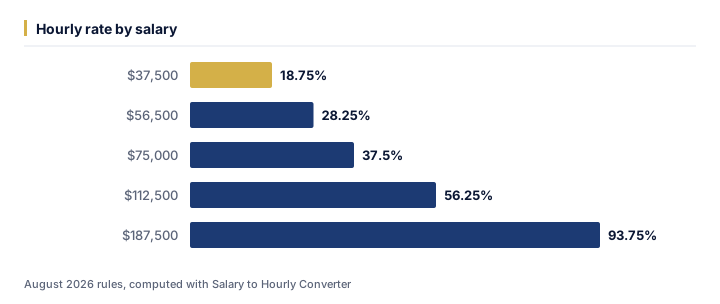
We ran 5 values of salary through the calculator and left every other input at its default. As of August 2026, the output was:
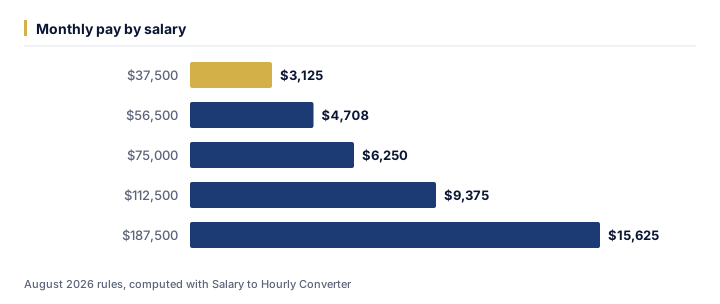
| Salary ($) | Hourly rate (%) | Monthly pay ($) | Biweekly pay ($) |
|---|---|---|---|
| 37,500 | 18.75% | 3,125 | 1,442.31 |
| 56,500 | 28.25% | 4,708.33 | 2,173.08 |
| 75,000 | 37.5% | 6,250 | 2,884.62 |
| 112,500 | 56.25% | 9,375 | 4,326.92 |
| 187,500 | 93.75% | 15,625 | 7,211.54 |
Running salary from $37,500 up to $187,500 moves hourly rate from 18.75% to 93.75% — a spread of 75%. That gap is the part a single headline rate never shows.
The same runs seen through monthly pay
At $37,500, monthly pay works out to $3,125; at $187,500 it is $15,625. Looking only at hourly rate tends to understate how much the outcome shifts across that range.
One example, straight from the API
The middle row above (salary = $75,000) is not a rounded illustration — it is exactly what /api/v1/tools/salary-to-hourly-converter/calculate returns for that input, August 2026 rules:
{
    "tool": "salary-to-hourly-converter",
    "inputs": {
        "salary": 75000,
        "hoursPerWeek": 40,
        "weeksPerYear": 50
    },
    "result": {
        "hourly_rate": 37.5,
        "monthly_pay": 6250,
        "biweekly_pay": 2884.62,
        "weekly_pay": 1442.31,
        "daily_pay": 300,
        "hours_per_year": 2000
    }
}
Assumptions behind these figures
| Input | Value |
|---|---|
| Salary | $75,000 |
| Hours per week | $40 |
| Weeks per year | 50 years |
| As of | August 2026 |
| Method | identical to /tools/salary-to-hourly-converter |
Rates, thresholds and typical costs change over time; the numbers above are accurate as of August 2026, not a permanent guarantee. For your own situation, open the Salary to Hourly Converter and enter your real numbers — the calculator runs the same code that produced every figure on this page.