PTO Cash-Out: How Much Is It Worth?
You've built up 120 hours of PTO. The offer letter for your new job is on the desk, and your current employer's HR portal shows a tempting line item: "PTO balance eligible for payout at separation." Quick mental math at your $40/hour wage says $4,800. Easy money, right?
Not quite. PTO cash-outs are paid as gross wages, but the IRS classifies them as supplemental income, which means the withholding hits harder than a regular paycheck. State law decides whether you're even entitled to the cash. And the "use it or lose it" trap can silently delete days you thought were yours.
This guide walks you through what a PTO cash-out is actually worth before you accept an offer, hand in notice, or burn through your balance in a last-minute beach week.
What PTO cash-out actually means
Paid Time Off is earned compensation. When you accrue PTO, you're being paid in time instead of cash. Most employers express this as hours per pay period (say, 4 hours every two weeks, which works out to roughly 13 days a year), or as a flat annual grant (e.g., 15 days dropped into your bucket on January 1).
A cash-out converts unused PTO hours back into wages at your regular rate. The most common cash-out scenarios:
- Separation: You quit, get laid off, or are terminated, and your remaining balance is paid out in your final check.
- Annual rollover cap: Your employer lets you cash out hours above a ceiling instead of forfeiting them.
- Mid-year voluntary cash-out: Some employers offer this once a year, often in December.
The dollar value before taxes is straightforward: your hourly rate (or salary-equivalent hourly rate — use Salary to Hourly Converter to get this) times your unused hours. The complications are legal and tax-driven.
State law: cash-out is not guaranteed
The federal Fair Labor Standards Act doesn't require employers to provide PTO at all, much less cash it out. State law fills the gap, and the rules vary dramatically.
States that treat accrued PTO as earned wages (cash-out at separation is mandatory):
- California — the clearest case. Accrued vacation is wages, "use it or lose it" policies are illegal, and unused balances must be paid at separation at your final wage rate.
- Colorado, Illinois, Massachusetts, Nebraska, North Dakota — similar protections, though specifics vary.
- Several others provide partial protection.
States that follow the employer's written policy: Most of the rest. If the handbook says you forfeit unused PTO at separation, you forfeit it. If the policy says it pays out, the employer has to honor it.
The lesson: Before you assume a balance is worth cash, read your employee handbook's PTO section. If you're in California, you're protected by law. If you're in Texas or Florida, you're protected only by what your employer wrote down.
How the IRS taxes PTO payouts
Here's where the "I earned $40/hour" math falls apart.
A PTO cash-out is supplemental wages, the same category as bonuses, commissions, and severance. Employers have two options for federal withholding:
- Flat 22% method: For supplemental payments up to $1 million in the calendar year, the employer can withhold a flat 22% for federal income tax, regardless of your W-4. This is the most common approach for PTO.
- Aggregate method: Lump the supplemental amount into your next regular paycheck and withhold based on your W-4 as if the combined amount were your usual pay. This often results in even higher withholding because it pushes the aggregated paycheck into a higher bracket.
On top of federal income tax withholding, your PTO payout is still subject to:
- FICA: 7.65% (Social Security + Medicare). Social Security applies up to the 2026 wage base of $176,100; Medicare has no cap.
- State income tax: Withheld at supplemental rates that vary by state.
- Additional Medicare tax: 0.9% on wages over $200,000 in a year.
For a worker in the 22% federal bracket in a moderate-tax state, the effective withholding on a PTO cash-out is typically 30-40%. That $4,800 gross payout might land as roughly $3,000-3,400 in your account.
Important distinction: Withholding is not the same as your actual tax liability. If the flat 22% over-withholds relative to your real marginal rate, you'll get some of it back at tax time. If it under-withholds, you'll owe. Use Bonus Tax Calculator to estimate the net for your situation, since the math is the same as a bonus.
A worked example
Sarah earns $80,000 salary in Texas (no state income tax). She's leaving her job with 120 hours of unused PTO. Her salary works out to roughly $38.46/hour ($80,000 / 2,080 hours).
Gross payout: 120 × $38.46 = $4,615
Withholding:
- Federal (flat 22% supplemental): $1,015
- FICA (7.65%): $353
- State: $0
Net to Sarah: $4,615 − $1,368 = $3,247
Her effective withholding rate is 29.6%. If Sarah's actual marginal federal rate for the year ends up at 22%, she's roughly even at tax time. If she's in the 12% bracket overall (lower-income year, big deductions), she'll get a refund of part of the 22% withheld.
Now contrast with Mike, who earns the same $80,000 but lives in California. He has the same 120 hours, but California requires cash-out at the final wage rate.
Gross payout: 120 × $38.46 = $4,615
Withholding:
- Federal (flat 22%): $1,015
- FICA (7.65%): $353
- California (supplemental rate, ~6.6% for most): $305
Net to Mike: $4,615 − $1,673 = $2,942
Mike keeps about 64% of the gross. To turn his actual paycheck math into a regular take-home estimate, Take-Home Pay Calculator is what you'd use day-to-day.
Valuing PTO when comparing offers
When you're negotiating between two jobs, PTO is real compensation, but you need to value it correctly.
The wrong way: "Job A offers 20 days PTO, Job B offers 15. Job A is 5 days × 8 hours × my hourly rate better."
The right way: Ask three questions about each plan:
- Does it cash out at separation? If no, the PTO is only worth what you actually use. Many high-burnout fields have low PTO utilization — those unused days are zero on the comp sheet.
- What's the accrual cap? Some plans cap accrual at 1.5× your annual grant. If you hit the cap, you stop accruing — effectively forfeiting future PTO until you take some.
- Is it "use it or lose it" or rollover? If unused days reset to zero each year, you're on a deadline. If they roll over (up to the cap), you have more flexibility.
A 20-day plan that doesn't cash out and resets every December is worth less than a 15-day plan that cashes out at separation.
Use-it-or-lose-it strategies
If you're stuck with a "use it or lose it" plan and you can see the end of the year approaching, options in rough order of preference:
- Take the time off. Obvious but underused. PTO is part of your compensation; not using it is leaving money on the table. Plan a December break or stack days against a holiday weekend.
- Ask for an in-policy cash-out. Some employers do an annual cash-out window (often December) for hours above a threshold. If your policy allows it, opt in.
- Check rollover provisions carefully. Some "use it or lose it" plans allow limited rollover (e.g., 40 hours into Q1). Read the fine print.
- Time your separation if you're already planning to leave. If you're in a cash-out state and you've decided to quit, hitting separation date with a large balance turns time into money.
The hidden value of unused PTO in a tough job market
One non-financial point: PTO is more than money. If you're laid off, your final paycheck — including PTO cash-out — is often the bridge to the next job. A burned-down balance is a thinner runway.
In sectors where layoffs are sudden (tech, finance, media), some people deliberately accrue toward the cap as a self-insurance mechanism. Combined with severance, three to four weeks of PTO can extend an unemployment buffer meaningfully.
This trade-off — using PTO for rest now versus banking it as insurance later — is personal. There's no universally right answer, but it deserves a conscious decision rather than drift.
When to talk to a professional
A few situations where the math gets complex enough that a CPA or employment attorney can pay for themselves:
- Large balances at high incomes: If you have 200+ hours and you're already over the Social Security wage base, the FICA math changes mid-payout.
- Equity-rich separations: If your final paycheck includes PTO plus RSU vesting plus a severance bonus, withholding can dramatically over- or under-shoot.
- Disputed forfeiture: If your employer is refusing to pay out a balance you believe is owed, especially in a state that treats PTO as wages, talk to an employment attorney.
PTO cash-outs aren't free money, but they aren't nothing either. Understanding the gross-to-net gap and the state rules around them lets you negotiate, plan, and separate with eyes open.
Run the numbers
Everything below came out of this site's own Salary to Hourly Converter. The figures are not quoted from anywhere else: each row is one run of the same calculation the tool page performs, using August 2026 rules. Put the same inputs in and you will get the same output.
How the result moves with salary
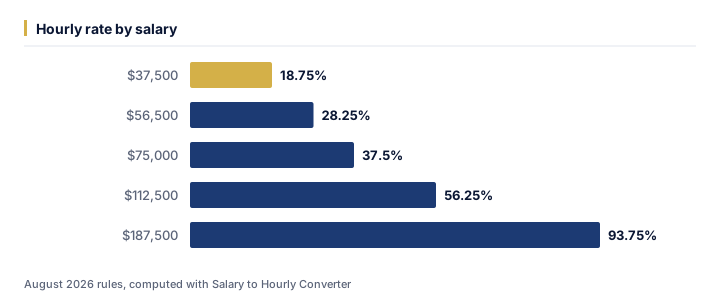
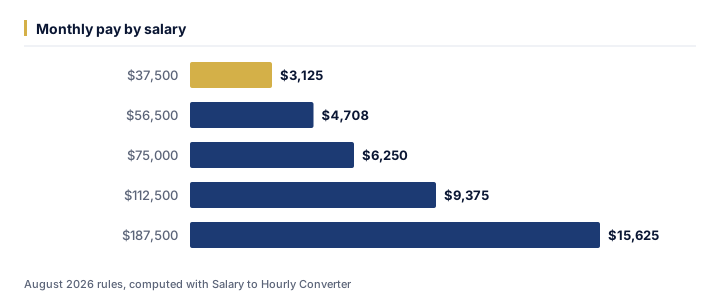
We ran 5 values of salary through the calculator and left every other input at its default. As of August 2026, the output was:
| Salary ($) | Hourly rate (%) | Monthly pay ($) | Biweekly pay ($) |
|---|---|---|---|
| 37,500 | 18.75% | 3,125 | 1,442.31 |
| 56,500 | 28.25% | 4,708.33 | 2,173.08 |
| 75,000 | 37.5% | 6,250 | 2,884.62 |
| 112,500 | 56.25% | 9,375 | 4,326.92 |
| 187,500 | 93.75% | 15,625 | 7,211.54 |
Running salary from $37,500 up to $187,500 moves hourly rate from 18.75% to 93.75% — a spread of 75%. That gap is the part a single headline rate never shows.
The same runs seen through monthly pay
At $37,500, monthly pay works out to $3,125; at $187,500 it is $15,625. Looking only at hourly rate tends to understate how much the outcome shifts across that range.
One example, straight from the API
The middle row above (salary = $75,000) is not a rounded illustration — it is exactly what /api/v1/tools/salary-to-hourly-converter/calculate returns for that input, August 2026 rules:
{
    "tool": "salary-to-hourly-converter",
    "inputs": {
        "salary": 75000,
        "hoursPerWeek": 40,
        "weeksPerYear": 50
    },
    "result": {
        "hourly_rate": 37.5,
        "monthly_pay": 6250,
        "biweekly_pay": 2884.62,
        "weekly_pay": 1442.31,
        "daily_pay": 300,
        "hours_per_year": 2000
    }
}
Assumptions behind these figures
| Input | Value |
|---|---|
| Salary | $75,000 |
| Hours per week | $40 |
| Weeks per year | 50 years |
| As of | August 2026 |
| Method | identical to /tools/salary-to-hourly-converter |
Rates, thresholds and typical costs change over time; the numbers above are accurate as of August 2026, not a permanent guarantee. For your own situation, open the Salary to Hourly Converter and enter your real numbers — the calculator runs the same code that produced every figure on this page.