Pay Transparency Laws: State by State
For most of US workplace history, salary was a secret. Asking what your colleague earned was a faux pas; asking what a posted job paid was rude. Then, starting in 2018, states began passing laws that flipped the default — and as of 2026, more than a dozen states require employers to disclose salary ranges in some form. The result is a slow, uneven, but very real shift in how candidates evaluate offers and how current employees negotiate raises.
Here is what the laws actually require, where they apply, what they don't cover, and how to use them.
What "pay transparency" actually means in law
Pay-transparency laws come in three rough flavors, and most states have some mix of all three:
- Job-posting disclosure. The employer must include a salary range in every public job listing.
- Applicant disclosure on request. The employer must share the range with a candidate at some point in the process — sometimes proactively, sometimes only when asked.
- Current-employee disclosure. Employees can request the range for their own position or for one they are applying for internally.
A second axis is what else the laws prohibit:
- Salary history bans. Many states (and some cities) prohibit employers from asking what you currently earn or what you earned at past jobs.
- Wage-discussion protection. Most states protect your right to discuss your pay with coworkers — though this is also already protected federally by the National Labor Relations Act for non-supervisory employees.
States with significant pay-transparency requirements (as of 2026)
This list is meant as an orientation, not a legal compliance reference. Laws are amended frequently; always check the state department of labor for current text before relying on it.
Strong job-posting laws (range required in postings)
- California — Employers with 15+ employees must include pay scale in job postings. Existing employees can request the pay scale for their current position.
- Colorado — One of the earliest. Job postings must include pay range and a general description of benefits. Applies to remote roles that could be filled in CO.
- Connecticut — Employers must disclose the wage range upon a candidate's request, and to current employees upon hire, promotion, or request.
- Hawaii — Job postings for employers with 50+ employees must include hourly rate or salary range.
- Illinois — As of 2025, employers with 15+ employees must include pay scale and benefits in postings.
- Maryland — Postings must include the wage range and general benefits description.
- Minnesota — Employers with 30+ employees must include salary range and benefits in postings (effective 2025).
- New Jersey — Effective 2025, employers with 10+ employees must disclose hourly wage or salary range and benefits in postings.
- New York — Statewide law in effect since 2023. Postings must include the range. New York City had its own ordinance before the statewide law and remains in effect.
- Rhode Island — Must disclose range upon applicant request and to employees moving to a new role.
- Vermont — As of 2025, employers with 5+ employees must include pay range in postings.
- Washington — Employers with 15+ employees must include pay range and a general description of benefits in postings.
Salary-history bans (separate from posting laws — but often layered on top)
Salary-history-ban states include Alabama, California, Colorado, Connecticut, Delaware, District of Columbia, Hawaii, Illinois, Maine, Maryland, Massachusetts, Nevada, New Jersey, New York, North Carolina (state agencies), Oregon, Pennsylvania (state agencies), Rhode Island, Vermont, Virginia, and Washington — with city-level rules in places like Cincinnati, Toledo, Kansas City, San Francisco, and Philadelphia.
In a salary-history-ban state, an employer cannot ask what you currently make or used to make. They can ask what you are looking for, and you can volunteer your number if you choose.
States with no posting law (as of 2026)
The remaining ~38 states have no general pay-transparency posting requirement, though some have narrower rules (state agencies only, certain industries only, or anti-retaliation protection for employees who discuss pay with coworkers).
There is no federal pay-transparency law. Bills are introduced regularly; none have passed. The patchwork is the system.
What postings actually look like
The laws specify the range but rarely the precision. In practice, you see three patterns:
| Pattern | Example | What it usually means |
|---|---|---|
| Narrow range | $135,000–$155,000 | Real, defensible band. They will likely pay near the middle. |
| Wide range | $120,000–$220,000 | Covers multiple levels. Where you land depends on what the recruiter codes you as. |
| "Up to" or "starting at" | "Starting at $90,000" | Compliant in some states, not all. Often hides the cap. |
A range posted as $135,000–$300,000 is almost always two or three levels rolled together. Ask early in the process which level the role corresponds to and what the range for that level is.
What the laws do not require
A few things people often expect but the laws generally do not deliver:
- Equity, bonus, or total compensation. Most posting laws cover only base salary or hourly rate. RSUs, options, and bonus targets are usually excluded.
- Geographic granularity. A nationwide remote role posted in NY may show a range that spans CA, NY, and rural Tennessee — all very different cost of living.
- Internal pay parity. Knowing the range does not entitle you to be paid at any specific point in it.
- Disclosure to anyone who asks. Most laws give the right to applicants and current employees, not to journalists or the public.
If the role you are evaluating spans multiple cities, run the numbers through Cost of Living Calculator — the same $150,000 range means very different things in San Francisco vs. Indianapolis.
How to use pay transparency in negotiation
Knowing the range is leverage. Using it well is a different skill.
As an applicant
- Anchor at the top of the range. If the posting says $135k–$155k, your number should be $155k or slightly above (with justification). The middle is rarely the best you can do.
- Ask which level the role is in. "I see the range is $120k–$200k. Where does this specific position sit, and what's the band for that level?" Forces the recruiter to be specific.
- Match the range to your data. Use Salary to Hourly Converter to translate hourly postings to apples-to-apples comparison with salary roles, and vice versa.
- Don't volunteer your current salary in a history-ban state — you don't have to, and it anchors you low.
- Cross-check against actual data. Levels.fyi, Glassdoor, and Blind have leaked numbers for many companies. The posted range is the legal minimum disclosure; the real range can be wider.
As a current employee
- Watch your own company's postings. A new posting for your job — or your boss's job — at a band higher than you are paid is leverage at your next review.
- Request the range for your role. In states that allow it (CA, CT, IL, RI, WA, etc.) you can ask HR for the pay scale of your current position. This is awkward and legal.
- Use the gap. If you are paid $140k in a posted range of $145k–$175k, you have a specific, documented case for a raise. Bring Raise / Promotion Calculator math to the conversation — the percentage gap to range-midpoint is your ask.
- Time it. Pull the data in advance of your annual review, salary cycle, or promotion conversation. Don't ambush.
Enforcement: is anyone actually checking?
State labor departments and state attorneys general are the primary enforcers. Penalties vary:
- New York: fines per posting after a cure period.
- Washington: actual damages plus statutory damages and attorney fees in private actions.
- California: per-violation civil penalties.
- Colorado: per-violation fines.
A modest but growing number of private lawsuits have been brought against large employers for posting "remote / nationwide" roles without disclosing CO, WA, or NY ranges. Most large employers have responded by posting either nationwide ranges or excluding those states from remote postings — which is technically legal but a workaround.
In practice, enforcement is uneven, but reputational damage is real, and the major job boards (LinkedIn, Indeed) have begun flagging postings that violate transparency rules.
Common gaps and workarounds
The laws have noticeable holes. Some are intentional, some accidental:
- "Approximately" ranges. Some states allow "approximately $X" rather than a hard floor/ceiling, weakening the signal.
- External recruiters. Postings by staffing agencies are sometimes excluded.
- Internal-only postings. Some laws apply only to public postings — internal mobility ads can skip the range.
- Pre-existing employees. Most laws don't force employers to retroactively adjust current employees' pay even if their pay is below the now-disclosed range.
- Nationwide remote. Employers sometimes post a range so wide it conveys little information.
The push-and-pull between regulators and employer counsel keeps the rules evolving. Expect amendments in most posting states over the next few years.
What is coming next
A few trends to watch:
- More states. Bills are pending in roughly a dozen additional states; expect 2-4 more to pass before 2027.
- Wage-data reporting. California already requires large employers to file annual pay data reports broken down by race and gender. More states are following.
- Federal action. Bills like the Salary Transparency Act and the Paycheck Fairness Act have been introduced repeatedly. Passage in the near term remains uncertain.
- AI / algorithmic pay decisions. New York City and others are starting to regulate algorithmic hiring tools. Expect this to extend to algorithmic compensation tools.
- Range narrowing. As regulators push back on absurdly wide ranges, expect more states to require meaningful ranges or include the median pay actually paid for the role.
Practical takeaways
- Always read the posted range for any role you apply to. It is the legal floor of what the employer will disclose.
- In salary-history-ban states, don't volunteer your past pay — you do not have to.
- Ask for the level-specific range if the posted range covers multiple levels.
- Cross-reference against cost-of-living differences for remote roles spanning multiple metros.
- Use postings of your own role as raise leverage at review time.
- Don't expect equity, bonus, or benefits to be disclosed — separately ask.
- Recheck the law for your state at the time of your job search — these are amended frequently.
Pay transparency is not a silver bullet. It will not close the wage gap by itself, and it will not magically get you the top of the band. But it removes the most one-sided information asymmetry in the labor market — the company knowing exactly what they'll pay while you guess — and uses that to your advantage where you can.
Run the numbers
Everything below came out of this site's own Salary to Hourly Converter. The figures are not quoted from anywhere else: each row is one run of the same calculation the tool page performs, using August 2026 rules. Put the same inputs in and you will get the same output.
How the result moves with salary
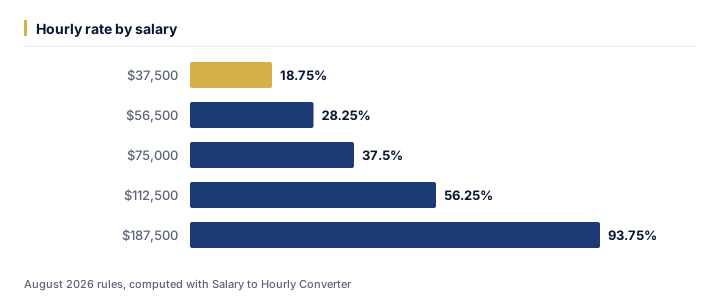
We ran 5 values of salary through the calculator and left every other input at its default. As of August 2026, the output was:
| Salary ($) | Hourly rate (%) | Monthly pay ($) | Biweekly pay ($) |
|---|---|---|---|
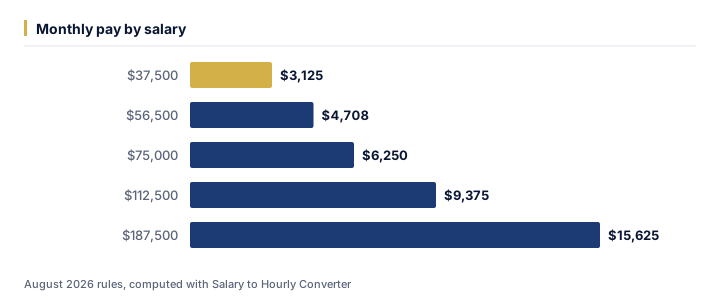
| 37,500 | 18.75% | 3,125 | 1,442.31 |
| 56,500 | 28.25% | 4,708.33 | 2,173.08 |
| 75,000 | 37.5% | 6,250 | 2,884.62 |
| 112,500 | 56.25% | 9,375 | 4,326.92 |
| 187,500 | 93.75% | 15,625 | 7,211.54 |
Running salary from $37,500 up to $187,500 moves hourly rate from 18.75% to 93.75% — a spread of 75%. That gap is the part a single headline rate never shows.
The same runs seen through monthly pay
At $37,500, monthly pay works out to $3,125; at $187,500 it is $15,625. Looking only at hourly rate tends to understate how much the outcome shifts across that range.
One example, straight from the API
The middle row above (salary = $75,000) is not a rounded illustration — it is exactly what /api/v1/tools/salary-to-hourly-converter/calculate returns for that input, August 2026 rules:
{
    "tool": "salary-to-hourly-converter",
    "inputs": {
        "salary": 75000,
        "hoursPerWeek": 40,
        "weeksPerYear": 50
    },
    "result": {
        "hourly_rate": 37.5,
        "monthly_pay": 6250,
        "biweekly_pay": 2884.62,
        "weekly_pay": 1442.31,
        "daily_pay": 300,
        "hours_per_year": 2000
    }
}
Assumptions behind these figures
| Input | Value |
|---|---|
| Salary | $75,000 |
| Hours per week | $40 |
| Weeks per year | 50 years |
| As of | August 2026 |
| Method | identical to /tools/salary-to-hourly-converter |
Rates, thresholds and typical costs change over time; the numbers above are accurate as of August 2026, not a permanent guarantee. For your own situation, open the Salary to Hourly Converter and enter your real numbers — the calculator runs the same code that produced every figure on this page.