How to Read Your Pay Stub
Most people glance at their pay stub for two numbers: the date and the amount deposited. Then they file it away. But your pay stub is the single most useful piece of paper your employer gives you — it's the proof of every deduction, the explanation for every "missing" dollar, and the document you'll need when you apply for a mortgage, dispute a tax issue, or figure out why your bonus check looked smaller than expected.
This guide walks through a sample pay stub line by line, using a consistent example: a worker earning $170,000 annually, paid biweekly, which works out to $7,083.33 per gross check (we'll use $7,083 in the math for cleanliness). By the end, you'll know exactly where every dollar of your paycheck goes.
The big picture: gross to net
Every pay stub follows the same logic:
- Gross pay — what you earned this period.
- Pre-tax deductions — subtract these first; they lower your taxable income.
- Taxes — federal, FICA (Social Security + Medicare), state, and sometimes local.
- Post-tax deductions — Roth contributions, garnishments, after-tax benefits.
- Net pay — what hits your bank account.
The stub also shows current period (this check) and year-to-date (YTD) for each line. YTD is what you've earned or paid since January 1 of the current year. It resets every January.
Let's run our $7,083 biweekly example through each section.
Section 1: Employee and pay period info
The header has the obvious stuff:
- Employee name and ID
- Pay period dates (e.g., "March 17 – March 30, 2026")
- Pay date (e.g., "April 3, 2026")
- Employer name and address
The dates matter for a couple of reasons. Pay period dates show what work the check covers. The pay date is what counts for tax-year purposes — a December 28 work week paid January 3 is in the following year's W-2. If you ever need to prove employment timing, the pay period dates are what HR and lenders care about.
Section 2: Earnings (gross pay)
This section breaks down what you earned:
| Earnings | Hours | Rate | Current | YTD |
|---|---|---|---|---|
| Regular salary | 80 | — | $6,538.46 | $39,230.76 |
| Overtime | — | — | $0.00 | $0.00 |
| Bonus | — | — | $0.00 | $0.00 |
| PTO | 8 | — | $544.87 | $1,634.61 |
| Gross total | $7,083.33 | $40,865.37 |
A few things to notice:
- Salaried workers still see "hours" — usually 80 for biweekly — even though salary doesn't actually vary with hours. It's just how payroll software is structured.
- PTO/vacation hours are typically separated out. If you took a day off, you'll see PTO hours instead of regular hours for that portion of the check.
- Bonus, commission, severance, retro pay all appear as separate line items when they apply.
YTD gross is what you've earned this calendar year. By July, our example worker has YTD gross around $85,000; by December, the full $170,000.
Section 3: Pre-tax deductions
These come off before income tax is calculated. They reduce your taxable income, which is why they save you money.
| Pre-tax deduction | Current | YTD |
|---|---|---|
| 401(k) traditional | $708.33 | $4,250.00 |
| Health insurance premium | $185.00 | $1,110.00 |
| HSA contribution | $80.00 | $480.00 |
| Dental | $25.00 | $150.00 |
| Vision | $8.00 | $48.00 |
| Pre-tax total | $1,006.33 | $6,038.00 |
In this example, the worker contributes 10% to a traditional 401(k) ($708.33 per check x 26 checks = $18,416/year). The 2026 employee 401(k) limit is $23,500 — so this worker has room to increase if they want.
Key point about 401(k) and FICA: Traditional 401(k) contributions reduce federal and state income tax, but not FICA. So that $708.33 still gets hit with Social Security and Medicare tax. HSA contributions, by contrast, reduce both income tax and FICA, making the HSA the most tax-efficient pre-tax bucket.
Pre-tax health insurance premiums also reduce FICA. That's why the line for "health insurance" on your stub typically reduces your taxable wages.
After pre-tax deductions, our worker's taxable wages this period are:
- Federal/state taxable: $7,083.33 − $1,006.33 = $6,077.00
- FICA taxable: $7,083.33 − $708.33 (401k is FICA-able) − $0 (other items reduce FICA too) = let's say $6,077.00 for simplicity, or roughly $6,785 if we strictly back out only non-FICA items.
Pay stubs label these as "federal taxable wages" and "Medicare/SS taxable wages" — and they're sometimes different numbers. If you see two different "taxable" totals, that's why.
Section 4: Taxes
This is the section most people stare at:
| Tax | Current | YTD |
|---|---|---|
| Federal income tax | $930.00 | $5,580.00 |
| Social Security (6.2%) | $420.67 | $2,524.00 |
| Medicare (1.45%) | $98.42 | $590.50 |
| State income tax (5% example) | $303.85 | $1,823.10 |
| Local tax (where applicable) | $0 | $0 |
| Tax total | $1,752.94 | $10,517.60 |
Let's break each down.
Federal income tax: Withheld based on your W-4. The $930 figure is approximate for a single filer claiming the standard deduction at this income level. Your actual withholding depends on what you put on your W-4 — if you claimed extra dependents, the number is lower; if you asked for additional withholding, it's higher. This is withholding, not your final tax bill. You true up at tax time.
Social Security (6.2%): 6.2% on wages up to the 2026 wage base of $176,100. Our worker at $170k will hit the cap late in the year, and Social Security withholding stops for the rest of the year once you cross the cap. So a December check looks bigger than a March check for high earners — that's why.
Medicare (1.45%): 1.45% on all wages, no cap. There's an additional 0.9% Additional Medicare Tax on wages above $200,000 single / $250,000 married. Our worker doesn't hit it on base salary, but a year-end bonus could push them past it.
State income tax: Varies wildly. Florida, Texas, Washington, Nevada and others = $0. New York, California, Hawaii, Oregon = 7-13%+ at this income level. The example uses 5%, roughly representative of states like Massachusetts (flat 5%) or Colorado (flat 4.4%).
Local tax: New York City, Philadelphia, parts of Ohio, Kentucky, and a handful of others impose local income tax. NYC is around 3.5-3.9% effective. Most US workers see $0 here.
Section 5: Post-tax deductions
These come out after taxes are calculated. They don't reduce taxable income.
| Post-tax deduction | Current | YTD |
|---|---|---|
| Roth 401(k) | $200.00 | $1,200.00 |
| Life insurance (supplemental) | $15.00 | $90.00 |
| Disability insurance | $22.00 | $132.00 |
| Post-tax total | $237.00 | $1,422.00 |
Common post-tax items:
- Roth 401(k) — taxes paid now, tax-free in retirement.
- Roth IRA contributions through payroll (rare; usually you set this up outside payroll).
- Supplemental life and disability — these are often paid post-tax so the benefit is tax-free if you ever claim it.
- Garnishments — child support, court-ordered debt, IRS levy. By federal law, garnishments come out after taxes.
- Stock purchase plans (ESPP) — typically post-tax contributions toward a discounted stock purchase.
Section 6: Net pay
The bottom line:
- Gross: $7,083.33
- Less pre-tax deductions: −$1,006.33
- Less taxes: −$1,752.94
- Less post-tax deductions: −$237.00
- Net pay: $4,087.06
That $4,087.06 is what hits your bank account on payday. As a fraction of gross, that's 57.7% — i.e., the worker takes home about 58 cents per gross dollar at this income level with these deductions. Move to a no-income-tax state, reduce health premium, and that climbs to 62-64%.
Want to estimate your own ratio? Take-Home Pay Calculator runs the same math with your actual deductions.
Section 7: YTD totals and accruals
The bottom of the stub usually shows:
- YTD gross, YTD taxes, YTD net — the year so far.
- Vacation/PTO balance — how many hours you have available, accrued, and used.
- Sick leave balance — same.
- Pre-tax benefits YTD — useful when you're tracking 401(k) toward the annual limit.
Check the 401(k) YTD against the 2026 limit ($23,500 employee, $31,000 with catch-up). If you'll over-contribute by year-end, ask payroll to throttle back. Over-contributions are a pain to undo at tax time.
Common confusions
"Why is my first paycheck of the year smaller?" Because Social Security withholding restarts at $0 YTD. If you hit the SS wage base in Q4 of last year and your checks got bigger, January feels like a step back.
"Why is my bonus check so much smaller than I expected?" Federal supplemental withholding on bonuses is a flat 22% (for bonuses up to $1M). Combined with FICA and state, you might see 35-40% withheld. The actual tax owed at year-end may be different — you might get money back. See Bonus Tax Calculator.
"Why don't my YTD taxes match what I'll owe?" Withholding is an estimate. Your actual tax bill at filing depends on your full return: itemized deductions, credits, other income, etc. The W-4 is a best guess.
"What is 'imputed income'?" Sometimes you'll see a line for imputed income — value of group-term life insurance over $50,000, domestic partner health coverage value, or personal use of a company car. It increases your taxable wages without giving you cash. Annoying but legal.
Save your stubs
Keep at least the last 12 months. Lenders ask for two-to-three recent stubs for any mortgage or refi. The IRS may ask if you're audited. And if you ever dispute pay with HR, the stub is your evidence.
Most modern payroll providers (ADP, Gusto, Paychex, Workday) archive stubs going back several years online — but employers sometimes change providers, and access can disappear. A PDF on your own drive is cheap insurance.
This is general guidance; specific tax treatment varies by state, locality, and individual situation. For questions about your particular withholding or whether your deductions are set up correctly, talk to your payroll department or a tax professional.
Run the numbers
Everything below came out of this site's own Salary to Hourly Converter. The figures are not quoted from anywhere else: each row is one run of the same calculation the tool page performs, using August 2026 rules. Put the same inputs in and you will get the same output.
How the result moves with salary
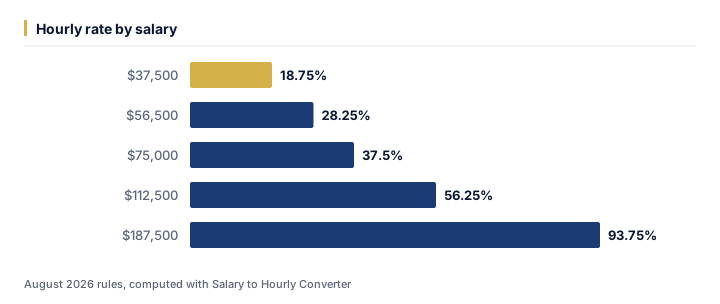
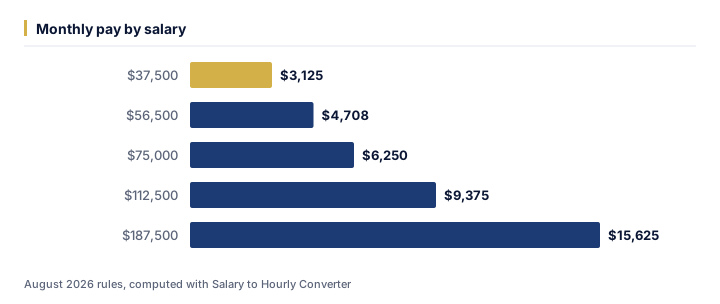
We ran 5 values of salary through the calculator and left every other input at its default. As of August 2026, the output was:
| Salary ($) | Hourly rate (%) | Monthly pay ($) | Biweekly pay ($) |
|---|---|---|---|
| 37,500 | 18.75% | 3,125 | 1,442.31 |
| 56,500 | 28.25% | 4,708.33 | 2,173.08 |
| 75,000 | 37.5% | 6,250 | 2,884.62 |
| 112,500 | 56.25% | 9,375 | 4,326.92 |
| 187,500 | 93.75% | 15,625 | 7,211.54 |
Running salary from $37,500 up to $187,500 moves hourly rate from 18.75% to 93.75% — a spread of 75%. That gap is the part a single headline rate never shows.
The same runs seen through monthly pay
At $37,500, monthly pay works out to $3,125; at $187,500 it is $15,625. Looking only at hourly rate tends to understate how much the outcome shifts across that range.
One example, straight from the API
The middle row above (salary = $75,000) is not a rounded illustration — it is exactly what /api/v1/tools/salary-to-hourly-converter/calculate returns for that input, August 2026 rules:
{
    "tool": "salary-to-hourly-converter",
    "inputs": {
        "salary": 75000,
        "hoursPerWeek": 40,
        "weeksPerYear": 50
    },
    "result": {
        "hourly_rate": 37.5,
        "monthly_pay": 6250,
        "biweekly_pay": 2884.62,
        "weekly_pay": 1442.31,
        "daily_pay": 300,
        "hours_per_year": 2000
    }
}
Assumptions behind these figures
| Input | Value |
|---|---|
| Salary | $75,000 |
| Hours per week | $40 |
| Weeks per year | 50 years |
| As of | August 2026 |
| Method | identical to /tools/salary-to-hourly-converter |
Rates, thresholds and typical costs change over time; the numbers above are accurate as of August 2026, not a permanent guarantee. For your own situation, open the Salary to Hourly Converter and enter your real numbers — the calculator runs the same code that produced every figure on this page.