How to Negotiate a Raise
Most people prepare for raise conversations the way they prepare for the dentist: by hoping it'll be over quickly. They walk into a meeting, mumble that they'd "like to talk about compensation," and accept whatever number is offered. Then they wonder why colleagues seem to make more for the same work.
The good news: negotiating a raise is a learnable skill, not a personality trait. The people who reliably get 10-20% raises aren't necessarily more aggressive — they're more prepared. They walk in with documented achievements, market data, a specific number, and a script. They also know that a 10% gross raise isn't 10% in their pocket once taxes are factored in, so they ask for the right amount in the first place.
This guide walks through a six-step framework for negotiating a raise, with example scripts and the net-of-tax math you need to make sure the ask actually matches what you want to take home.
Step 1: Document your achievements
You can't argue for more money based on how you feel. You argue based on what you delivered. Start a running document — not before the negotiation, but starting today, even if your next review is months away. Update it weekly or monthly.
What to log:
- Specific projects shipped, with dates and outcomes
- Metrics you moved — revenue, retention, conversion, latency, NPS, headcount you saved or recruited
- Cost savings or revenue generation with dollar amounts when possible
- Scope expansion — new responsibilities you've taken on since you were hired or last leveled
- Cross-functional praise — emails, Slack messages, performance reviews where peers or leaders called out specific work
- External recognition — speaking, publications, certifications, awards
The pattern you want is action → measurable outcome → business impact. Not "I worked hard on the platform rewrite," but "Led the platform rewrite that reduced p95 latency from 800ms to 220ms, which contributed to the 15% drop in checkout abandonment Q2."
When you sit down to prepare for the raise conversation, you'll have months of receipts instead of trying to remember what happened in February.
Step 2: Research the market
Without market data, your number is a guess. With market data, it's a position. Use multiple sources because each has biases:
- Levels.fyi — best for tech roles (engineering, product, design, data). Crowdsourced, but well-curated. Shows base, equity, bonus separately by company and level.
- Glassdoor — broad coverage across industries, but salary data skews lower than reality because of self-reporting bias.
- Salary.com / Payscale — useful for non-tech professional roles. Both have free comparison tools.
- BLS OEWS (Occupational Employment and Wage Statistics) — federal data, reliable, broken out by metro area. Good for a sanity check, but tends to lag the market by 6-12 months.
- LinkedIn Salary Insights — useful if you have Premium; otherwise limited.
- Talk to recruiters — even when you're not job-hunting. Take the 15-minute call. They'll tell you ranges they're seeing right now, which is fresher than any database.
- Trusted peers and former colleagues — the highest-signal source if you can ask without it being weird.
For each source, pull a range — 25th, 50th (median), 75th percentile — for your role, level, location, and years of experience. Write it down. You're looking for the realistic top of your market value, not the average.
Quick tools:
- Salary to Hourly Converter to translate between formats when comparing roles
- Take-Home Pay Calculator to model what each gross number actually puts in your pocket
Step 3: Pick the right moment
Timing matters. The same ask in two different moments can land very differently. Good moments:
- Right after a big win. You shipped something visible, closed a deal, saved the team in a crisis. Praise is fresh in everyone's mind.
- Before annual review cycles, not after. Most companies finalize comp adjustments 4-8 weeks before raises take effect. By the time your review meeting happens, budgets are often already set. Get on your manager's radar early.
- When you've taken on new responsibilities. A promotion in scope without a promotion in pay is a strong setup. "I've been doing X for the last six months and I'd like the compensation to match the scope."
- When the company is doing well. Strong quarter, recent funding round, big customer win. Money is psychologically easier to give when there's clear momentum.
- When you have leverage. A competing offer, a recruiter conversation, evidence of being underpaid relative to market. Use carefully — see Step 5.
Bad moments:
- Right after a miss or layoff round. Anxiety reduces appetite for risk, and a raise feels risky to a manager who just had to let people go.
- Right after you started. Wait at least 12-18 months to ask for a raise on your starting salary; if you negotiated badly at offer, accept it and rebuild from your first review.
- Mid-crisis or fire drill. Your manager isn't thinking about retention strategy; they're thinking about whatever just broke.
Step 4: Pick a specific number — and gross it up
Vague asks get vague responses. Specific asks force specific responses.
Start by deciding what you want to take home (net) annually. Then gross it up.
Worked example: You currently earn $130,000 (single filer, no state income tax). Your current take-home is roughly $96,000 after federal income tax, FICA, and standard pre-tax deductions. You want to take home an additional $7,000-8,000 per year (about $600/month after tax).
Naïve approach: ask for a $7,500 raise.
Reality: at $130k single, you're in the 24% federal marginal bracket. Add 7.65% FICA. That's 31.65% marginal rate. So a $7,500 gross raise nets you about $7,500 × (1 − 0.3165) = $5,125 in your pocket. Not the $7,500 you wanted.
To actually net $7,500 more per year, you need a gross raise of about $7,500 / (1 − 0.3165) = $10,975.
The general formula:
Required gross raise = (desired net raise) / (1 − marginal tax rate)
Marginal tax rate combines federal, FICA, state, and local. A few common combinations for 2026:
| Income / state | Approximate marginal rate |
|---|---|
| $80k single, TX/FL | ~30% (22% fed + 7.65% FICA) |
| $130k single, TX/FL | ~32% (24% fed + 7.65%) |
| $130k single, CA | ~41% (24% + 7.65% + 9.3% state) |
| $200k single, NYC | ~46% (32% + 7.65% + 6.5% state + 3.9% city) |
| $400k single, CA | ~54%+ (35% fed + Additional Medicare + 10.3% state) |
This is why a "10% raise" feels different in different places. A 10% gross raise in California or NYC is roughly a 5.5-6.5% real take-home bump. In Texas or Florida, it's closer to 6.8-7%. Use Raise / Promotion Calculator to model your specific situation.
Once you have your gross number, anchor 15-20% above it. If you want $11,000, ask for $13,500. The number you'll actually accept is somewhere in the middle, and starting at the floor leaves no negotiating room.
For our example, the ask becomes $143,000 ($13,000 raise, ~10% of current). The walk-away ceiling on the company side might be $141,000 ($11,000 raise). You'd land roughly where you wanted.
Step 5: Make the ask
Here's a script for the moment itself. Adapt the words to your voice, but keep the structure:
"Thanks for making time. I want to talk about my compensation. Over the past year, I've [achievement 1], [achievement 2], and [achievement 3 — pick the three biggest]. Based on what I'm seeing for [role] at [level] in [market] — looking at Levels.fyi, recruiter conversations, and BLS data — the market range for someone with my scope and outcomes is $[range from Step 2]. I'd like to bring my base salary to $[your number from Step 4]. Can we make that work?"
A few rules:
- Lead with the achievements, not the ask. You're earning the right to the conversation before you make it.
- Say a specific number. "I'd like a raise" forces them to come up with the number; you lose.
- Stop talking after you say the number. Silence is uncomfortable. Let them be the ones to break it. Do not soften, qualify, or hedge.
- Don't apologize. Not "I know this might be a lot, but..." Not "I hate to bring this up." You're a professional asking about your pay.
- Don't threaten unless you mean it. Mentioning a competing offer is only credible if you'd actually take it. Empty threats train your manager to call your bluff next time.
If you have a competing offer in hand and you're genuinely open to taking it:
"I've been approached by [Company / a recruiter] with an offer at $[X]. I'd prefer to stay if we can close the gap. Is there room for $[your number]?"
Only do this when you'd actually leave. Otherwise it backfires badly.
Step 6: Handle the response
Three possible responses, three plays.
"Yes, we can do that." Don't celebrate visibly. Say "Thank you, I appreciate it." Confirm the effective date and how it will be communicated in writing. Then, in the same conversation: "What would it take to get to [next level] in the next 12 months?" You've just normalized comp conversations; use the momentum.
"Yes, but a smaller number — how about $X?" This is the most common outcome. Two responses possible:
- Accept it gracefully if it's close. "That works. Thank you. Can we agree on what would put me in line for the original number at next review?"
- Negotiate up if there's daylight. "I appreciate the offer. Given [strongest achievement] and the market data, I think $[your number — 5%] is closer to right. Can we meet there?"
Avoid splitting the difference reflexively. If they offer $8k and you asked $13k, "meet me at $10.5k" is too obvious. Make your counter-offer with a justification, not arithmetic.
"Not right now." Don't get defensive; get information. Ask what would change the answer.
"I understand. Can you help me understand what would need to be true for that to be possible? Is it timing, budget, scope, or performance? I want to make sure I'm working toward the right things."
Listen carefully. If the answer is timing ("next quarter / next review cycle"), get a specific date and confirm in writing. If it's scope ("get to senior level first"), agree on what "senior level" requires in measurable terms. If the answer is vague or shifting, you've learned something important about whether to stay.
What "10%" really means
A few real-world net-of-tax outcomes for a $100,000 worker asking for a 10% raise:
| Location | Gross raise | Approx. marginal tax | Net raise to take-home |
|---|---|---|---|
| Texas / Florida (no state tax) | $10,000 | 30% | ~$7,000/year (~$580/mo) |
| Massachusetts (5% flat) | $10,000 | 35% | ~$6,500/year (~$540/mo) |
| California (9.3% bracket) | $10,000 | 39% | ~$6,100/year (~$510/mo) |
| New York City | $10,000 | 42% | ~$5,800/year (~$480/mo) |
This is one reason high earners often optimize for equity and bonuses alongside base salary — different tax treatment, different timing, different growth profile. But for most raises, base salary increases compound annually. A 10% raise this year becomes the baseline for next year's percentage. It's worth fighting for.
Final checklist before the meeting
- [ ] Three to five specific achievements with metrics
- [ ] Market data from at least two independent sources
- [ ] A specific gross number, calculated from a net target
- [ ] An anchor 15-20% above that number
- [ ] A script you've practiced out loud
- [ ] Knowledge of your true walk-away alternative (BATNA) — what you'll do if the answer is no
That's it. The framework doesn't guarantee a yes, but it dramatically improves your odds and ensures that when you do get a raise, it's in the right amount. These are general guidelines; for very large packages, consult a compensation advisor or financial professional, especially when equity, retention bonuses, or non-compete clauses are involved.
Run the numbers
Everything below came out of this site's own Salary to Hourly Converter. The figures are not quoted from anywhere else: each row is one run of the same calculation the tool page performs, using August 2026 rules. Put the same inputs in and you will get the same output.
How the result moves with salary
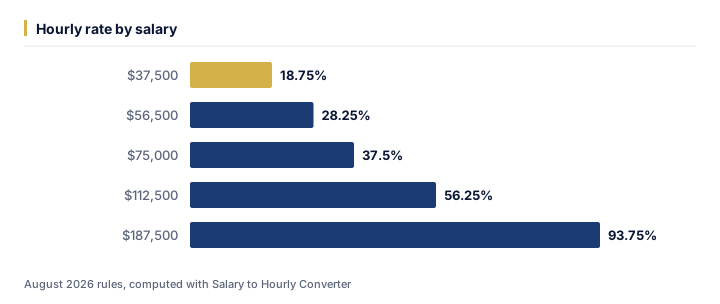
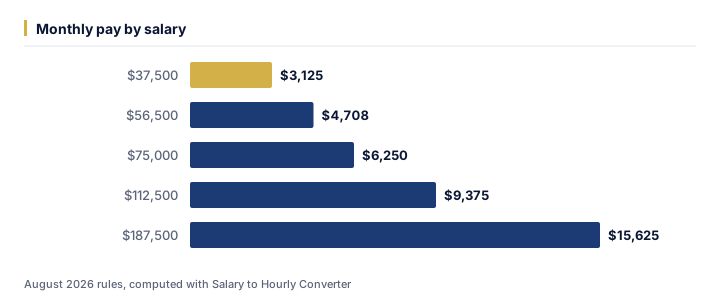
We ran 5 values of salary through the calculator and left every other input at its default. As of August 2026, the output was:
| Salary ($) | Hourly rate (%) | Monthly pay ($) | Biweekly pay ($) |
|---|---|---|---|
| 37,500 | 18.75% | 3,125 | 1,442.31 |
| 56,500 | 28.25% | 4,708.33 | 2,173.08 |
| 75,000 | 37.5% | 6,250 | 2,884.62 |
| 112,500 | 56.25% | 9,375 | 4,326.92 |
| 187,500 | 93.75% | 15,625 | 7,211.54 |
Running salary from $37,500 up to $187,500 moves hourly rate from 18.75% to 93.75% — a spread of 75%. That gap is the part a single headline rate never shows.
The same runs seen through monthly pay
At $37,500, monthly pay works out to $3,125; at $187,500 it is $15,625. Looking only at hourly rate tends to understate how much the outcome shifts across that range.
One example, straight from the API
The middle row above (salary = $75,000) is not a rounded illustration — it is exactly what /api/v1/tools/salary-to-hourly-converter/calculate returns for that input, August 2026 rules:
{
    "tool": "salary-to-hourly-converter",
    "inputs": {
        "salary": 75000,
        "hoursPerWeek": 40,
        "weeksPerYear": 50
    },
    "result": {
        "hourly_rate": 37.5,
        "monthly_pay": 6250,
        "biweekly_pay": 2884.62,
        "weekly_pay": 1442.31,
        "daily_pay": 300,
        "hours_per_year": 2000
    }
}
Assumptions behind these figures
| Input | Value |
|---|---|
| Salary | $75,000 |
| Hours per week | $40 |
| Weeks per year | 50 years |
| As of | August 2026 |
| Method | identical to /tools/salary-to-hourly-converter |
Rates, thresholds and typical costs change over time; the numbers above are accurate as of August 2026, not a permanent guarantee. For your own situation, open the Salary to Hourly Converter and enter your real numbers — the calculator runs the same code that produced every figure on this page.