How to Calculate Total Compensation
When a recruiter says "your total comp is $310,000," most people hear "salary." That's the first mistake. Base salary is one line in a stack of seven or eight pay components, and ignoring the others is how candidates leave $50,000-$100,000 on the table at every job change. This guide walks you through every bucket that belongs in total compensation, shows you how to annualize one-time payments correctly, and ends with a worked example for a senior software engineer whose $180,000 base actually delivers around $310,000 per year.
The goal isn't to inflate your sense of self-worth. It's to compare offers honestly and to know what you're really walking away from when you accept or reject.
The Eight Buckets
A complete total-comp number includes eight buckets. Some apply to every job; some only kick in at certain employers or seniority levels.
- Base salary — guaranteed annual cash
- Target bonus — annual performance bonus, expressed as a percent of base
- Sign-on bonus — one-time payment, amortized over expected tenure
- Equity — RSUs, options, or ESPP, annualized over the vesting period
- 401(k) match — employer retirement contribution
- Health and welfare benefits — medical, dental, vision, life, disability
- HSA / FSA contributions — employer contributions to tax-advantaged accounts
- PTO and other time-based benefits — vacation, sick leave, parental leave, sabbaticals
Each bucket needs to be expressed as an annual dollar figure. That's the only way to compare two offers, or to know whether a 10% raise is actually a raise.
Bucket 1: Base Salary
The easy one. Whatever appears on your offer letter as "annual salary" or "base pay" is your base. Don't include overtime, on-call pay, or commissions here — those go elsewhere.
For 2026, the federal 22% bracket starts at $47,150 for single filers. The standard deduction is $14,600 for single, $29,200 for married filing jointly, and $21,900 for head of household. These matter because base salary is taxed at ordinary income rates.
Use Take-Home Pay Calculator to convert your base into actual monthly take-home after federal, state, FICA, and benefit deductions.
Bucket 2: Target Bonus
Companies state bonuses as a percent of base: 10%, 15%, 20%, sometimes higher for sales or executive roles. Always use the target, not the maximum. Real-world payouts cluster around 80-100% of target in normal years, with downside risk in bad ones.
For a $180,000 base with a 15% target bonus:
Target bonus = $180,000 × 0.15 = $27,000
If the recruiter mentions "up to 30%," ignore the top number. Use the realistic target. Bonuses are also taxed at the supplemental withholding rate (typically 22% federal, sometimes 37% for amounts over $1 million in a single year), so model take-home with Bonus Tax Calculator.
Bucket 3: Sign-On Bonus, Amortized
Sign-on bonuses are one-time payments, often tied to a clawback if you leave within 1-2 years. To compare offers fairly, divide by your expected tenure — usually 1 year if there's a 12-month clawback, or 2 years for longer commitments.
A $30,000 sign-on amortized over one year adds $30,000 to year-one comp but $0 to year two. If you're comparing two offers and only looking at year one, you'll over-value the offer with the bigger sign-on. Always show year-one comp and steady-state comp separately.
Bucket 4: Equity, Annualized Over the Vest
This is where the biggest miscalculations happen. A "$400,000 grant" sounds enormous until you realize it vests over four years. Annualize it.
For RSUs: divide the grant value by the vesting period (typically 4 years). A $400,000 RSU grant delivers $100,000/year if the stock price holds. Stress-test with a 20% price drop. Public-company RSUs are taxed as ordinary income at vest, and your employer withholds shares automatically — use RSU Calculator to model the after-tax cash.
For stock options: the math is harder because options only have value if the strike price is below the market price at exercise. For private companies, discount heavily — a common rule is to value private-company options at 25-50% of their stated face value. Use Stock Options Calculator to model different exit scenarios.
For ESPP (Employee Stock Purchase Plan): the typical 15% discount on quarterly purchases is worth roughly 1-2% of base salary per year if you participate fully. Include it.
Bucket 5: 401(k) Match
Most US employers match between 3% and 6% of base salary into your 401(k). Some use a partial-match formula (e.g., 100% of the first 3%, then 50% of the next 2%, which caps at 4% of salary). Read the plan document.
For a $180,000 base with a 6% full match, you get $10,800/year in employer contributions — assuming you contribute enough to capture the full match. This is real money: it grows tax-deferred and belongs to you (after vesting, usually 0-4 years).
If you don't contribute enough to capture the match, you're leaving cash on the table. The IRS 401(k) employee contribution limit for 2026 is $23,500 (with a $7,500 catch-up if you're 50+), well above what's needed to capture most matches.
Bucket 6: Health and Welfare Benefits
The dollar value of employer-paid health insurance is large and consistently underestimated. Employer contributions to medical premiums typically run $6,000-$12,000/year for an individual plan and $15,000-$25,000/year for a family plan. Dental and vision add another $500-$2,000.
To find your number: look at the "employer contribution" line on your benefits enrollment summary, or ask HR. If your monthly premium is $150 and your employer covers $700, that's $8,400/year of value.
Disability insurance (short-term and long-term) plus employer-paid life insurance usually adds another $500-$1,500 in value.
Bucket 7: HSA / FSA Contributions
If your employer contributes to a Health Savings Account (HSA) on top of premiums, that's straight cash. Typical employer HSA contributions range from $500 to $2,000/year. The 2026 HSA contribution limit (employee plus employer combined) is $4,400 for individual coverage and $8,750 for family.
FSA dollars are use-it-or-lose-it and typically aren't employer-contributed, so they don't show up in total comp.
Bucket 8: PTO Value
PTO has a real dollar value: it's days you're paid not to work. The calculation is:
PTO value = (PTO days) × (base salary / 260 working days)
For a $180,000 base with 20 days PTO:
PTO value = 20 × ($180,000 / 260) = 20 × $692 = $13,846
Unlimited PTO policies are trickier. Most surveys show that employees on unlimited PTO take fewer days than those on capped plans, so value unlimited PTO at roughly 15-18 days of use, not "infinite."
Parental leave is another lump: 12-16 weeks of paid leave is worth $40,000-$60,000 at a $180,000 base, but only if you actually use it.
Worked Example: Senior Software Engineer
Let's add it up for a senior software engineer at a public tech company. The offer:
- Base: $180,000
- Target bonus: 15% → $27,000
- Sign-on: $30,000, amortized over 1 year
- RSU grant: $400,000 over 4 years → $100,000/year
- 401(k) match: 6% → $10,800
- Health insurance (employer share): $9,000
- HSA employer contribution: $1,000
- Dental/vision/life/disability: $1,200
- PTO: 20 days at $692/day → $13,846
Year-one total comp:
$180,000 base
+ $27,000 bonus
+ $30,000 sign-on
+ $100,000 RSUs
+ $10,800 401(k) match
+ $9,000 health
+ $1,000 HSA
+ $1,200 other benefits
+ $13,846 PTO
= $372,846
Steady-state (year 2+) total comp (no sign-on):
$342,846
If you exclude PTO (some people argue it's "already in the base"), steady-state lands around $329,000. The recruiter's headline "$310,000 total comp" is in the right neighborhood — but only after the sign-on rolls off.
The base salary alone, $180,000, captures less than half of what this job actually pays.
Pitfalls to Avoid
Don't double-count. If your PTO is already baked into the base salary calculation (i.e., you get paid for 52 weeks but only work 50), you shouldn't add it again. Most US salaried jobs work this way.
Don't trust "expected value" on private equity. A $500,000 stock option grant at a Series B startup is not worth $125,000/year. The expected value is dominated by the probability of exit, which most candidates wildly overestimate. A 25-50% discount is more realistic.
Don't ignore vest cliffs. Most RSU and option grants have a one-year cliff: leave before 12 months and you get nothing. Sign-on bonuses usually have 1-2 year clawbacks. Both should be factored into your tenure planning.
Don't forget state taxes. A $310,000 total comp package in Texas (no state income tax) lands very differently from the same package in California (top marginal 13.3%). Use Cost of Living Calculator to translate gross comp into purchasing power.
Putting It All Together
Build a spreadsheet with one row per bucket and one column per offer. Sum the buckets. Then run the totals through Take-Home Pay Calculator for an after-tax view, and Cost of Living Calculator for a location-adjusted view. The offer with the biggest base often isn't the offer with the biggest total comp, and the offer with the biggest total comp often isn't the best lived experience once taxes and cost of living are factored in.
Total comp is the real number. Calculate it once, every time you change jobs or negotiate a raise, and you'll never again be tricked by a recruiter dangling a shiny base salary.
Run the numbers
Everything below came out of this site's own Take-Home Pay Calculator. The figures are not quoted from anywhere else: each row is one run of the same calculation the tool page performs, using August 2026 rules. Put the same inputs in and you will get the same output.
How the result moves with salary
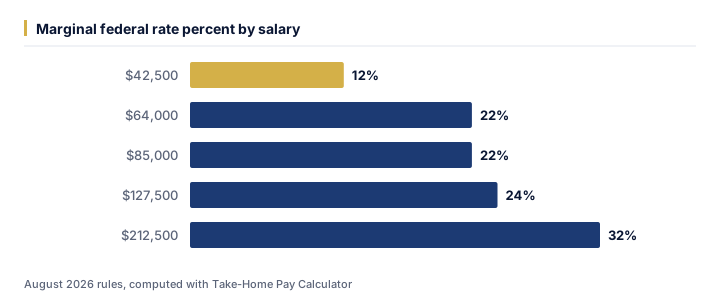
We ran 5 values of salary through the calculator and left every other input at its default. As of August 2026, the output was:
| Salary ($) | Marginal federal rate percent (%) | Effective tax rate percent (%) | Take home annual ($) |
|---|---|---|---|
| 42,500 | 12% | 17.1% | 35,245.07 |
| 64,000 | 22% | 20.4% | 50,950.64 |
| 85,000 | 22% | 24.8% | 63,897.41 |
| 127,500 | 24% | 29.7% | 89,596.16 |
| 212,500 | 32% | 33.4% | 141,456.96 |
Running salary from $42,500 up to $212,500 moves marginal federal rate percent from 12% to 32% — a spread of 20%. That gap is the part a single headline rate never shows.
The same runs seen through effective tax rate percent
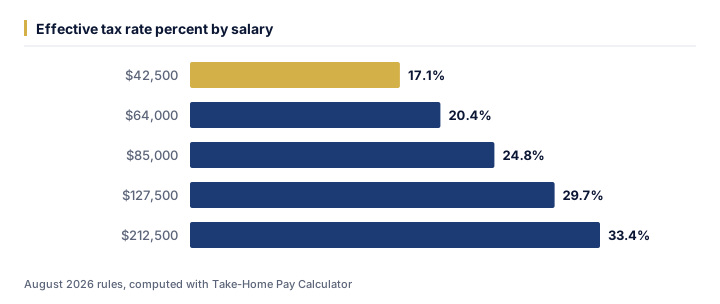
At $42,500, effective tax rate percent works out to 17.1%; at $212,500 it is 33.4%. Looking only at marginal federal rate percent tends to understate how much the outcome shifts across that range.
One example, straight from the API
The middle row above (salary = $85,000) is not a rounded illustration — it is exactly what /api/v1/tools/take-home-pay-calculator/calculate returns for that input, August 2026 rules:
{
    "tool": "take-home-pay-calculator",
    "inputs": {
        "salary": 85000,
        "filing": "single",
        "state": "CA",
        "contrib_pct": 0,
        "other_pre_tax": 0
    },
    "result": {
        "take_home_annual": 63897.41,
        "take_home_monthly": 5324.78,
        "take_home_biweekly": 2457.59,
        "federal_tax": 10541,
        "fica": 6502.5,
        "state_tax": 4059.09,
        "pretax_401k": 0,
        "federal_taxable": 70400,
        "marginal_federal_rate_percent": 22,
        "effective_tax_rate_percent": 24.8
    }
}
Assumptions behind these figures
| Input | Value |
|---|---|
| Salary | $85,000 |
| Filing | Single |
| State | Ca |
| Contrib pct | 0% |
| Other pre tax | $0 |
| As of | August 2026 |
| Method | identical to /tools/take-home-pay-calculator |
Rates, thresholds and typical costs change over time; the numbers above are accurate as of August 2026, not a permanent guarantee. For your own situation, open the Take-Home Pay Calculator and enter your real numbers — the calculator runs the same code that produced every figure on this page.