How to Calculate RSU Value at Vesting
Restricted Stock Units sound simple — your employer grants you shares that vest over time, and you own them. The math seems trivial: vested shares × stock price = your money. But that's where most employees get blindsided. The IRS treats vested RSUs as ordinary income, withholding kicks in at a rate that's often too low, and the tax bill the following April can wipe out months of savings.
This guide walks through the exact RSU math, the supplemental withholding trap that catches high earners, and what happens when you eventually sell the shares.
What an RSU Actually Is
A Restricted Stock Unit is a promise from your employer to give you company shares once a vesting condition is met — usually time-based, sometimes performance-based. You don't own anything until vesting day. There's no cost basis, no purchase decision, no choice to exercise. The shares simply appear in your brokerage account, and you owe ordinary income tax on their market value the moment they land.
This is fundamentally different from stock options. With options, you choose when to exercise and at what price. With RSUs, the IRS makes the decision for you — at vesting, at the stock's market price that day.
The Core Formula
The ordinary income generated by an RSU vesting event is:
Vested shares × Market price on vesting day = Ordinary income
That's it. There's no purchase price to subtract, because you didn't purchase anything. Your employer simply gave you shares that have a market value, and the IRS counts every dollar of that value as wages.
Example
You have 1,200 RSUs vesting on a quarterly schedule — 75 shares per vest. On the vesting date, your company's stock closes at $180.
75 shares × $180 = $13,500 in ordinary income
That $13,500 is added to your W-2 wages for the year. It's subject to federal income tax at your marginal rate, FICA (Social Security and Medicare), and state income tax if applicable.
Use RSU Calculator to model multiple vesting events across a year, including the tax drag at each vest.
The Three Taxes That Hit Every Vest
When RSUs vest, three taxes apply simultaneously:
- Federal income tax — at your marginal rate (10%, 12%, 22%, 24%, 32%, 35%, or 37% in 2026)
- FICA — 6.2% Social Security (up to the $176,100 wage base in 2026) plus 1.45% Medicare (no cap, plus 0.9% Additional Medicare tax on wages above $200,000 single / $250,000 MFJ)
- State income tax — varies; California's top rate is 13.3%, while Texas, Florida, Washington, and a few other states charge nothing
For a high earner in California with $300,000 of base wages plus RSU vests, the combined marginal rate on each vested dollar can easily exceed 45%.
The 22% Withholding Trap
Here's the part that surprises people every April.
The IRS classifies RSU income as a supplemental wage, alongside bonuses and commissions. Employers default to a flat 22% federal withholding rate on supplemental wages up to $1 million per year. Above $1 million, the rate jumps to 37%.
If your marginal tax bracket is 22% or lower, this works fine. If you're in the 24%, 32%, 35%, or 37% bracket, your employer is under-withholding — sometimes by tens of thousands of dollars.
The gap, illustrated
Suppose you earn a $250,000 base salary and have $100,000 of RSUs vesting this year. Filing single, your marginal federal rate on the RSU income is roughly 32% (after the standard deduction and remaining bracket math).
RSU income:                  $100,000
Your marginal federal rate:   32%
Actual federal tax owed:     $32,000

Employer withholding (22%):  $22,000
Federal underpayment:        $10,000
Add state tax under-withholding (your employer typically withholds at a flat state rate that may also under-shoot), and you could be staring down a $15,000+ surprise bill in April. Plus a possible underpayment penalty.
Sometimes employers withhold differently
Some employers use a "shares-withheld" method, where they keep enough vested shares to cover the 22% federal supplemental rate plus state and FICA. You receive the net shares. The shares withheld are sold by the broker, and the cash is remitted to the IRS on your behalf. The W-2 shows the gross income and the total taxes withheld.
The math is the same — you still owe at your marginal rate, and you still face the under-withholding gap if you're in a higher bracket.
How to Avoid the April Surprise
You have three tools to close the withholding gap:
-
Submit a new W-4 with extra withholding. Use Step 4(c) on Form W-4 to specify an additional federal amount per paycheck. Calculate the annual gap (RSU income × bracket difference) and divide by remaining pay periods.
-
Make estimated quarterly tax payments. Pay the difference via IRS Form 1040-ES on the quarterly deadlines (April 15, June 15, September 15, January 15). This is the cleanest approach for irregular vest amounts.
-
Sell shares immediately at vesting and set aside cash. If your employer doesn't withhold enough, sell some vested shares the same day, set aside the cash difference, and pay it as estimated tax.
The "safe harbor" rule shields you from underpayment penalties as long as you pay at least 110% of last year's total federal tax (100% if your prior year AGI was under $150,000), or 90% of this year's tax through withholding plus estimated payments. Hit one of those, and the IRS won't add a penalty even if your final balance is still high.
Run Take-Home Pay Calculator with your RSU-included gross to estimate what should be withheld and compare against your latest paystub.
Cost Basis After Vesting
Once your RSUs vest and the ordinary income tax is settled, the shares become regular stock holdings in your brokerage account. Their cost basis is the market price on the vesting day — the same price used to calculate your ordinary income.
If you sell the shares later, you'll owe capital gains tax on the difference between the sale price and the cost basis:
- Sold within 1 year of vesting → short-term capital gains (taxed as ordinary income)
- Sold more than 1 year after vesting → long-term capital gains (0%, 15%, or 20% depending on income)
Example, continued
Take the earlier vest: 75 shares at $180 = $13,500 of ordinary income. Cost basis = $180/share.
Scenario A: You sell three months later at $200.
Proceeds:    75 × $200 = $15,000
Cost basis:  75 × $180 = $13,500
Gain:        $1,500
This is a short-term capital gain, taxed at your ordinary rate.
Scenario B: You hold for 14 months and sell at $250.
Proceeds:    75 × $250 = $18,750
Cost basis:  75 × $180 = $13,500
Gain:        $5,250
This is a long-term capital gain, taxed at 0%, 15%, or 20% depending on your taxable income.
Scenario C: You hold for 14 months and the stock drops to $140.
Proceeds:    75 × $140 = $10,500
Cost basis:  75 × $180 = $13,500
Loss:        ($3,000) long-term capital loss
You can deduct up to $3,000 of net capital losses against ordinary income per year ($1,500 if married filing separately) and carry the rest forward to future years.
The Double-Tax Mistake to Avoid
This is the single most common RSU tax error: people forget that the income was already reported on their W-2, then they pay tax on the full sale proceeds again when filing capital gains.
Your broker's 1099-B usually shows the gross sale proceeds and the cost basis. For RSUs, the cost basis on Form 1099-B is sometimes reported as $0 or the original grant value, not the market price at vesting. If you don't adjust it on Form 8949, you'll over-report the gain and double-pay tax on the same dollars.
Always check the 1099-B cost basis against your own vesting-date records. Adjust on Form 8949 with code "B" if needed.
Diversification: Should You Sell at Vesting?
A separate question from the tax math is whether to hold or sell. Many financial planners suggest selling RSUs at vesting and reinvesting in a diversified portfolio. The reasoning:
- You already have salary risk concentrated in the same employer
- A vested RSU is functionally a cash bonus you immediately reinvested in your company's stock — you wouldn't take a $13,500 bonus and put all of it into a single stock, so why should the vest be different?
- Long-term capital gains treatment isn't a strong enough reason to hold if the company's stock is volatile or concentrated in your portfolio
That said, the decision is personal. Some employees believe strongly in the long-term trajectory and want concentration. The key is to decide deliberately, not by default.
For comparing equity components across offers or scenarios, Stock Options Calculator can help model option-style grants alongside RSU values.
Quick Reference
- Ordinary income at vest = shares vested × market price on vest date
- Federal withholding = 22% supplemental rate (often too low for high earners)
- FICA = 6.2% SS up to $176,100 + 1.45% Medicare + 0.9% Additional Medicare above $200k/$250k
- State tax = varies by state, applied at vest
- Cost basis after vest = market price on vest date
- Short-term cap gain = sale within 1 year of vest, taxed as ordinary income
- Long-term cap gain = sale 1+ year after vest, taxed at 0/15/20%
Final Thoughts
RSUs are excellent compensation — they're real, liquid (once vested at a public company), and they appreciate with the company's success. But they're also a tax trap if you don't plan ahead. Track every vest, know your marginal rate, close the withholding gap with estimated payments or W-4 adjustments, and adjust the cost basis when you file.
A 30-minute exercise each year — running your numbers through a calculator and updating your W-4 — can save you a five-figure surprise the following April.
This article is educational and not personal tax advice. RSU taxation has individual nuances depending on state, filing status, and employer practice. Consult a qualified CPA or financial planner for your specific situation.
Run the numbers
Everything below came out of this site's own Take-Home Pay Calculator. The figures are not quoted from anywhere else: each row is one run of the same calculation the tool page performs, using August 2026 rules. Put the same inputs in and you will get the same output.
How the result moves with salary
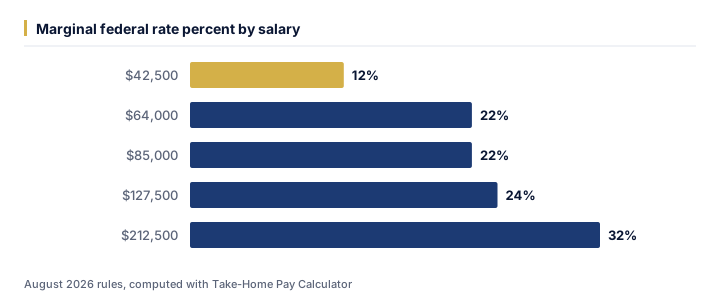
We ran 5 values of salary through the calculator and left every other input at its default. As of August 2026, the output was:
| Salary ($) | Marginal federal rate percent (%) | Effective tax rate percent (%) | Take home annual ($) |
|---|---|---|---|
| 42,500 | 12% | 17.1% | 35,245.07 |
| 64,000 | 22% | 20.4% | 50,950.64 |
| 85,000 | 22% | 24.8% | 63,897.41 |
| 127,500 | 24% | 29.7% | 89,596.16 |
| 212,500 | 32% | 33.4% | 141,456.96 |
Running salary from $42,500 up to $212,500 moves marginal federal rate percent from 12% to 32% — a spread of 20%. That gap is the part a single headline rate never shows.
The same runs seen through effective tax rate percent
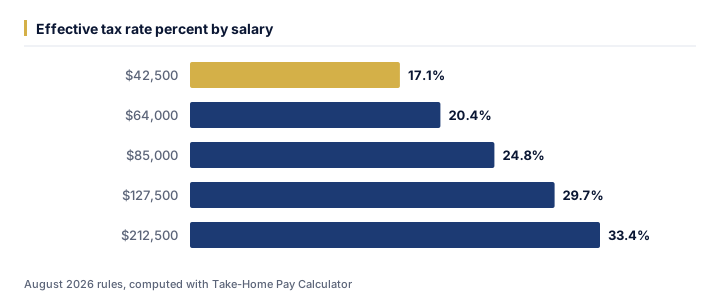
At $42,500, effective tax rate percent works out to 17.1%; at $212,500 it is 33.4%. Looking only at marginal federal rate percent tends to understate how much the outcome shifts across that range.
One example, straight from the API
The middle row above (salary = $85,000) is not a rounded illustration — it is exactly what /api/v1/tools/take-home-pay-calculator/calculate returns for that input, August 2026 rules:
{
    "tool": "take-home-pay-calculator",
    "inputs": {
        "salary": 85000,
        "filing": "single",
        "state": "CA",
        "contrib_pct": 0,
        "other_pre_tax": 0
    },
    "result": {
        "take_home_annual": 63897.41,
        "take_home_monthly": 5324.78,
        "take_home_biweekly": 2457.59,
        "federal_tax": 10541,
        "fica": 6502.5,
        "state_tax": 4059.09,
        "pretax_401k": 0,
        "federal_taxable": 70400,
        "marginal_federal_rate_percent": 22,
        "effective_tax_rate_percent": 24.8
    }
}
Assumptions behind these figures
| Input | Value |
|---|---|
| Salary | $85,000 |
| Filing | Single |
| State | Ca |
| Contrib pct | 0% |
| Other pre tax | $0 |
| As of | August 2026 |
| Method | identical to /tools/take-home-pay-calculator |
Rates, thresholds and typical costs change over time; the numbers above are accurate as of August 2026, not a permanent guarantee. For your own situation, open the Take-Home Pay Calculator and enter your real numbers — the calculator runs the same code that produced every figure on this page.