How to Compare Job Offers
You've worked hard to land two — maybe even three — competing job offers. Now comes the part most candidates do badly: comparing them. Base salary is the loudest number, so people default to it. They take the offer that pays $5,000 more on paper, then realize six months in that the commute, the health plan, or the equity vest schedule made the "lower" offer worth more.
Apples-to-apples comparison is a structured exercise. This guide walks you through the framework, the line items, and a worked two-offer example. By the end, you'll have a spreadsheet that tells you which offer actually pays better — not just which one sounds biggest.
Why Base Salary Lies
Base is the most visible number, which is exactly why companies use it as a recruiting hook. A $180,000 base with a 5% bonus, weak equity, no 401(k) match, and a $400/month health premium is worse than a $170,000 base with a 15% bonus, $40,000/year in RSUs, a 6% match, and full health coverage — by roughly $40,000/year. Most candidates miss the gap because they never line the two offers up side by side.
To compare correctly, you need to convert every component into an annualized dollar value, then adjust for taxes and cost of living. The framework has six buckets.
The 6-Bucket Framework
- Cash compensation — base salary, target bonus, sign-on
- Equity — RSUs, options, ESPP discounts
- Retirement and savings — 401(k) match, HSA contribution, ESPP value
- Benefits — health insurance, dental, vision, life, disability, FSA
- Time and flexibility — PTO, remote work, parental leave, sabbaticals
- Location adjustment — cost of living, state income tax, commute cost
Every offer can be expressed in these six buckets. Once it is, the comparison becomes math, not vibes.
Bucket 1: Cash Compensation
Add three numbers:
- Base salary — the guaranteed annual figure
- Target bonus — companies state a percentage of base (10%, 15%, 20%). Use the target, not the maximum. Real-world bonuses average around 80-100% of target for most years.
- Sign-on bonus, amortized — divide by your expected tenure (a typical sign-on amortizes over 1-2 years, since it's a one-shot payment)
For a $150,000 base with a 15% target bonus and a $20,000 sign-on amortized over two years:
Cash = $150,000 + ($150,000 × 0.15) + ($20,000 / 2)
     = $150,000 + $22,500 + $10,000
     = $182,500
Bucket 2: Equity
Equity is where most miscalculations happen. RSUs and options have very different value profiles, and the four-year vesting schedule means a $200,000 grant is really worth $50,000/year — not $200,000 in year one.
For RSUs, take the grant value and divide by the vesting period (typically four years). Adjust for a realistic stock-price assumption — most planners use the current price, but stress-test with a 20% drop.
For options, the math is harder. The grant value depends on the spread between strike price and fair market value at exercise. For private companies, assume the current 409A valuation, and discount heavily for illiquidity and risk. A common rule: private-company option grants are worth roughly 25-50% of their stated face value for comparison purposes.
Use RSU Calculator to model what RSU grants actually deliver after taxes and vesting.
Bucket 3: Retirement and Savings
The 401(k) match is real, taxable-deferred money that vanishes if you don't enroll. A 6% match on a $150,000 salary is $9,000/year. Add it directly to your total comp.
Other items to capture:
- HSA employer contribution — typically $500-$2,000/year, triple-tax-advantaged
- ESPP — most plans offer a 15% discount with a six-month lookback. For an employee maxing out ($25,000/year), that's roughly $3,750 in guaranteed annual value
- Pension or profit sharing — rare outside of finance and law, but valuable when present
Bucket 4: Benefits
Health insurance is the single largest non-cash benefit, and it varies dramatically by employer. To compare, calculate the premium delta between offers:
Employer A: $400/month premium = $4,800/year out of pocket
Employer B: $50/month premium = $600/year out of pocket
Delta: $4,200/year in Employer B's favor (pre-tax dollars, so real net effect is even higher)
For coverage quality, compare deductibles, out-of-pocket maximums, and network breadth. A "cheap" plan with a $7,000 deductible can cost more than a "pricier" plan with a $1,500 deductible in any year you actually use it.
Other benefits to itemize: dental, vision, employer-paid life insurance, short- and long-term disability, FSA contributions, commuter benefits, gym stipends, wellness reimbursements.
Bucket 5: Time and Flexibility
Time is money, literally. Calculate your daily rate (annual base / 250 working days) and multiply by the difference in PTO days between offers.
For a $150,000 base, your daily rate is $600. An offer with 25 PTO days vs. an offer with 15 days is worth $6,000/year more in time value alone.
Other items in this bucket:
- Parental leave — Companies range from 6 weeks unpaid to 6 months fully paid. If you might have kids in the next few years, this is enormous.
- Remote work — Saving 1 hour of commute per day equals roughly 250 hours/year, or six work weeks of your life back.
- Flexible schedule — Hard to monetize, but real.
- Sabbatical eligibility — Some firms offer 4-6 week paid sabbaticals after 4-5 years.
Bucket 6: Location Adjustment
A $180,000 salary in San Francisco isn't a $180,000 salary in Austin. The cost-of-living adjustment can swing $30,000-$50,000 in real purchasing power.
Use Cost of Living Calculator to translate one city's salary into another's. As a rough mental model:
- San Francisco, NYC = baseline 100
- Seattle, Boston, DC = 75-85
- Austin, Denver, Atlanta = 60-70
- Most mid-sized metros = 50-60
State income tax matters too. Moving from California (top marginal 13.3%) to Texas (no state income tax) on a $200,000 salary can put $15,000+ back in your pocket.
Worked Example: Two Offers Compared
Let's walk through a realistic comparison for a mid-career product manager.
Offer A: Big Tech, Seattle
- Base: $185,000
- Target bonus: 15% ($27,750)
- Sign-on: $30,000 (amortized over 2 years = $15,000/yr)
- RSUs: $240,000 over 4 years = $60,000/yr
- 401(k) match: 6% = $11,100
- Health premium: $80/month = $960/yr
- PTO: 20 days
- Remote: 2 days/week
- COL index: 80
Offer B: Mid-size SaaS, Austin
- Base: $165,000
- Target bonus: 20% ($33,000)
- Sign-on: $15,000 (amortized over 2 years = $7,500/yr)
- RSUs: $80,000 over 4 years = $20,000/yr
- 401(k) match: 4% = $6,600
- Health premium: $200/month = $2,400/yr
- PTO: 25 days
- Remote: full remote
- COL index: 65
Step 1: Calculate gross total comp
Offer A: $185,000 + $27,750 + $15,000 + $60,000 + $11,100 = $298,850
Offer B: $165,000 + $33,000 + $7,500 + $20,000 + $6,600 = $232,100
Offer A leads by $66,750.
Step 2: Apply benefits delta
Offer A health: -$960
Offer B health: -$2,400
Net benefit delta: Offer A +$1,440
Step 3: Apply time value
PTO delta: 5 extra days in Offer B × daily rate ($660) = $3,300 in B's favor
Commute savings: Offer B saves 3 days/week × 1hr × $66/hr × 50 weeks = $9,900 in B's favor
Step 4: Apply location adjustment
A $232,100 package in Austin (COL 65) buys roughly the same lifestyle as $232,100 × (80/65) = $285,660 in Seattle terms.
Final Comparison (Seattle-equivalent dollars)
| Component | Offer A (Seattle) | Offer B (Austin, normalized) |
|---|---|---|
| Total comp | $298,850 | $285,660 |
| Benefits delta | +$1,440 | $0 |
| PTO value | $0 | +$3,300 |
| Commute value | $0 | +$9,900 |
| Adjusted total | $300,290 | $298,860 |
The offers are nearly identical in adjusted economic value. From here, decide on growth potential, manager quality, team strength, and personal life factors. The financial dimension is close enough that culture and trajectory should decide.
Use Take-Home Pay to Sanity-Check
Total comp is the ceiling, but what hits your bank account matters more day-to-day. Federal and state withholding, FICA, and benefit deductions can shift the picture by 25-35%. Run each base salary through Take-Home Pay Calculator to see the actual paycheck difference.
Build Your Own Comparison Sheet
For your own comparison:
- List every line item in all six buckets for each offer
- Annualize one-time payments (sign-on, relocation)
- Annualize multi-year items (equity over the vest period)
- Apply the cost-of-living adjustment to make geographies comparable
- Compute time-and-flexibility deltas in dollar terms
- Stress-test equity assumptions with a 20% downside scenario
A spreadsheet with rows for each line item and columns for each offer will tell you the truth that a recruiter pitch never will.
Final Thoughts
The best offer isn't always the biggest. It's the one that maximizes your total economic and personal value for the next several years of your life. Use the framework, do the math, and trust the numbers — not the headline.
This article is educational and not a substitute for personalized financial or career advice. For complex equity packages or tax situations, consult a qualified financial planner or CPA.
Run the numbers
Everything below came out of this site's own Take-Home Pay Calculator. The figures are not quoted from anywhere else: each row is one run of the same calculation the tool page performs, using August 2026 rules. Put the same inputs in and you will get the same output.
How the result moves with salary
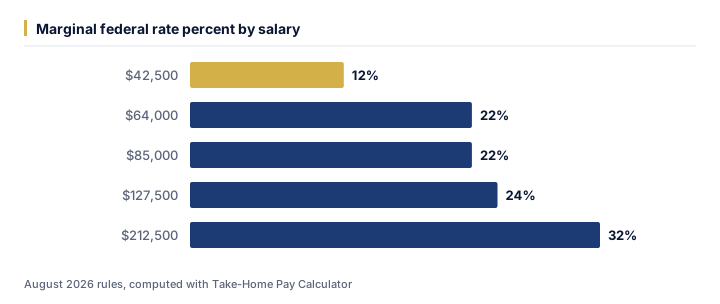
We ran 5 values of salary through the calculator and left every other input at its default. As of August 2026, the output was:
| Salary ($) | Marginal federal rate percent (%) | Effective tax rate percent (%) | Take home annual ($) |
|---|---|---|---|
| 42,500 | 12% | 17.1% | 35,245.07 |
| 64,000 | 22% | 20.4% | 50,950.64 |
| 85,000 | 22% | 24.8% | 63,897.41 |
| 127,500 | 24% | 29.7% | 89,596.16 |
| 212,500 | 32% | 33.4% | 141,456.96 |
Running salary from $42,500 up to $212,500 moves marginal federal rate percent from 12% to 32% — a spread of 20%. That gap is the part a single headline rate never shows.
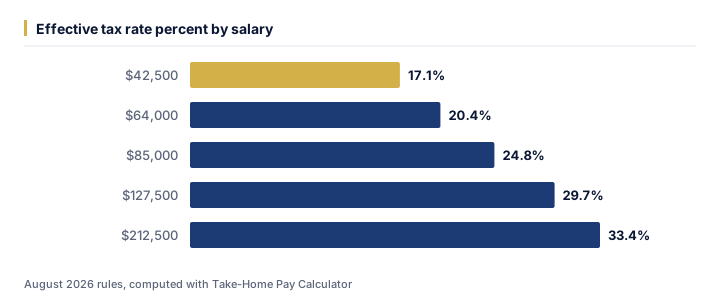
The same runs seen through effective tax rate percent
At $42,500, effective tax rate percent works out to 17.1%; at $212,500 it is 33.4%. Looking only at marginal federal rate percent tends to understate how much the outcome shifts across that range.
One example, straight from the API
The middle row above (salary = $85,000) is not a rounded illustration — it is exactly what /api/v1/tools/take-home-pay-calculator/calculate returns for that input, August 2026 rules:
{
    "tool": "take-home-pay-calculator",
    "inputs": {
        "salary": 85000,
        "filing": "single",
        "state": "CA",
        "contrib_pct": 0,
        "other_pre_tax": 0
    },
    "result": {
        "take_home_annual": 63897.41,
        "take_home_monthly": 5324.78,
        "take_home_biweekly": 2457.59,
        "federal_tax": 10541,
        "fica": 6502.5,
        "state_tax": 4059.09,
        "pretax_401k": 0,
        "federal_taxable": 70400,
        "marginal_federal_rate_percent": 22,
        "effective_tax_rate_percent": 24.8
    }
}
Assumptions behind these figures
| Input | Value |
|---|---|
| Salary | $85,000 |
| Filing | Single |
| State | Ca |
| Contrib pct | 0% |
| Other pre tax | $0 |
| As of | August 2026 |
| Method | identical to /tools/take-home-pay-calculator |
Rates, thresholds and typical costs change over time; the numbers above are accurate as of August 2026, not a permanent guarantee. For your own situation, open the Take-Home Pay Calculator and enter your real numbers — the calculator runs the same code that produced every figure on this page.