How to Calculate Your Real Hourly Wage
Take your annual salary, divide by 2,080 hours, and you have your hourly rate. That is the math most people do once, write down, and quote forever. It is also wrong — or at least incomplete enough to be misleading. The number that actually matters is what your time earns after you subtract everything you spend to do the job and add back the hours you work but never log.
For most salaried workers, the honest figure is 30% to 40% lower than the headline rate. Knowing the real number changes how you think about overtime, side gigs, commute decisions, and whether that promotion is worth what it costs you.
The naive formula and why it lies
The standard back-of-envelope calculation looks like this:
Annual salary ÷ 2,080 hours = hourly rate
A $90,000 salary divided by 2,080 gives you $43.27/hour. Clean. Memorable. And it assumes:
- You work exactly 40 hours per week, 52 weeks per year.
- All of those hours happen at your desk, in your office, during paid time.
- The salary is the only thing the job costs or pays.
- The salary is what hits your bank account.
Every one of those assumptions is wrong for most people. The math needs to account for time you do not get paid for and money you spend or lose because of the job.
If you want the quick version of just the headline math first, run Salary to Hourly Converter — that is the starting point. Everything below is what you do to that number to make it honest.
Step 1: Count the hours you actually work
The 2,080 figure assumes 40-hour weeks. Salaried professionals routinely log 45 to 55 hours including:
- Evening and weekend email. Twenty minutes a night, five nights a week, is almost two extra hours.
- "Quick" Slack threads after hours. Three messages at 9 p.m. is still mental labor.
- Meetings that bleed past 5 p.m. Especially the 4:30 p.m. "ten-minute sync."
- Travel that is not billed as work. Sunday-evening flights to client sites count.
- The mental-load tax. Drafting tomorrow's deck in your head during dinner is real cognitive work, even if it never shows up on a timesheet.
Be ruthlessly honest. Track a typical week. If your real total is 48 hours, your year is 48 × 50 working weeks = 2,400 hours, not 2,080. (Use 50 weeks rather than 52 to account for two weeks of PTO actually being off.)
That alone moves a $90,000 salary from $43.27/hour to $37.50/hour — a 13% cut before any expenses.
Step 2: Add commute and "getting ready" time
Your commute is unpaid time that exists only because of the job. The same goes for ironing the shirt, packing lunch, the morning coffee-shop stop, and the decompression drive home where you replay the bad meeting.
Conservative add-back:
| Activity | Daily minutes | Annual hours (240 work days) |
|---|---|---|
| Commute (round trip, 35 min) | 70 | 280 |
| Prep — shower, dress, pack | 20 | 80 |
| Mental decompression after work | 15 | 60 |
| Total | 105 / day | 420 / year |
Now your $90,000 buys 2,400 + 420 = 2,820 hours of your life. Hourly rate: $31.91.
A remote worker can skip most of this, which is exactly why remote roles often pay less without making people poorer per hour.
Step 3: Subtract job-related expenses
Money you spend to keep the job is money the job is not actually paying you. Tally yours honestly:
- Wardrobe. Suits, dry cleaning, replacement shoes, that one client-meeting blazer you never wear otherwise.
- Transportation. Gas, parking, transit pass, vehicle wear, or a higher car payment than you would otherwise carry.
- Meals out. The lunches you buy because there is no time to pack. The Friday team dinners. The airport food on travel days.
- Childcare during work hours. This one alone often dominates the math for parents of small kids.
- Home office. The portion of your phone bill, internet, and electricity that exists because of the job, especially if you work hybrid.
- Continuing education. Certifications, license renewals, conferences not reimbursed.
A realistic mid-career number sits between $4,000 and $15,000 per year. For a parent of two in daycare while both adults work, the daycare line alone can run $25,000+. If your job-attributable expenses are $8,000, you are effectively earning $90,000 − $8,000 = $82,000.
Hourly rate now: $82,000 ÷ 2,820 = $29.08.
Step 4: Subtract taxes (the part you actually keep)
The salary on your offer letter is not what hits your account. Federal income tax, FICA (Social Security at 6.2% up to the $176,100 wage base and Medicare at 1.45%), state tax in most states, and city tax in a handful of places all come out first.
A single filer earning $90,000 in 2026 pays roughly:
- FICA: 7.65% × $90,000 = $6,885
- Federal income tax: After the $14,600 standard deduction, taxable income is $75,400. That lands in the 22% bracket (which starts at $47,150 for single filers), giving roughly $11,800 of federal tax.
- State tax: Highly variable. Zero in TX, FL, WA, NV, TN; 5% to 9% in CA, NY, NJ, OR.
Take-home runs roughly $65,000 to $70,000 depending on state. Use Take-Home Pay Calculator for your exact figure.
If your take-home is $67,000:
$67,000 − $8,000 expenses = $59,000 net contribution to your life.
$59,000 ÷ 2,820 hours = $20.92/hour.
That is a 51% cut from the headline $43.27. And for many people, this is the real hourly wage.
Step 5: Add back the value of benefits
To be fair to the salary, you need to credit benefits the job provides that you would otherwise pay for yourself. The big four:
- Employer 401(k) match. A 4% match on $90,000 is $3,600/year of real retirement contribution you did not pay for.
- Health insurance. The employer share of a family plan can be $15,000 to $25,000/year. For a single plan, $5,000 to $8,000.
- Paid time off. Your two weeks of PTO are part of your compensation. If you took unpaid leave for that time, you would forfeit roughly $3,500.
- Disability and life insurance. Easy to overlook. Market value maybe $500 to $1,500/year for combined coverage.
A reasonable benefits add-back for a single employee with employer health coverage and a 4% 401(k) match is $10,000 to $12,000/year. For a parent on a family health plan, $20,000+.
Add $11,000 in benefit value to the $59,000 net: $70,000 effective compensation.
$70,000 ÷ 2,820 hours = $24.82/hour.
The full formula
$$ \text{Real hourly} = \frac{(\text{Take-home pay}) - (\text{Job-related expenses}) + (\text{Benefit value})}{(\text{Hours worked}) + (\text{Commute and prep time})} $$
Run the same arithmetic for any offer and you can compare jobs apples-to-apples — which is much harder when one role pays $85,000 with a 15-minute walking commute and the other pays $105,000 with a two-hour daily train ride.
What the real number is good for
Knowing your real hourly rate changes specific decisions:
- Side work and freelancing. If your real hourly is $25, then taking a $75/hour freelance project is genuinely three times your day-job rate. (And if you are pricing your own freelance work, run it through Freelance Rate Calculator — freelancers need to clear a much higher gross hourly to net what an employee does because they pay both halves of FICA and self-fund benefits.)
- Buying time back. A $30 meal-kit delivery that saves 90 minutes is worth it if your real hourly is $25+. Hiring a $40 lawn service for what would take you three hours is the same math.
- Commute decisions. Adding 30 minutes each direction to a commute costs you roughly 240 hours/year. At $25/hour, that is $6,000 of your life. The "$10,000 raise" for the further job is actually $4,000.
- Promotion decisions. A promotion with a $15,000 raise that adds eight hours a week of work adds about 400 hours/year. $15,000 ÷ 400 = $37.50/hour for the marginal time. Compare to your existing rate.
- Saying no. The volunteer board seat, the "quick favor," the side project — all priced in hours of your life. Knowing the rate makes the cost visible.
A few caveats
The real-hourly-wage calculation is a tool, not a verdict. Three things worth keeping in mind:
- Not all hours are equal. Sixty hours of work you love is not 60 hours of work you dread. The number does not capture that.
- Careers are nonlinear. A first job that pays a terrible real hourly may set you up for a $200,000 role four years later. The arithmetic of any single year misses the compounding.
- Benefits have option value. Health insurance is worth a lot more the year you need it. Counting only its average cost understates it.
But for honest comparison shopping — between offers, between freelance projects, between "is this overtime worth it?" — the real hourly is the number to use. The headline $43/hour might feel good. The honest $25/hour helps you make better calls.
Run the numbers
Everything below came out of this site's own Salary to Hourly Converter. The figures are not quoted from anywhere else: each row is one run of the same calculation the tool page performs, using August 2026 rules. Put the same inputs in and you will get the same output.
How the result moves with salary
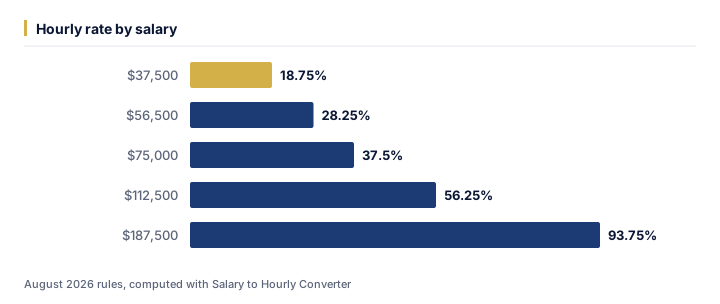
We ran 5 values of salary through the calculator and left every other input at its default. As of August 2026, the output was:
| Salary ($) | Hourly rate (%) | Monthly pay ($) | Biweekly pay ($) |
|---|---|---|---|
| 37,500 | 18.75% | 3,125 | 1,442.31 |
| 56,500 | 28.25% | 4,708.33 | 2,173.08 |
| 75,000 | 37.5% | 6,250 | 2,884.62 |
| 112,500 | 56.25% | 9,375 | 4,326.92 |
| 187,500 | 93.75% | 15,625 | 7,211.54 |
Running salary from $37,500 up to $187,500 moves hourly rate from 18.75% to 93.75% — a spread of 75%. That gap is the part a single headline rate never shows.
The same runs seen through monthly pay
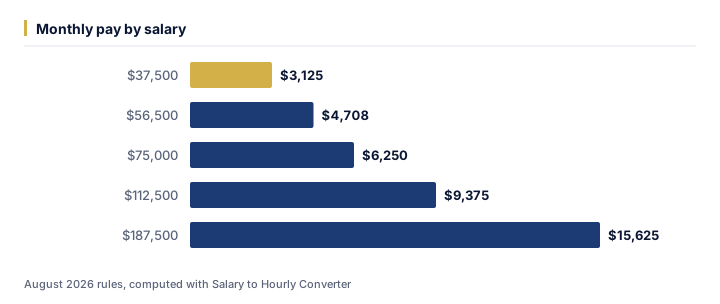
At $37,500, monthly pay works out to $3,125; at $187,500 it is $15,625. Looking only at hourly rate tends to understate how much the outcome shifts across that range.
One example, straight from the API
The middle row above (salary = $75,000) is not a rounded illustration — it is exactly what /api/v1/tools/salary-to-hourly-converter/calculate returns for that input, August 2026 rules:
{
    "tool": "salary-to-hourly-converter",
    "inputs": {
        "salary": 75000,
        "hoursPerWeek": 40,
        "weeksPerYear": 50
    },
    "result": {
        "hourly_rate": 37.5,
        "monthly_pay": 6250,
        "biweekly_pay": 2884.62,
        "weekly_pay": 1442.31,
        "daily_pay": 300,
        "hours_per_year": 2000
    }
}
Assumptions behind these figures
| Input | Value |
|---|---|
| Salary | $75,000 |
| Hours per week | $40 |
| Weeks per year | 50 years |
| As of | August 2026 |
| Method | identical to /tools/salary-to-hourly-converter |
Rates, thresholds and typical costs change over time; the numbers above are accurate as of August 2026, not a permanent guarantee. For your own situation, open the Salary to Hourly Converter and enter your real numbers — the calculator runs the same code that produced every figure on this page.