How to Calculate Your Hourly Rate From Salary
Someone asks what you make, and instead of saying "$75,000," you say "about $36 an hour." That's a clean translation — and it's also wrong, depending on what you actually want to know.
There are three ways to convert an annual salary into an hourly rate, and they give meaningfully different numbers. A $75,000 salary can honestly be $36/hour, $37.50/hour, or $25/hour. None of those is wrong; they answer different questions.
This guide explains the three formulas, when to use each one, and why the answer matters more than it sounds when you're comparing offers, considering freelance work, or trying to figure out if a side project is worth your time.
The three formulas at a glance
| Method | Formula | Example: $75,000 salary | Best for |
|---|---|---|---|
| Quick (2,080-hour year) | Salary ÷ 2,080 | $36.06/hour | Benchmark; converting offers |
| Careful (working weeks) | Salary ÷ (40 × 50) | $37.50/hour | Accounting for 2 weeks PTO |
| Honest (real hours) | Salary ÷ actual hours worked | $25-32/hour typical | Reality check, freelance pricing |
The differences look small percentage-wise, but they compound into real money over a career.
Method 1: The 2,080-hour formula
The most common conversion is simply:
Salary ÷ 2,080 = Hourly rate
Where does 2,080 come from? It's 40 hours per week × 52 weeks per year. This is the federal government's standard for converting between salary and hourly. The Office of Personnel Management uses it; most employers use it; most online salary-to-hourly tools (including Salary to Hourly Converter) use it as the default.
When to use it:
- Comparing two salaried jobs against each other
- Comparing a salary offer to an hourly rate offer at a "standard" 40-hour expectation
- Quick public benchmark conversions
Why it can mislead: 2,080 hours implies you work every single calendar week, including holidays. In reality, most salaried employees get 8-10 federal holidays, plus PTO, plus sick days. You're being paid the same salary for fewer worked hours than 2,080.
For benchmark purposes, this is fine — everyone uses the same denominator, so apples-to-apples comparisons hold. For valuing your actual hourly worth, it under-counts.
Method 2: The working-weeks formula
If you assume two weeks of vacation per year (a common minimum in the US), the formula becomes:
Salary ÷ (40 × 50) = Salary ÷ 2,000
A $75,000 salary works out to $37.50/hour by this method. The 4% difference from the 2,080 method ($36.06 vs $37.50) reflects the fact that you're getting paid for those two weeks of vacation while not actually working.
If you get more PTO — say, three weeks plus federal holidays — the worked weeks drop further:
- 3 weeks PTO + 10 federal holidays = ~47 worked weeks → $75,000 ÷ 1,880 = $39.89/hour
- 4 weeks PTO + 10 federal holidays = ~46 worked weeks → $75,000 ÷ 1,840 = $40.76/hour
When to use it:
- Comparing your salary against a freelance/contract offer (because freelancers don't get paid time off, so they need a higher hourly to match)
- Understanding what your time off is worth in dollars
- Calculating the per-hour value of additional PTO when negotiating
The PTO-value insight: If your hourly rate by Method 2 is $40 and you negotiate one extra week of PTO, you're effectively giving yourself a $1,600 raise (40 hours × $40), tax-free in the sense that PTO isn't a separate taxable event.
Method 3: The honest (or "real billable") rate
The third formula is the one most people refuse to do because the answer is depressing:
Salary ÷ actual hours worked in a year = Honest hourly rate
For a 40-hour-per-week salaried employee with two weeks of PTO and no overtime, this matches Method 2. But that profile is rare. The honest formula matters most for:
- Salaried roles with heavy unpaid overtime ("we expect 50-60 hours during sprints")
- Roles with mandatory after-hours work (on-call, weekend deploys)
- "Exempt" roles where the labor laws don't require overtime pay
If you work 50 hours per week, 50 weeks a year (2,500 hours), and earn $75,000 salary, your real hourly rate is $30, not $36. The 25-30% premium your employer thinks they're paying for that "senior" title is being eaten by the unpaid overtime.
Stories where this matters:
- The 60-hour-per-week startup associate: $100k salary, 3,000 actual hours worked → $33/hour. A "$100k senior role" turns out to pay below a $25/hour barista job, with worse benefits and zero overtime protection.
- The on-call SRE: $150k salary, but a 1-in-4 on-call rotation that adds 30 hours per week of low-grade alertness for a quarter of the year. Effective hours: 2,400-2,600 → $58-63/hour, before you account for the sleep deprivation.
When to use the honest formula:
- Before accepting a salaried offer where you suspect 50+ hour weeks
- Comparing two roles where one has aggressive overtime expectations
- Deciding whether to take a contract gig instead of a W-2 (you'll need it for Freelance Rate Calculator anyway)
- Negotiating with yourself about whether to quit
The honest formula is also useful in reverse. If you're a freelancer or consultant, comparing your hourly rate to a salary equivalent helps with client conversations: "$150/hour sounds expensive, but I work 1,200 billable hours a year, so I'm grossing $180,000 — which is a $130,000 W-2 equivalent after the self-employment tax and benefits I'm covering myself."
Worked examples
Example 1: comparing a W-2 offer to a contract gig
You have a $90,000 W-2 offer with 15 days PTO + 10 federal holidays, and a freelance project that pays $55/hour.
- 2,080 method (W-2): $90,000 ÷ 2,080 = $43.27/hour
- Working-weeks method (W-2): 15 days PTO + 10 holidays = 25 days off = 5 weeks. 47 worked weeks × 40 hours = 1,880 hours. $90,000 ÷ 1,880 = $47.87/hour
The freelance gig at $55/hour seems obviously better. But you're not done — you have to gross up for self-employment tax (an additional 15.3% on net earnings) and the benefits the W-2 was covering (health insurance, paid time off, retirement match). After those adjustments, $55/hour as a 1099 contractor is often worse than $43-48/hour W-2. Use Hourly to Annual Salary Converter in reverse and compare.
Example 2: deciding if a raise is worth more hours
You're offered a promotion: $85k → $105k, but with expected weekly hours moving from 45 to 55.
- Old role honest rate: $85,000 ÷ (45 × 50) = $37.78/hour
- New role honest rate: $105,000 ÷ (55 × 50) = $38.18/hour
The promotion is a $20k raise on paper, but the honest hourly rate barely moves. You're being paid more by working more, not by being more valuable per hour. Whether that's worth it depends on your career goals, but it's not the obvious win the salary numbers suggest.
Which formula should you use?
A useful default:
- For public benchmarks and clean comparisons between salaried roles, use 2,080.
- For comparing W-2 versus contract work, or for valuing PTO, use working weeks (2,000 or lower).
- For your own internal sanity check — "what am I actually earning per hour of my life?" — use honest hours.
The most important habit: when someone gives you an hourly conversion, ask which method they used. The answer reveals what they're trying to communicate. Recruiters quote the 2,080 method because it makes salaries look bigger per hour. Freelancers selling rates quote the honest method because it justifies higher numbers. Both are right; they're just answering different questions.
A note on overtime-exempt status
In the US, the Fair Labor Standards Act exempts salaried employees from overtime pay if they meet certain salary and duty tests. The 2026 federal salary threshold for the exemption is in the high $30k range, and it can be higher in states like California ($66,560+ for executives), New York, and Washington.
If you're a non-exempt salaried employee (your salary is below the threshold or you fail the duties test), your employer owes you 1.5× your hourly rate for hours over 40 per week. In that case, the 2,080-hour formula is what's used to determine your hourly base.
If you're exempt, you can work 60 hours a week and earn no overtime, which is exactly the scenario that makes the honest formula essential for self-awareness.
The bottom line
A salary number, by itself, is incomplete. Asking "what's my hourly rate?" is a way of forcing the conversation into per-hour terms, where the trade-offs become clearer. The three formulas are tools for three different conversations:
- 2,080: "How does my pay compare to other people's?"
- Working weeks: "What's my hour of work actually worth, given my PTO?"
- Honest: "What am I really being paid, given how I actually spend my time?"
Once you've internalized that the same salary can be three different hourly rates, you'll catch yourself a lot earlier the next time you're tempted to take a "raise" that's really just a request for more hours.
Run the numbers
Everything below came out of this site's own Salary to Hourly Converter. The figures are not quoted from anywhere else: each row is one run of the same calculation the tool page performs, using August 2026 rules. Put the same inputs in and you will get the same output.
How the result moves with salary
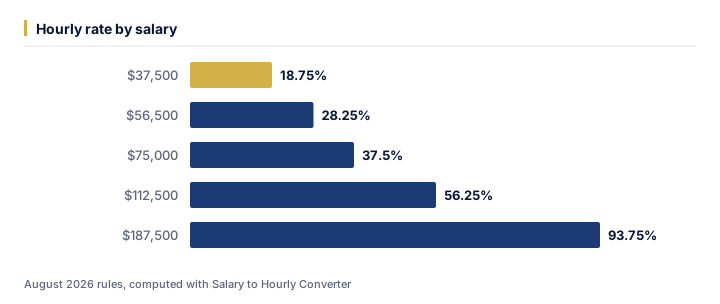
We ran 5 values of salary through the calculator and left every other input at its default. As of August 2026, the output was:
| Salary ($) | Hourly rate (%) | Monthly pay ($) | Biweekly pay ($) |
|---|---|---|---|
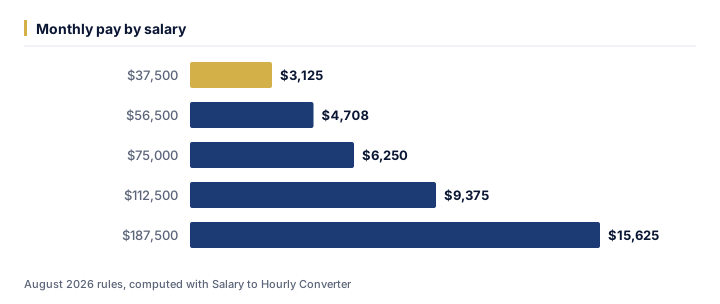
| 37,500 | 18.75% | 3,125 | 1,442.31 |
| 56,500 | 28.25% | 4,708.33 | 2,173.08 |
| 75,000 | 37.5% | 6,250 | 2,884.62 |
| 112,500 | 56.25% | 9,375 | 4,326.92 |
| 187,500 | 93.75% | 15,625 | 7,211.54 |
Running salary from $37,500 up to $187,500 moves hourly rate from 18.75% to 93.75% — a spread of 75%. That gap is the part a single headline rate never shows.
The same runs seen through monthly pay
At $37,500, monthly pay works out to $3,125; at $187,500 it is $15,625. Looking only at hourly rate tends to understate how much the outcome shifts across that range.
One example, straight from the API
The middle row above (salary = $75,000) is not a rounded illustration — it is exactly what /api/v1/tools/salary-to-hourly-converter/calculate returns for that input, August 2026 rules:
{
    "tool": "salary-to-hourly-converter",
    "inputs": {
        "salary": 75000,
        "hoursPerWeek": 40,
        "weeksPerYear": 50
    },
    "result": {
        "hourly_rate": 37.5,
        "monthly_pay": 6250,
        "biweekly_pay": 2884.62,
        "weekly_pay": 1442.31,
        "daily_pay": 300,
        "hours_per_year": 2000
    }
}
Assumptions behind these figures
| Input | Value |
|---|---|
| Salary | $75,000 |
| Hours per week | $40 |
| Weeks per year | 50 years |
| As of | August 2026 |
| Method | identical to /tools/salary-to-hourly-converter |
Rates, thresholds and typical costs change over time; the numbers above are accurate as of August 2026, not a permanent guarantee. For your own situation, open the Salary to Hourly Converter and enter your real numbers — the calculator runs the same code that produced every figure on this page.