How to Calculate Freelance Rates
The single biggest mistake new freelancers make is pricing their work based on what they used to earn as an employee. They divide a $100,000 salary by 2,080 hours, get $48/hour, and quote it to clients. Six months later, they're broke, exhausted, and confused — they "matched their old salary" on paper but somehow can't pay the bills.
The reason is that freelance rates have to cover things that an employee salary never had to: self-employment tax, business expenses, unpaid hours, health insurance, retirement contributions you used to make pre-tax through payroll, and gaps between projects. Skip the math and you'll under-charge by 40-60%.
This guide reverses the equation. Instead of starting from an hourly rate and seeing what you make, we'll start from a target take-home income and work backwards to the rate you actually need.
The four steps
- Pick a target net (take-home) income. What do you actually need to deposit in your account each year?
- Gross it up for taxes. Self-employment tax is the big surprise; plan for 30-35% total effective rate at modest incomes, higher at $200k+.
- Add business expenses. Software, hardware, health insurance, retirement contributions, professional services, marketing.
- Divide by realistic billable hours. Not 2,080. Closer to 1,000-1,500 for most freelancers.
The output often shocks people. A freelancer who wants the rough equivalent of a $100k W-2 lifestyle commonly needs $125-175/hour. That's not greed — it's just the actual cost of being your own employer.
Step 1: Target net income
This is what you want to keep, after taxes and business expenses, to live on. Be honest about your real spending, not what you wish it were.
For our worked example, let's use a target of $80,000 net annual income. That's roughly equivalent to a $105-110k W-2 take-home in most states (we'll see why shortly), and a comfortable middle-income lifestyle for a single freelancer in a moderately-priced US city.
If you're not sure what your target should be: list rent/mortgage, utilities, food, healthcare premium (if you'll buy your own — typically $5,000-12,000/year for a single person), insurance, transportation, and savings goals (retirement + emergency fund + taxes-on-untaxed-income). Add 15-20% buffer. That's your target net.
Step 2: Gross up for taxes
This is where W-2 thinking breaks down. As an employee, your employer pays half of FICA (7.65%) and you pay the other half. As a freelancer, you pay both halves yourself as self-employment tax — 15.3% on the first $176,100 (2026 Social Security wage base), then 2.9% (Medicare only) above that, with an additional 0.9% Additional Medicare on earnings above $200k single / $250k married.
So your effective tax burden looks roughly like this at the $80k-net level:
- Federal income tax: ~$8,000-10,000 (after the 20% QBI deduction for pass-through income, if you qualify)
- Self-employment tax (after the 50% deduction adjustment): ~$10,000-12,000
- State income tax: $0-7,000 depending on state
- Combined effective tax rate on gross self-employment income: 28-35%
To net $80,000, you need to gross roughly $115,000-125,000 in self-employment income (this is after business expense deductions). At a 30% blended rate, $80,000 / (1 − 0.30) = $114,286. At 33%: $80,000 / 0.67 = $119,400.
Let's use $120,000 in taxable net business income as our working target.
Run your specific situation through 1099 vs W-2 Income Calculator to see the exact gross-up for your state and filing status.
Step 3: Add business expenses
Your gross revenue needs to be higher than your net business income because you have deductible business expenses. These reduce your taxable income, but you still have to pay for them out of revenue.
A realistic annual budget for a solo professional services freelancer:
| Expense | Annual cost (typical) |
|---|---|
| Health insurance premium (self-purchased) | $7,000-12,000 |
| Software subscriptions (Adobe, Office, accounting, project tools) | $1,800-3,600 |
| Hardware/equipment amortization | $1,500-3,000 |
| Internet + phone (business portion) | $1,200-2,000 |
| Home office (utilities/space portion) | $1,200-3,000 |
| Professional services (accountant, lawyer, contractors) | $1,500-4,000 |
| Insurance (E&O, general liability) | $600-2,500 |
| Marketing (website, ads, networking, conferences) | $1,000-5,000 |
| Continuing education | $500-2,000 |
| Banking and merchant fees | $300-1,000 |
| Travel and meals (deductible portion) | $1,000-4,000 |
| Retirement contribution (Solo 401(k) up to $69,000 in 2026) | $15,000-30,000 |
| Miscellaneous (supplies, postage, etc.) | $500-1,500 |
| Total | $33,000-73,000 |
Two things to flag:
-
Health insurance and retirement contributions are personal benefits, not just business costs. As an employee, the company paid most of your health premium and matched your 401(k). As a freelancer, you pay both. Don't skip them — that's not a savings, it's a cost shift to your future self.
-
The Solo 401(k) is a huge advantage. The 2026 total contribution limit is $69,000 ($76,500 with catch-up if you're 50+). You contribute both as "employee" (up to $23,500) and "employer" (up to 25% of net SE income). This is dramatically more than a W-2 employee can save. Use it.
For our worked example, assume $35,000 in business expenses (modest, including $9,000 health insurance and $15,000 Solo 401(k) employer contribution — the employee portion would come out of personal income but reduces taxable income).
So target gross revenue:
- Taxable business income target: $120,000
-
- Business expenses: $35,000
- = Gross revenue needed: ~$155,000/year
Step 4: Divide by realistic billable hours
Here's the second place freelancers undercharge. They assume they'll bill 40 hours a week, 52 weeks a year = 2,080 billable hours. This is fantasy.
In reality, you spend time on:
- Sales and pitching (proposals, calls, follow-ups): 5-10 hrs/week
- Admin (invoicing, accounting, taxes, contracts): 3-5 hrs/week
- Marketing (content, networking, portfolio updates): 2-5 hrs/week
- Continuing education and skill maintenance: 2-3 hrs/week
- Unpaid client calls and revisions (within scope): 2-5 hrs/week
- Vacation, sick days, holidays: ~4-5 weeks/year
- Gaps between projects: 4-8 weeks/year typical
When you actually track it, most full-time freelancers bill 1,000-1,500 hours per year. The hyper-efficient ones at the top of their field hit 1,500-1,800. New freelancers in their first year often manage only 700-900.
Let's use 1,200 billable hours as a realistic target for our example.
Doing the math
- Gross revenue needed: $155,000
- Billable hours: 1,200
- Hourly rate needed: $129/hour
Compare that to the naïve calculation:
- $80,000 / 2,080 = $38/hour
- $100,000 (W-2 equivalent) / 2,080 = $48/hour
A freelancer charging $48-$50/hour to "match a $100k salary" is actually replicating something closer to a $50k-$60k W-2 lifestyle, because they're absorbing all the costs employers normally cover and only billing a fraction of the hours they work.
Why this rate is fair
When clients balk at $129/hour, remember what they're getting:
- No employer payroll tax, unemployment insurance, or workers' comp premium
- No benefits (health, dental, vision, retirement match, paid leave)
- No HR overhead or office space
- No commitment past the engagement — they can stop hiring you any time
- A specialist they didn't have to recruit, onboard, or train
The fully-loaded cost of a $100k employee to a US company is typically $130k-$150k once you add taxes, benefits, equipment, office space, and overhead. A freelancer at $129/hour billing 100 hours costs the client $12,900 — for the same work an employee might do in 100 hours of paid time, while costing the company $5,000-7,000 in benefits-loaded compensation. It's not a wild markup; it's the actual market price of flexible expertise.
Quick reference: rate for common target incomes
Using 1,200 billable hours, 30% effective tax, $35k business expenses:
| Target net | Gross income needed | Rate (1,200 hrs) |
|---|---|---|
| $60,000 | ~$120,000 | $100/hr |
| $80,000 | ~$155,000 | $129/hr |
| $100,000 | ~$190,000 | $158/hr |
| $150,000 | ~$280,000 | $233/hr |
| $200,000 | ~$370,000 | $308/hr |
Adjust up for higher-cost states (CA, NY, MA add 5-10%), down if you can bill more hours sustainably or live cheaply. Freelance Rate Calculator runs this with your specific inputs.
Common pricing mistakes
- Quoting an annual salary divided by 2,080. Discussed above. Add 60-100%.
- Charging the same per-hour rate to every client. Big agencies pay more than startups. Charge accordingly. "Rate sheets" with one number leave money on the table.
- Not raising rates with experience. Increase your published rate 10-15% every 12-18 months as your portfolio grows.
- Pricing in hours when the client cares about outcomes. Many projects are better priced as a fixed fee for a defined deliverable. The hourly equivalent of a good fixed-fee project is often 2-3x your hourly rate.
- Forgetting taxes. Set aside 30% of every payment in a separate account from day one. The first April 15 of your freelance career is brutal otherwise.
Final reality check
If $130-$160/hour feels too high to charge, you may be underselling the value you actually provide — or your market is one where employees, not freelancers, are the norm. Talk to other freelancers in your field, look at agency rates (which are usually 2-3x what individual freelancers charge for similar work), and price with confidence. Use Freelance Rate Calculator to model alternatives, and remember that rates aren't permanent — you can always raise them with the next client.
These are estimates based on US tax law; consult a CPA for your specific situation, especially regarding entity structure (sole prop vs LLC vs S-corp), estimated tax payments, and retirement plan choices.
Run the numbers
Everything below came out of this site's own Salary to Hourly Converter. The figures are not quoted from anywhere else: each row is one run of the same calculation the tool page performs, using August 2026 rules. Put the same inputs in and you will get the same output.
How the result moves with salary
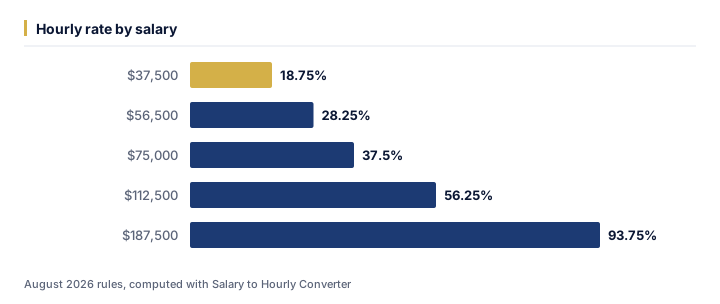
We ran 5 values of salary through the calculator and left every other input at its default. As of August 2026, the output was:
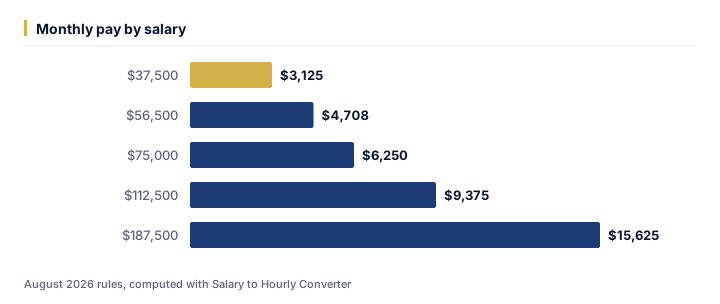
| Salary ($) | Hourly rate (%) | Monthly pay ($) | Biweekly pay ($) |
|---|---|---|---|
| 37,500 | 18.75% | 3,125 | 1,442.31 |
| 56,500 | 28.25% | 4,708.33 | 2,173.08 |
| 75,000 | 37.5% | 6,250 | 2,884.62 |
| 112,500 | 56.25% | 9,375 | 4,326.92 |
| 187,500 | 93.75% | 15,625 | 7,211.54 |
Running salary from $37,500 up to $187,500 moves hourly rate from 18.75% to 93.75% — a spread of 75%. That gap is the part a single headline rate never shows.
The same runs seen through monthly pay
At $37,500, monthly pay works out to $3,125; at $187,500 it is $15,625. Looking only at hourly rate tends to understate how much the outcome shifts across that range.
One example, straight from the API
The middle row above (salary = $75,000) is not a rounded illustration — it is exactly what /api/v1/tools/salary-to-hourly-converter/calculate returns for that input, August 2026 rules:
{
    "tool": "salary-to-hourly-converter",
    "inputs": {
        "salary": 75000,
        "hoursPerWeek": 40,
        "weeksPerYear": 50
    },
    "result": {
        "hourly_rate": 37.5,
        "monthly_pay": 6250,
        "biweekly_pay": 2884.62,
        "weekly_pay": 1442.31,
        "daily_pay": 300,
        "hours_per_year": 2000
    }
}
Assumptions behind these figures
| Input | Value |
|---|---|
| Salary | $75,000 |
| Hours per week | $40 |
| Weeks per year | 50 years |
| As of | August 2026 |
| Method | identical to /tools/salary-to-hourly-converter |
Rates, thresholds and typical costs change over time; the numbers above are accurate as of August 2026, not a permanent guarantee. For your own situation, open the Salary to Hourly Converter and enter your real numbers — the calculator runs the same code that produced every figure on this page.