How Cost of Living Affects Real Salary
A recruiter calls with a $100,000 offer in San Francisco. A few weeks later, a different recruiter offers $75,000 in Cleveland. Which one is better?
Headline salary says San Francisco wins by $25,000. Real-world purchasing power says Cleveland may actually leave you with more money in your pocket at the end of the month — and a paid-off mortgage a decade sooner.
Welcome to the cost-of-living puzzle. This guide explains how COL indices work, the math behind equivalent salary calculations, why housing dominates the comparison, and how to think about cost of living when you're weighing a job offer or considering relocation.
What "Cost of Living" Actually Measures
Cost of living indices summarize how expensive it is to maintain a comparable lifestyle in different cities. The most common scale uses 100 as the national average.
- COL index of 100 = average U.S. cost
- COL index of 150 = 50% more expensive than average
- COL index of 75 = 25% cheaper than average
Different organizations publish their own indices (the Council for Community and Economic Research's C2ER index is the most widely cited), but they generally cover the same six categories:
- Housing (rent or mortgage)
- Groceries
- Utilities
- Transportation
- Healthcare
- Goods and services (everything else)
Each category is weighted by typical household spending. Housing usually carries the heaviest weight — often 25-35% of the index — because it's the single largest expense for most households.
Use Cost of Living Calculator to compare specific cities side by side.
The Equivalent Salary Math
The basic equation:
Equivalent salary = Your current salary × (Destination COL ÷ Origin COL)
If you're moving from Cleveland (index ~85) to San Francisco (index ~190), and your Cleveland salary is $75,000:
Equivalent SF salary = $75,000 × (190 / 85) ≈ $167,600
In other words, you'd need about $167,600 in San Francisco to maintain the same lifestyle as $75,000 in Cleveland.
If the offer is $100,000 in SF, you'd be taking a massive lifestyle pay cut relative to Cleveland, even though the headline number is higher.
Conversely, if you're moving from San Francisco to Cleveland and earning $150,000 in SF:
Equivalent Cleveland salary = $150,000 × (85 / 190) ≈ $67,100
A $90,000 Cleveland job would be a lifestyle raise of roughly $23,000 relative to your SF income.
Why Housing Dominates
Most COL differences between metros come from housing. Groceries vary by maybe 20% between cheap and expensive cities. Utilities vary similarly. Healthcare is mostly tied to your employer's plan, not your city. Transportation can vary, especially in cities with strong public transit vs. car-dependent metros.
But housing? Housing can vary by 3x or more between cities.
Median rent for a one-bedroom apartment in 2025-2026 (rough approximations, varying by neighborhood and quarter):
| City | Approx. Median 1BR Rent |
|---|---|
| San Francisco | $3,200-$3,800 |
| New York (Manhattan) | $3,800-$4,500 |
| Los Angeles | $2,500-$2,900 |
| Boston | $2,700-$3,200 |
| Seattle | $2,200-$2,600 |
| Austin | $1,700-$2,100 |
| Atlanta | $1,600-$1,900 |
| Cleveland | $1,000-$1,300 |
| Pittsburgh | $1,100-$1,400 |
| Indianapolis | $1,100-$1,400 |
Rent in Cleveland is roughly one-third the rent in San Francisco for a similar apartment. That single line item drives most of the equivalent salary calculation.
If you can negotiate to keep your salary while moving from a high-cost to low-cost metro (e.g., remote work to a cheaper city), the lifestyle uplift is dramatic.
Regional Patterns Worth Knowing
A few patterns hold across U.S. metros:
Coastal urban cores are most expensive
San Francisco, San Jose, New York, Boston, Honolulu, Washington D.C., Seattle, and Los Angeles consistently top COL rankings. Housing is the main driver, but groceries and services follow because of higher wages in those service industries.
Midwest and South are cheaper
Cleveland, Pittsburgh, Cincinnati, Kansas City, Memphis, Birmingham, Indianapolis, and St. Louis frequently rank below the national average. Tornadoes, weather, and slower job growth in some metros are tradeoffs.
Sunbelt boomtowns are no longer cheap
Austin, Nashville, Phoenix, Tampa, Charlotte, and Raleigh have all seen rapid cost-of-living increases over the past several years. Austin in particular has shifted from "cheap Texas" to "moderately expensive" as tech expanded there.
Rural areas vary widely
A small town near a major metro can be cheap. A small town in a high-cost state (Vermont, Hawaii, certain parts of California) can be surprisingly expensive due to transportation and services.
What COL Indices Get Wrong
Indices are useful but imperfect. Watch out for:
1. They assume an "average" household
Cost-of-living calculators assume a baseline lifestyle. If you have kids in private school, drive an expensive car, or eat out 4 nights a week, your personal COL diverges from the index.
2. They average across an entire metro
San Francisco the city averages with surrounding Bay Area suburbs. Within SF, the Sunset is much cheaper than Pacific Heights. Index-based equivalents are coarse.
3. State and local taxes are sometimes folded in, sometimes not
Some indices include state income tax. Others don't. Verify what's baked in.
4. Quality differences are invisible
A $1,200 1-bedroom in Cleveland might be a beautifully renovated unit in a walkable neighborhood. A $3,400 1-bedroom in San Francisco might be a small studio in a noisy district. Indices can't capture quality, neighborhood character, or commute pleasantness.
5. Career capital varies by metro
A $100,000 software job in Cleveland might cap out at $130,000. The same role in SF might lead to $250,000+ within 5 years. The lifetime earnings potential of a metro matters, especially earlier in a career.
How to Use COL in Decision Making
Scenario 1: Comparing two job offers
- Get the headline salaries.
- Find the COL index for each city using Cost of Living Calculator.
- Compute the equivalent salary in your reference city.
- Subtract state and city taxes using Take-Home Pay Calculator.
- Add the value of benefits (employer 401(k) match, health insurance, etc.).
- Now you can compare apples to apples.
Scenario 2: Considering a remote move
If your employer allows remote work and won't cut your pay when you move, COL becomes pure upside. A $130,000 SF salary maintained while moving to Pittsburgh creates a roughly $40,000-$50,000 effective raise.
Some employers do "geographic pay bands" — your pay decreases if you move to a cheaper market. Ask before you sign a lease.
Scenario 3: Negotiating a relocation package
When a company asks you to move to a higher-COL city, negotiate:
- A salary that maintains your equivalent purchasing power (use the equation above).
- A signing bonus to cover moving costs.
- A relocation budget for closing costs, deposits, and temporary housing.
- Sometimes: a cost-of-living adjustment for the first year.
Scenario 4: Lifestyle change retirement
Many retirees move from high-cost coastal cities to low-cost interior cities or states. A retired couple with $70,000/year in income lives very differently in San Diego vs. Knoxville. COL indices help quantify how far your fixed retirement income will go.
A Concrete Example
Two software engineers, both single, both 32 years old, both saving aggressively:
Engineer A — San Francisco, $180,000 salary
- Gross: $180,000
- Federal + FICA + CA state tax: roughly 32-35% combined effective rate
- Net take-home: ~$117,000-$120,000
- Rent for a decent 1BR: $3,400/month = $40,800/year
- Net after rent: ~$76,000-$79,000
- Adds: groceries, utilities, transit, healthcare, savings → typical expenses ~$45,000-$55,000 in SF
- Remaining for savings/investments: roughly $25,000-$35,000
Engineer B — Cleveland, $115,000 salary
- Gross: $115,000
- Federal + FICA + OH state + city tax: roughly 24-27% combined
- Net take-home: ~$83,000-$87,000
- Rent for a decent 1BR: $1,200/month = $14,400/year
- Net after rent: ~$68,000-$72,000
- Adds: groceries, utilities, transit, healthcare, savings → typical expenses ~$25,000-$32,000 in Cleveland
- Remaining for savings/investments: roughly $36,000-$45,000
Engineer A makes more on paper. Engineer B saves more in actual dollars — by something like $10,000-$15,000 per year. Compound that over a decade and the gap is enormous.
Both choices can be right. SF offers career capital, density of opportunity, and lifestyle amenities. Cleveland offers financial breathing room and homeownership accessibility (a $250,000 house in Cleveland is mid-range; in SF, that doesn't exist).
You can stress-test this with Salary to Hourly Converter to see how your real per-hour value shifts when you factor in cost of living.
The Quality-of-Life Factor
Money isn't everything. A few non-financial considerations:
- Commute time — A 60-minute SF commute vs. a 15-minute Cleveland commute reclaims around 360 hours per year.
- Weather — A real factor for many people.
- Family proximity — Hard to put a dollar value on it, but it matters.
- Cultural and food scene — Big city advantage, especially earlier in life.
- Outdoor access — Varies by metro; Denver, Salt Lake City, and Portland punch above their COL weight here.
These don't show up in any cost-of-living index, but they belong in the decision.
Final Thoughts
Cost of living turns headline salaries into real purchasing power. The math is simple — destination COL divided by origin COL — but the implications are big. A $25,000 raise in a 2x-COL city is often a lifestyle pay cut. A $20,000 pay cut to move to a 0.5x-COL city is often a lifestyle raise.
Use the math. Use Cost of Living Calculator to compare cities. Layer in taxes, benefits, and career trajectory. Then make the choice that fits where you want your life to go — not just where the biggest number lives.
This article is for general education and not financial advice. Cost-of-living indices are estimates; verify housing prices and tax rates in your specific neighborhoods before making major decisions.
Run the numbers
Everything below came out of this site's own Salary to Hourly Converter. The figures are not quoted from anywhere else: each row is one run of the same calculation the tool page performs, using August 2026 rules. Put the same inputs in and you will get the same output.
How the result moves with salary
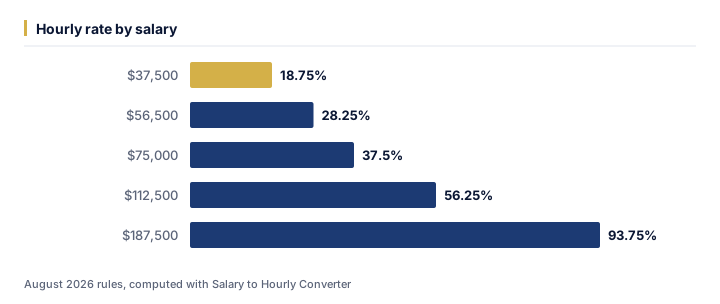
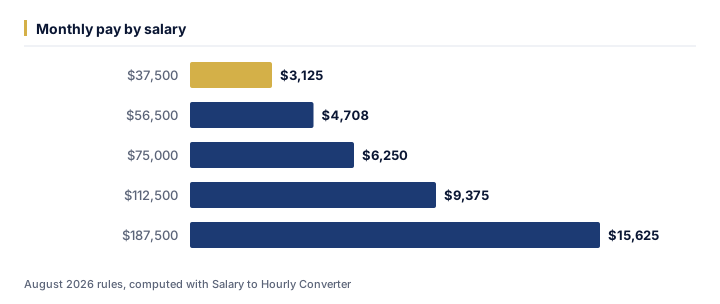
We ran 5 values of salary through the calculator and left every other input at its default. As of August 2026, the output was:
| Salary ($) | Hourly rate (%) | Monthly pay ($) | Biweekly pay ($) |
|---|---|---|---|
| 37,500 | 18.75% | 3,125 | 1,442.31 |
| 56,500 | 28.25% | 4,708.33 | 2,173.08 |
| 75,000 | 37.5% | 6,250 | 2,884.62 |
| 112,500 | 56.25% | 9,375 | 4,326.92 |
| 187,500 | 93.75% | 15,625 | 7,211.54 |
Running salary from $37,500 up to $187,500 moves hourly rate from 18.75% to 93.75% — a spread of 75%. That gap is the part a single headline rate never shows.
The same runs seen through monthly pay
At $37,500, monthly pay works out to $3,125; at $187,500 it is $15,625. Looking only at hourly rate tends to understate how much the outcome shifts across that range.
One example, straight from the API
The middle row above (salary = $75,000) is not a rounded illustration — it is exactly what /api/v1/tools/salary-to-hourly-converter/calculate returns for that input, August 2026 rules:
{
    "tool": "salary-to-hourly-converter",
    "inputs": {
        "salary": 75000,
        "hoursPerWeek": 40,
        "weeksPerYear": 50
    },
    "result": {
        "hourly_rate": 37.5,
        "monthly_pay": 6250,
        "biweekly_pay": 2884.62,
        "weekly_pay": 1442.31,
        "daily_pay": 300,
        "hours_per_year": 2000
    }
}
Assumptions behind these figures
| Input | Value |
|---|---|
| Salary | $75,000 |
| Hours per week | $40 |
| Weeks per year | 50 years |
| As of | August 2026 |
| Method | identical to /tools/salary-to-hourly-converter |
Rates, thresholds and typical costs change over time; the numbers above are accurate as of August 2026, not a permanent guarantee. For your own situation, open the Salary to Hourly Converter and enter your real numbers — the calculator runs the same code that produced every figure on this page.