How Bonuses Are Taxed in the U.S.
You get a $10,000 bonus, log into your bank, and see about $6,000 hit your account. Naturally, you assume you just paid 40% in tax. You did not. You paid 40% in withholding — a very different thing.
This article walks through what actually happens to a bonus in the U.S. tax system, why the deposit is smaller than you expect, and how it all reconciles at tax time.
The headline confusion: withholding is not tax
The number on your paycheck labeled "federal income tax" is what your employer sent to the IRS on your behalf, not what you ultimately owe. At tax time the IRS adds up everything you earned for the year, calculates the actual tax, and compares it to what was withheld:
- Withheld more than owed → refund
- Withheld less than owed → bill
Bonuses get withheld at rates that often look high compared to regular paychecks, which creates the universal "they took half my bonus" reaction. The amount you actually owe is settled in April. For many people the withholding is roughly correct. For high earners it's often too little, leading to a tax bill they didn't expect.
Two methods employers use to withhold bonus tax
The IRS lets employers choose between two ways of withholding federal tax on bonuses ("supplemental wages" in IRS language).
Method 1: The percentage method (most common)
The simplest. For supplemental wages under $1 million in a year, the employer withholds a flat 22% federal income tax, regardless of your regular tax bracket. Above $1 million in supplemental wages, the rate is 37%.
State withholding follows your state's own supplemental-wage rules (often a flat state rate). FICA (Social Security 6.2% up to the wage base of $176,100 for 2026, plus Medicare 1.45%) and any state disability or local taxes get withheld normally.
So a $10,000 bonus paid by the percentage method typically sees:
- Federal: 22% = $2,200
- FICA: 7.65% = $765
- State (varies — assume 5%): $500
- Net deposit: roughly $6,500
You "lost a third," but the federal piece is just 22% of the bonus, not your marginal bracket.
Method 2: The aggregate method
The aggregate method combines the bonus with your regular paycheck for the period, looks up withholding as if that combined amount were your normal earnings (using your W-4), and subtracts what was already withheld on your regular pay. The remainder gets withheld on the bonus.
This usually makes the bonus appear to be withheld at a higher rate, especially if the combined paycheck pushes you into a higher withholding bracket for that pay period. A high earner with a big bonus may see effective federal withholding of 30-37% on the bonus portion.
Employers can choose either method. Most large employers use the percentage method because it's simpler.
The Bonus Tax Calculator lets you compare both methods on your own bonus.
What does it actually look like?
Let's run a realistic example. You're a single filer earning $120,000 base. Your employer pays a $15,000 year-end bonus using the percentage method.
Bonus withholding (percentage method):
| Item | Amount |
|---|---|
| Federal (22% flat) | $3,300 |
| Social Security (6.2%) | $930 |
| Medicare (1.45%) | $217.50 |
| State (assume 5% flat) | $750 |
| Net to your bank | ~$9,802 |
You feel like you "lost $5,200." Here's what actually happens at tax time.
Year-end reconciliation. Your total wages are $135,000. The 22% federal bracket ends at $191,950 for 2026 single filers, so your entire bonus stays in the 22% bracket. Federal tax owed on the bonus is roughly $3,300 — basically what was withheld. You owe no extra federal tax on this bonus. The state piece similarly washes out.
In this case, the percentage method gave you the right answer. Many bonuses work this way.
When withholding is wrong (and how to handle it)
The percentage method breaks down at the extremes:
Withheld too much (your refund grows)
You're in the 12% federal bracket overall, but the bonus had 22% federal withholding. The extra 10% comes back as part of your refund. Nice, but you essentially lent the government an interest-free loan.
Withheld too little (you owe in April)
You're in the 32% or 35% federal bracket, but the bonus only had 22% withheld. The IRS still expects 32-35% on that income, so the gap shows up as tax owed when you file.
This bites high earners hardest. A $50,000 bonus to someone in the 32% federal bracket means about $5,000 of under-withholding ($50,000 × 10%). State piece can add another $2,000-$4,000 in high-tax states.
If you've taken a big bonus and don't want the April surprise, you have a few options:
- Adjust your W-4 for the rest of the year to withhold more from regular pay.
- Make an estimated tax payment to the IRS for the quarter the bonus was received (Form 1040-ES).
- Just save the difference in a high-yield account, ready for April.
The Take-Home Pay Calculator is useful for figuring out what your actual marginal rate is so you know how much to set aside.
Different bonus types, same tax treatment
The IRS doesn't really care what the bonus is called. They're all supplemental wages and they all get the percentage or aggregate method. But the contractual flavor matters for negotiation and planning.
Sign-on bonuses
Paid at job start, often with a clawback if you leave within 12-24 months. Tax treatment is the same as any bonus, but watch for two pitfalls:
- Clawback in a later year. If you repay a $20,000 sign-on bonus in 2027 because you quit early, the original 2026 tax already went out the door. You may be able to deduct the repayment, but the rules are messy. Try to negotiate a structure where the bonus vests over time instead of being paid upfront.
- Timing. A January sign-on combined with relocation reimbursement can spike your first-year income unexpectedly. Plan estimated taxes accordingly.
Retention bonuses
Paid for staying through a defined date (often during an acquisition or restructuring). Same withholding rules. Often larger than annual bonuses and more likely to under-withhold for high earners — if you get a $100,000 retention bonus and you're in the 32% bracket, expect to owe roughly $10,000 in additional federal tax above what was withheld.
Year-end / performance bonuses
The most common, paid in Q4 or January. Sometimes employers split a bonus across multiple checks or pay periods. The total still ends up on your W-2, and the total withholding is what matters.
Spot bonuses, referral bonuses, milestone bonuses
Same rules. Even a $500 referral bonus is supplemental wages with 22% federal withholding plus FICA and state.
Non-cash bonuses
Gift cards, trips, awards over a small threshold ($25-$100 depending on category) are taxable income, and your employer is supposed to either gross them up or include them in your W-2 with appropriate withholding. The Christmas-turkey rule (de minimis fringe benefits) covers small stuff; anything substantial is taxable.
Bonus vs raise: the comparison people get wrong
Workers sometimes prefer a one-time bonus over a permanent raise because the bonus feels bigger. Tax treatment is essentially the same — bonuses are not taxed at a higher rate than salary in any real sense. The differences are about:
- Compounding. A $5,000 raise becomes $5,000 every year, plus future raises calculated as a percentage of the new base.
- Retirement contributions. A bonus may or may not generate 401(k) matching depending on plan design. A raise almost always does.
- Negotiation reset. A higher base sets up future raises, severance, and outside offers; a bonus does not.
Most of the time a permanent raise is more valuable than a one-time bonus of similar dollar size, even though the bonus feels bigger in the moment. The Raise / Promotion Calculator makes that comparison concrete.
Special situations
Deferring a bonus into a 401(k)
Some employers let you contribute a percentage (sometimes 100%) of your bonus directly to your 401(k), avoiding federal income tax on the deferred amount. FICA is still withheld. If you're trying to hit the annual 401(k) limit or smooth out a big bonus year, this can be a powerful lever.
Mega-bonuses and the $1M threshold
Once your year-to-date supplemental wages cross $1,000,000, the federal withholding rate jumps from 22% to 37% on the excess. For tech and finance employees with multi-million bonus or RSU events, the back half of a big-bonus year withholds heavily. The actual tax owed at the top bracket is also 37%, so this withholding is usually closer to correct.
Bonuses near year-end
Bonuses paid late in December vs early January can shift your tax year. If your employer pays Dec 31 vs Jan 2, that's a different W-2. For people on income-driven repayment plans, ACA subsidies, or near a bracket break, the timing matters more than you'd think — though you usually can't control it.
State residency
The state you worked in when you earned the bonus generally taxes it. If you switched states mid-year, expect a more complex state return. High earners who move from CA or NY to a no-income-tax state mid-year sometimes get a surprise on their first January bonus.
The bottom line
A bonus is income. It's taxed at your marginal rate, just like the rest of your salary. The reason it "looks" smaller is that:
- Federal withholding on bonuses is a flat 22% (37% above $1M YTD), independent of your bracket.
- FICA and state withholding stack on top of that.
- For most middle earners, 22% is roughly accurate, so the withholding ≈ tax owed.
- For high earners, 22% is too low, and the gap shows up in April.
If a bonus hits, do three things:
- Note the withholding rate (look at the pay stub).
- Compare it to your actual marginal federal + state rate.
- If the gap is meaningful (more than a few thousand dollars), adjust withholding or make an estimated payment so April doesn't bite.
You earned the bonus. With a little planning, you keep what's actually yours instead of accidentally lending the IRS too much or paying a surprise bill.
This article is general information for U.S. taxpayers and is not tax advice. Bonus tax rules vary by state and by employer plan design; consult a CPA or your HR department for guidance on your specific situation.
Run the numbers
Everything below came out of this site's own Take-Home Pay Calculator. The figures are not quoted from anywhere else: each row is one run of the same calculation the tool page performs, using August 2026 rules. Put the same inputs in and you will get the same output.
How the result moves with salary
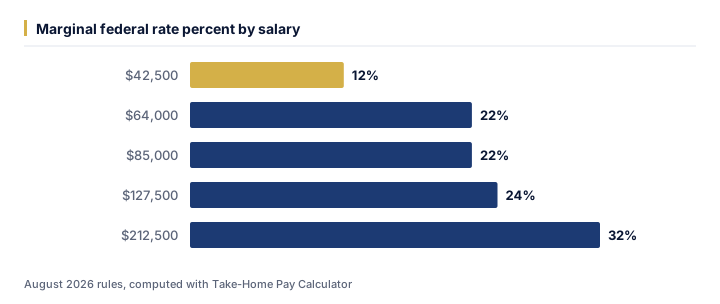
We ran 5 values of salary through the calculator and left every other input at its default. As of August 2026, the output was:
| Salary ($) | Marginal federal rate percent (%) | Effective tax rate percent (%) | Take home annual ($) |
|---|---|---|---|
| 42,500 | 12% | 17.1% | 35,245.07 |
| 64,000 | 22% | 20.4% | 50,950.64 |
| 85,000 | 22% | 24.8% | 63,897.41 |
| 127,500 | 24% | 29.7% | 89,596.16 |
| 212,500 | 32% | 33.4% | 141,456.96 |
Running salary from $42,500 up to $212,500 moves marginal federal rate percent from 12% to 32% — a spread of 20%. That gap is the part a single headline rate never shows.
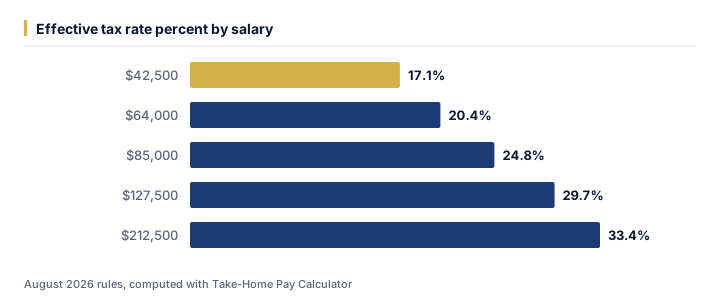
The same runs seen through effective tax rate percent
At $42,500, effective tax rate percent works out to 17.1%; at $212,500 it is 33.4%. Looking only at marginal federal rate percent tends to understate how much the outcome shifts across that range.
One example, straight from the API
The middle row above (salary = $85,000) is not a rounded illustration — it is exactly what /api/v1/tools/take-home-pay-calculator/calculate returns for that input, August 2026 rules:
{
    "tool": "take-home-pay-calculator",
    "inputs": {
        "salary": 85000,
        "filing": "single",
        "state": "CA",
        "contrib_pct": 0,
        "other_pre_tax": 0
    },
    "result": {
        "take_home_annual": 63897.41,
        "take_home_monthly": 5324.78,
        "take_home_biweekly": 2457.59,
        "federal_tax": 10541,
        "fica": 6502.5,
        "state_tax": 4059.09,
        "pretax_401k": 0,
        "federal_taxable": 70400,
        "marginal_federal_rate_percent": 22,
        "effective_tax_rate_percent": 24.8
    }
}
Assumptions behind these figures
| Input | Value |
|---|---|
| Salary | $85,000 |
| Filing | Single |
| State | Ca |
| Contrib pct | 0% |
| Other pre tax | $0 |
| As of | August 2026 |
| Method | identical to /tools/take-home-pay-calculator |
Rates, thresholds and typical costs change over time; the numbers above are accurate as of August 2026, not a permanent guarantee. For your own situation, open the Take-Home Pay Calculator and enter your real numbers — the calculator runs the same code that produced every figure on this page.