Freelance Hourly Rate: How to Calculate Yours
Setting your freelance rate is one of the hardest pieces of going independent. Quote too low and you grind for months only to realize you're earning less than your old W-2 job after taxes. Quote too high without justification and you scare off clients before the conversation starts.
The good news: there's nothing mystical about it. A defensible rate is the output of five inputs, each of which you can calculate or estimate in a few minutes. This guide walks you through that framework so you stop guessing.
Why "double your old salary" is bad math
You've probably heard the "doubling rule" — take your old W-2 salary, divide by 2,000 hours, then double it. So a $100,000 job becomes $100/hour.
It's a decent rule of thumb for a starting point. But it hides the actual math, which means you can't defend the number to a client or adjust it for your situation. The doubling rule assumes:
- Roughly 30% goes to taxes (including self-employment tax)
- Roughly 30% goes to overhead, benefits, and time off
- The remaining 40% is take-home pay
That's not wrong, but it varies wildly by state, by health insurance situation, by how many billable hours you actually log, and by whether you're filing as a sole proprietor or an S-corp. Building the rate from inputs lets you stress-test it.
Step 1: Decide your target take-home pay
Start with what you want to keep, not what you want to charge. Open a spreadsheet and write down:
- Living expenses: rent, food, utilities, transportation
- Savings goals: retirement contributions, emergency fund, taxes you'll owe
- Discretionary: travel, hobbies, the things that make work worth it
Add it up. That's your minimum target annual take-home, the money that hits your checking account after taxes.
A useful sanity check: look at your old W-2 pay stub. The net deposit number is your old take-home. If you want to maintain that lifestyle, that's your floor.
Step 2: Gross up for taxes
Take-home is what you keep. Gross is what you bill. The gap is taxes, and freelancers face three layers:
Federal income tax
Same brackets as W-2 employees. The 2026 standard deduction is $14,600 for a single filer and $29,200 for married filing jointly. The 22% federal bracket starts at $47,150 of taxable income for single filers, so anyone earning a real freelance income is at least partly in that bracket.
Self-employment tax
This is the big one most new freelancers miss. As a W-2 employee, your employer pays half of your Social Security and Medicare (7.65%) and you pay the other half. As a freelancer, you pay both halves: 15.3% on net earnings, with Social Security applying up to the wage base ($176,100 for 2026) and Medicare with no cap.
You do get to deduct half of SE tax on your federal return, which softens the blow slightly. But for rate-setting purposes, plan for the full 15.3% on top of your federal and state income tax.
State income tax
Anywhere from 0% (Texas, Florida, Washington, Tennessee, and a few others) to over 13% at the top (California). Use your state's top marginal rate as a planning number — it's conservative but keeps you out of trouble.
A reasonable combined tax rate for a mid-six-figure freelancer is 30-40% of gross income, sometimes more in high-tax states. Don't be the freelancer who gets a 1099 surprise in April.
The Take-Home Pay Calculator gives you a quick gross-to-net conversion if you want a concrete number for your state.
Step 3: Add overhead, benefits, and time off
A W-2 paycheck looks small partly because your employer is silently spending another 25-30% on benefits, payroll taxes, and overhead. As a freelancer, that bill is yours.
| Cost category | Typical annual cost |
|---|---|
| Health insurance (single, mid-tier) | $7,000-$12,000 |
| Health insurance (family) | $20,000-$30,000 |
| Retirement contributions (15% of income) | varies |
| Software, tools, subscriptions | $1,500-$5,000 |
| Accounting, legal, banking | $1,000-$3,000 |
| Office space or home-office portion | $0-$10,000 |
| Professional development, travel | $1,000-$5,000 |
| Liability or E&O insurance | $500-$2,000 |
Add up your line items. This is overhead — money that comes off the top before you've paid yourself a dollar.
Don't forget time off. W-2 employees get paid vacation, sick days, and holidays. A freelancer charging by the hour earns zero on those days. If you want four weeks of vacation, two weeks of sick time, and federal holidays off, you're billing maybe 45 weeks a year instead of 52.
Step 4: Divide by realistic billable hours
Here's where most freelancers cripple themselves: they assume 2,000 billable hours a year (40 hours × 50 weeks) and divide their target gross by that. The result is a rate that looks reasonable and earns them half what they expected.
The reality is that not all working hours are billable. You spend time on:
- Marketing and sales (proposals, calls, networking)
- Admin (invoicing, bookkeeping, taxes, contracts)
- Learning (keeping skills sharp, certifications)
- Project management between billable tasks
- Inevitable downtime between contracts
For most freelancers, billable hours run 20-30 per week, not 40. A solo consultant with a steady book might hit 25. A creative juggling new business and delivery might hit 20. Almost nobody sustains 40 billable hours per week long-term without burning out.
So the math becomes:
Hourly rate = (target take-home + taxes + overhead) ÷ (billable hours per week × billable weeks per year)
Example: you want $90,000 take-home in a 5% state-tax state, you have $15,000 in overhead and health insurance, and you can bill 25 hours a week for 45 weeks (1,125 hours):
- Target take-home: $90,000
- Gross-up at ~32% combined tax: $90,000 ÷ (1 – 0.32) ≈ $132,400
- Add overhead: $132,400 + $15,000 = $147,400
- Divide by 1,125 hours: $131/hour
If you assumed 2,000 hours instead, you'd get $74/hour — and find yourself short by tens of thousands at year-end.
The Freelance Rate Calculator runs this math for you with your own inputs.
Step 5: Stress-test and compare to market
Now check your number against reality.
Market range. Search recent contracts, talk to peers, look at Upwork or Toptal listings for your specialty. If the market for your skill caps at $110/hour and your calculator says you need $150 to hit your goals, something has to give — usually lower expenses, more billable hours, or finding higher-end clients.
Geographic flex. A rate that supports a comfortable life in Austin might be tight in San Francisco. Use the Cost of Living Calculator to compare metros if you're considering a move or working with clients in different markets.
1099 vs W-2 trade-off. If your gross freelance rate doesn't comfortably beat your old W-2 salary by 25-40%, you may be better off employed. The 1099 vs W-2 Income Calculator makes that comparison concrete — same gross dollars do not equal same take-home.
Project pricing vs hourly
Hourly billing is honest but punishes efficiency. If you get faster, you earn less per project. That's why most experienced freelancers shift toward project pricing or retainers.
The trick: price the project as if you were billing hourly, then quote the total without the hour breakdown. Use your hourly rate as the internal benchmark. If a website redesign would take you 60 hours at $130/hour, quote it at $7,800 — or higher if there's risk, urgency, or strategic value. The client pays for the outcome; you keep the upside of working efficiently.
For retainers, build in a "scope ceiling" (e.g., up to 20 hours per month) so unbounded requests don't quietly destroy your effective rate.
Common mistakes to avoid
- Charging your old W-2 hourly rate. A $50/hour W-2 employee needs roughly $85-$95/hour to match take-home as a freelancer. The gap is taxes and benefits.
- Forgetting estimated quarterly taxes. The IRS expects you to pay tax as you earn it. Set aside 25-35% of each invoice in a separate account.
- Ignoring health insurance. Marketplace plans, COBRA, or a spouse's plan — every option has a real monthly cost that has to live somewhere in your rate.
- Discounting for "exposure." Portfolio pieces have value, but they don't pay rent. Discount sparingly, and only when there's a clear payoff (case study rights, multi-project commitments).
- Refusing to raise rates. Your skills compound, your costs go up, and your rate should track. Plan an annual review — even a 5% bump on existing clients adds up.
When to revisit your rate
Run this exercise:
- Annually, every January
- After any major life change (marriage, kids, mortgage, health event)
- After acquiring a new specialty or certification
- When you've been booked solid for three+ months (a strong signal you can charge more)
- After a tax year that surprised you in either direction
A rate is not a one-time decision. It's the price tag on your work, and the price tag should keep up with the work's actual value and cost.
A defensible freelance rate isn't about confidence or what a competitor charges. It's about doing the math, knowing your numbers, and being able to explain — to a client or to yourself — exactly why the rate is what it is. Run the calculation once a year, adjust for reality, and stop guessing.
This article provides general information for U.S. freelancers and is not tax or financial advice. Tax situations vary; consult a CPA or financial planner for guidance on your specific situation.
Run the numbers
Everything below came out of this site's own Take-Home Pay Calculator. The figures are not quoted from anywhere else: each row is one run of the same calculation the tool page performs, using August 2026 rules. Put the same inputs in and you will get the same output.
How the result moves with salary
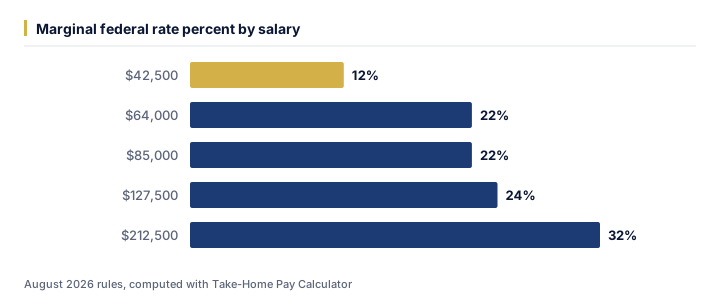
We ran 5 values of salary through the calculator and left every other input at its default. As of August 2026, the output was:
| Salary ($) | Marginal federal rate percent (%) | Effective tax rate percent (%) | Take home annual ($) |
|---|---|---|---|
| 42,500 | 12% | 17.1% | 35,245.07 |
| 64,000 | 22% | 20.4% | 50,950.64 |
| 85,000 | 22% | 24.8% | 63,897.41 |
| 127,500 | 24% | 29.7% | 89,596.16 |
| 212,500 | 32% | 33.4% | 141,456.96 |
Running salary from $42,500 up to $212,500 moves marginal federal rate percent from 12% to 32% — a spread of 20%. That gap is the part a single headline rate never shows.
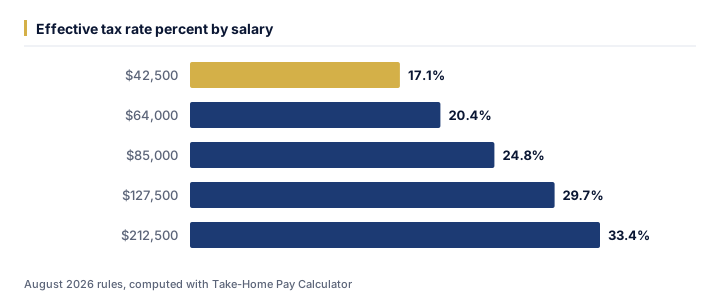
The same runs seen through effective tax rate percent
At $42,500, effective tax rate percent works out to 17.1%; at $212,500 it is 33.4%. Looking only at marginal federal rate percent tends to understate how much the outcome shifts across that range.
One example, straight from the API
The middle row above (salary = $85,000) is not a rounded illustration — it is exactly what /api/v1/tools/take-home-pay-calculator/calculate returns for that input, August 2026 rules:
{
    "tool": "take-home-pay-calculator",
    "inputs": {
        "salary": 85000,
        "filing": "single",
        "state": "CA",
        "contrib_pct": 0,
        "other_pre_tax": 0
    },
    "result": {
        "take_home_annual": 63897.41,
        "take_home_monthly": 5324.78,
        "take_home_biweekly": 2457.59,
        "federal_tax": 10541,
        "fica": 6502.5,
        "state_tax": 4059.09,
        "pretax_401k": 0,
        "federal_taxable": 70400,
        "marginal_federal_rate_percent": 22,
        "effective_tax_rate_percent": 24.8
    }
}
Assumptions behind these figures
| Input | Value |
|---|---|
| Salary | $85,000 |
| Filing | Single |
| State | Ca |
| Contrib pct | 0% |
| Other pre tax | $0 |
| As of | August 2026 |
| Method | identical to /tools/take-home-pay-calculator |
Rates, thresholds and typical costs change over time; the numbers above are accurate as of August 2026, not a permanent guarantee. For your own situation, open the Take-Home Pay Calculator and enter your real numbers — the calculator runs the same code that produced every figure on this page.