Federal vs State Tax Impact on Take-Home Pay
Two engineers earn the exact same $120,000 salary. One lives in Austin. The other lives in San Francisco. After taxes, one of them keeps roughly $9,000-$11,000 more every year — and the other one pays $750-$900 more in rent every month.
That's the federal-vs-state-tax puzzle in a nutshell. Federal tax is the same wherever you live in the U.S. State tax is wildly different. And those differences interact with cost of living in ways that aren't obvious from the headline numbers.
This guide breaks down how federal and state taxes layer together, walks through real 2026 examples in four states, and explains why "no-income-tax states" aren't always the financial win they look like on paper.
The Two-Layer System
Every W-2 employee in the U.S. pays:
- Federal income tax — Progressive brackets administered by the IRS. Same rules in all 50 states.
- FICA payroll tax — 6.2% Social Security (up to the 2026 wage base of $176,100) and 1.45% Medicare on all wages, plus a 0.9% additional Medicare tax above $200,000 single / $250,000 married filing jointly.
- State income tax — Set independently by each state. Some states have none. Others have rates rivaling federal.
- Local / city income tax — In a handful of cities (NYC, Philadelphia, etc.), an additional layer.
Federal tax is the bigger of the two for most workers. But state tax can swing your annual take-home by $5,000-$15,000 or more at higher incomes.
How Federal Brackets Work
The IRS uses progressive marginal brackets. Each dollar you earn is taxed at the rate of the bracket it falls in, not your overall income.
For 2026, federal brackets remain in seven tiers: 10%, 12%, 22%, 24%, 32%, 35%, and 37%. Bracket thresholds vary by filing status (single, married filing jointly, married filing separately, head of household).
The standard deduction for 2026 is approximately:
- Single: around $14,600 to $15,000+ (adjusted annually)
- Married filing jointly: around $29,200 to $30,000+
- Head of household: around $21,900 to $22,500+
Your effective federal rate is your total federal tax divided by total income. A single filer at $100,000 typically has an effective federal rate around 14-16%, even though their top marginal bracket is 22% or 24%.
State Tax: Five Different Models
States choose how (and whether) to tax income. There are five main models:
1. No income tax (9 states)
Alaska, Florida, Nevada, New Hampshire (no wage tax), South Dakota, Tennessee, Texas, Washington, and Wyoming charge no state income tax on wages. New Hampshire historically taxed interest and dividends but is phasing that out.
These states often make up the revenue through higher sales tax, property tax, or other levies.
2. Flat rate
A single percentage applies to all wage income. Examples include Colorado (around 4.4%), Illinois (4.95%), Indiana (around 3.0% plus county), Massachusetts (5%), Michigan (4.25%), North Carolina (around 4.5%), Pennsylvania (3.07%), and Utah (around 4.65%). Rates change frequently — check the latest from your state's revenue department.
3. Progressive brackets
Most states use federal-style brackets, often with different thresholds and rates. California, New York, New Jersey, Hawaii, Oregon, Minnesota, and DC have particularly progressive structures.
4. Only investment income taxed
Until its phase-out completes, New Hampshire historically taxed only interest and dividends — not wages.
5. Local layered taxes
Some cities add a local tax on top of state tax:
- New York City charges roughly 3-4% on residents in addition to NY state tax.
- Philadelphia charges a wage tax just under 4% on residents.
- Detroit, Cleveland, Cincinnati, Kansas City (MO) charge local income taxes.
Real 2026 Examples: $100,000 Single Filer
Let's compare four states for an identical single filer earning $100,000, with no pre-tax 401(k) contributions or itemized deductions (using only the standard deduction for cleanest comparison).
These are illustrative estimates based on published rate structures and standard deductions; actual filings vary based on credits, deductions, and rounding.
Example A — Texas ($100,000 single)
- Federal income tax (estimated): ~$13,800-$14,400
- FICA (Social Security 6.2% + Medicare 1.45%): $7,650
- Texas state income tax: $0
- Total tax: roughly $21,500-$22,000
- Net take-home: roughly $78,000-$78,500
- Effective combined tax rate: about 22%
Example B — California ($100,000 single)
- Federal income tax (estimated): ~$13,800-$14,400
- FICA: $7,650
- California state income tax (estimated): ~$5,200-$5,800
- Total tax: roughly $26,700-$27,800
- Net take-home: roughly $72,200-$73,300
- Effective combined tax rate: about 27-28%
Difference vs. Texas: roughly $5,500-$6,300 more in tax per year.
Example C — New York State (outside NYC) ($100,000 single)
- Federal income tax (estimated): ~$13,800-$14,400
- FICA: $7,650
- NY state tax (estimated): ~$5,200-$5,600
- Total tax: roughly $26,700-$27,600
- Net take-home: roughly $72,400-$73,300
If the same person lives in New York City, add roughly $3,400-$3,800 in NYC resident tax. Net take-home drops closer to $68,800-$69,800.
Example D — Washington State ($100,000 single)
- Federal income tax (estimated): ~$13,800-$14,400
- FICA: $7,650
- Washington state income tax: $0 (but note WA does levy a capital gains tax above certain thresholds — not relevant to wages)
- Total tax: roughly $21,500-$22,000
- Net take-home: roughly $78,000-$78,500
Effectively the same outcome as Texas for a wage earner.
The takeaway
At $100,000 of wage income, the gap between a no-tax state (TX, WA) and a high-tax state (CA, NYC) is roughly $5,500 to $10,000 per year in take-home — meaningful, but not life-changing on its own.
The gap widens significantly at higher incomes (because of progressive state brackets) and at lower incomes when state tax credits kick in.
Use Take-Home Pay Calculator to model your specific income, state, and filing status.
Why High-Tax States Aren't Always Worse
State tax is one variable. The full equation includes:
Cost of living
San Francisco rents are roughly 3x Austin rents for comparable housing. A $9,000 tax savings disappears in 4 months of rent difference. Use Cost of Living Calculator to translate between metros.
Services and infrastructure
Higher-tax states often fund:
- Better public schools (especially for K-12)
- More extensive public transit
- Larger safety nets (unemployment, healthcare subsidies, family leave)
- Better-maintained roads and parks in some cases
Whether you personally use these matters for the value calculation.
Local economies
High-tax states often have higher median salaries. A senior engineer might earn $200k in Austin and $260k in San Francisco for similar work — the higher gross can more than offset the higher state tax.
Property tax and sales tax
States that skip income tax often raise revenue elsewhere:
- Texas: No income tax, but high property taxes (often 2-3% of home value annually).
- Washington: No income tax, but high sales tax (around 10% combined in Seattle).
- Florida: No income tax, but high property insurance costs in many markets.
Total tax burden, not just income tax, matters.
Unique State Quirks Worth Knowing
A few cases that confuse people:
- Pennsylvania: Flat-rate state but doesn't allow most federal-style deductions. Pre-tax 401(k) contributions don't reduce PA state tax (though they reduce federal). This makes Roth 401(k) more attractive in PA from a state-tax-arbitrage perspective.
- New Jersey: Doesn't allow 401(k) contributions to reduce state taxable income either (but does allow some traditional IRA).
- California: HSA contributions are NOT deductible from CA state tax (one of two states with this rule).
- Tennessee: Phased out the Hall Tax (investment income tax). Now truly no income tax.
- Nevada: No income tax for individuals, but high gross receipts business tax.
If you contribute heavily to pre-tax retirement accounts, check whether your state honors those deductions before assuming the tax savings work the same as federal.
How Remote Work Changes the Equation
Remote work complicates state taxation significantly. Depending on your situation, you may owe tax in:
- The state where you live
- The state where your employer is located (in some "convenience of the employer" rules — notably New York, Connecticut, Delaware, Nebraska, Pennsylvania)
- A state you traveled to and worked in
A New York employer with a remote worker in Florida often still owes New York state tax — even though the worker never sets foot in New York. This rule has been challenged in court but generally stands.
If you're considering relocating to a no-tax state while keeping a remote job in a high-tax state, consult a tax professional before assuming you'll save.
Putting It All Together
To compare two job offers across states fairly:
- Start with gross salary.
- Compute federal tax (same in all states).
- Compute FICA (same in all states up to the wage base).
- Compute state income tax for the state you'd actually live in.
- Add any city tax (NYC, Philly, etc.).
- Subtract pre-tax deductions and re-check.
- Adjust for cost of living using Cost of Living Calculator.
- Adjust for benefits (401(k) match, health insurance employer contribution, etc.).
- Then compare.
A $150,000 offer in Austin and a $180,000 offer in San Francisco look like the SF job pays more — until you factor in the $7,000+ extra state tax and roughly 60% higher cost of living. The Austin offer might be a better deal even at a lower gross.
Final Thoughts
Federal tax is a fixed cost wherever you work. State tax is where the real differences live, and it interacts with cost of living, employer pay bands, and your personal use of public services in ways that aren't obvious.
When evaluating a relocation or remote work move, compute total take-home and total expenses — not just headline salary. The cheapest tax bill is often not the cheapest place to live.
This article is for general education and not tax advice. State tax rules change frequently — verify with your state revenue department or a qualified tax professional before making major decisions.
Run the numbers
Everything below came out of this site's own Take-Home Pay Calculator. The figures are not quoted from anywhere else: each row is one run of the same calculation the tool page performs, using August 2026 rules. Put the same inputs in and you will get the same output.
How the result moves with salary
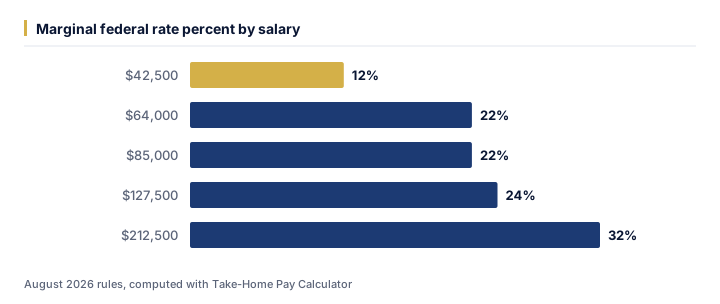
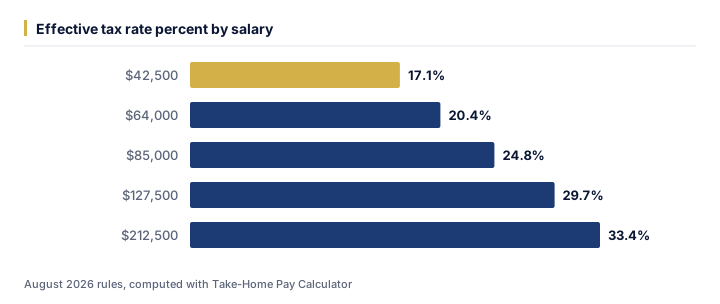
We ran 5 values of salary through the calculator and left every other input at its default. As of August 2026, the output was:
| Salary ($) | Marginal federal rate percent (%) | Effective tax rate percent (%) | Take home annual ($) |
|---|---|---|---|
| 42,500 | 12% | 17.1% | 35,245.07 |
| 64,000 | 22% | 20.4% | 50,950.64 |
| 85,000 | 22% | 24.8% | 63,897.41 |
| 127,500 | 24% | 29.7% | 89,596.16 |
| 212,500 | 32% | 33.4% | 141,456.96 |
Running salary from $42,500 up to $212,500 moves marginal federal rate percent from 12% to 32% — a spread of 20%. That gap is the part a single headline rate never shows.
The same runs seen through effective tax rate percent
At $42,500, effective tax rate percent works out to 17.1%; at $212,500 it is 33.4%. Looking only at marginal federal rate percent tends to understate how much the outcome shifts across that range.
One example, straight from the API
The middle row above (salary = $85,000) is not a rounded illustration — it is exactly what /api/v1/tools/take-home-pay-calculator/calculate returns for that input, August 2026 rules:
{
    "tool": "take-home-pay-calculator",
    "inputs": {
        "salary": 85000,
        "filing": "single",
        "state": "CA",
        "contrib_pct": 0,
        "other_pre_tax": 0
    },
    "result": {
        "take_home_annual": 63897.41,
        "take_home_monthly": 5324.78,
        "take_home_biweekly": 2457.59,
        "federal_tax": 10541,
        "fica": 6502.5,
        "state_tax": 4059.09,
        "pretax_401k": 0,
        "federal_taxable": 70400,
        "marginal_federal_rate_percent": 22,
        "effective_tax_rate_percent": 24.8
    }
}
Assumptions behind these figures
| Input | Value |
|---|---|
| Salary | $85,000 |
| Filing | Single |
| State | Ca |
| Contrib pct | 0% |
| Other pre tax | $0 |
| As of | August 2026 |
| Method | identical to /tools/take-home-pay-calculator |
Rates, thresholds and typical costs change over time; the numbers above are accurate as of August 2026, not a permanent guarantee. For your own situation, open the Take-Home Pay Calculator and enter your real numbers — the calculator runs the same code that produced every figure on this page.