Pay Transparency Updates 2026
Five years ago, asking a recruiter for the salary range on a job posting felt awkward. Today, in roughly a dozen US states, that range has to be in the job posting itself — and if it isn't, the employer is breaking the law. Pay transparency requirements have spread quickly since Colorado's pioneering 2021 law, and 2026 brings a new round of expansions, enforcement actions, and changes to internal employee disclosure rules.
This is a periodic update on where pay transparency stands in 2026: which states require salary ranges in job postings, what's new this year, where the federal landscape stands, and what the early data shows about whether these laws actually work. If you're job hunting, hiring, or negotiating a raise, knowing your state's rules is leverage.
This article is informational, not legal advice. Pay transparency laws change frequently, and specific compliance requirements depend on company size, employee count, and exact posting language. For any employer-specific question, consult an employment attorney.
The Core List: States Requiring Salary Ranges in Job Postings
As of 2026, the following states have laws requiring most employers to disclose pay ranges in job postings. Specific thresholds (number of employees, type of posting) vary by state.
- California — applies to employers with 15+ employees; range must be in the posting; effective since January 2023
- Colorado — the original pay transparency law; applies to most employers with at least one employee in Colorado; effective since 2021
- Connecticut — requires disclosure of pay range to applicants, with strengthened posting rules added in recent years
- Hawaii — requires pay range in postings for employers with 50+ employees; effective January 2024
- Illinois — requires pay scale and benefits in postings for employers with 15+ employees; effective January 2025
- Maryland — requires pay range disclosure in postings; expanded in 2024
- Minnesota — requires pay range in postings for employers with 30+ employees; effective January 2025
- New Jersey — requires pay and benefits range in postings for employers with 10+ employees; effective June 2025
- New York (state law) — requires pay range in postings for employers with 4+ employees; effective September 2023 — with separate NYC, Westchester, and Ithaca local ordinances that predated the state law
- Rhode Island — pay range must be disclosed to applicants on request, with stricter rules for postings under recent amendments
- Vermont — pay range in postings required for employers with 5+ employees; effective July 2025
- Washington — requires pay range and benefits in postings for employers with 15+ employees; effective January 2023
That brings the count to roughly 12 states with active "must include pay range in job posting" requirements in 2026, plus a handful of cities (Cincinnati, Toledo, Jersey City) with local ordinances of varying scope.
A larger group of states require pay disclosure at later stages — after a first interview, on applicant request, or only for current employees — without requiring it in the posting itself. These include Nevada, Massachusetts (a posting law takes effect October 2025 / 2026 implementation), and several others with partial-disclosure rules. The line between "posting requirement" and "disclosure requirement" matters legally; both push transparency forward, but the posting requirements are what change the day-to-day applicant experience.
What's New in 2026
A few notable shifts this year:
Massachusetts is now in active enforcement of its 2024-passed pay transparency law, which requires employers with 25+ employees to include pay ranges in job postings and to share ranges with current employees on request for their own position. The law also requires larger employers (100+) to submit EEO-style pay data to the state.
Several states are extending the rules to internal employee disclosure. California, Colorado, New York, and Washington now have provisions requiring employers to disclose the pay range for an internal employee's current job or promotion opportunity on request. This shifts the focus from "what does the new job pay" to "what does my current job pay, and what's the band for my next level."
Enforcement is ramping up. The early years of these laws saw mostly warnings and small fines. In 2026, several state labor departments have stepped up audits, with penalties scaling by the number of non-compliant postings. Washington has been particularly active; private lawsuits under the state's pay transparency law have moved through the courts and shaped how employers structure ranges.
Range width is becoming a battleground. Some employers responded to disclosure laws by posting absurdly wide ranges ($80,000-$220,000 for the same role). State labor departments and courts have started pushing back on the principle that the range must be the employer's good-faith expectation of what they'll actually pay. California's enforcement guidance specifically calls out unreasonably wide ranges as likely violations.
Federal Status: Still No National Law
There is no federal pay transparency law as of 2026. Several bills have been introduced in Congress over the past several years — the most prominent being the Salary Transparency Act — but none have advanced to passage. The federal Equal Pay Act of 1963 prohibits pay discrimination based on sex but doesn't require disclosure.
The federal contracting space is a separate story. Executive actions have at various points required federal contractors to disclose pay data in EEO-1 reports or to refrain from asking about salary history. The exact rules in 2026 depend on current executive action and OFCCP enforcement priorities.
For most US workers, the practical pay transparency framework is the state-level patchwork above.
Salary History Bans: A Related but Different Rule
Separately from pay range disclosure, around 20 states and many cities prohibit employers from asking job applicants about their salary history. This rule predates the pay transparency wave and is independent of it — a state can ban salary history questions without requiring salary range disclosure, and vice versa.
The salary history ban list (state and major city) includes California, Colorado, Connecticut, Delaware, Hawaii, Illinois, Maine, Massachusetts, New Jersey, New York, North Carolina (state employers), Oregon, Pennsylvania (state employers), Rhode Island, Vermont, Washington, and Washington DC — plus a long list of cities with their own ordinances.
If you're job hunting in one of these jurisdictions, a recruiter or hiring manager who asks "what's your current salary?" is breaking the law. You don't have to answer. The legally safe response is some version of "I'd prefer to discuss the range for this role first."
Does Pay Transparency Actually Work?
Multiple academic studies and industry reports have looked at the early effects of state pay transparency laws. The picture is more nuanced than either side predicted.
What the data suggests:
- Posted ranges have moved closer to actual hiring pay over time. Early studies found very wide initial ranges; subsequent enforcement and norms have narrowed them in compliant employers.
- Pay gaps between similar workers at the same employer have compressed modestly in states with disclosure laws, particularly gender and racial pay gaps for newly-hired employees.
- Some employers have raised entry-level salaries to make their ranges look competitive in disclosed postings, with effects that ripple through internal bands.
- Some employers have lowered the top of their ranges to avoid setting expectations they can't meet, which has reduced some negotiation upside for top-of-band candidates.
- Existing employee pay tends to compress upward when ranges become public and existing employees discover they're below the posted minimum for their own role.
What the data does not strongly support:
- The idea that pay transparency causes employers to leave a state. There's little evidence this has happened at scale; employers have largely adapted.
- The idea that disclosure has no effect at all. The compressing wage gap data is reasonably robust across multiple analyses.
The net effect for most workers in covered states: better information at the start of the negotiation, somewhat compressed ranges, and a culture shift in which asking about pay early in the process is no longer taboo.
What This Means for Your Job Search
If you live or work in one of the 12 states above, the practical implications are:
- The posted range is your starting anchor. Don't accept "we'll discuss compensation later" if the law requires the range in the posting — push back politely and ask where it is.
- Aim for the top half of the range. Most candidates land in the middle. Strong negotiators with relevant experience routinely land at the 70th-90th percentile of the band.
- Know that the range is the band, not the offer. Where you land within the band depends on your level, experience, and negotiating leverage.
- Use the range to compare offers. If two employers post overlapping ranges, that's useful data about the market rate for the role.
- Don't share your current salary if you don't have to. In salary-history-ban jurisdictions, you have no obligation. In other states, it's still your choice.
If you're in a state without these requirements, the same logic applies in spirit. You can — and should — ask for the range early. Most US employers, even outside covered states, now disclose ranges to applicants who ask directly, because the cultural norm has shifted nationally even where the law hasn't.
What This Means for Negotiation
Knowing the posted range changes the negotiation dynamic. Before, candidates were often blind on pay until late in the interview process; now, in covered states, the band is public from the start.
A few tactics:
- Use Take-Home Pay Calculator to convert the posted range into after-tax monthly cash. A $130,000-$160,000 range at different points in the band may mean $7,500/month vs $9,000/month after federal and state taxes — a meaningful gap.
- Use Cost of Living Calculator for cross-state comparisons. A range that looks high in absolute terms may not be high in cost-of-living-adjusted terms if it's in a high-cost state.
- For internal moves and raises, use Raise / Promotion Calculator to model what a band-top move actually delivers vs the midpoint number a manager might offer first.
- For commission, bonus, and equity-heavy roles, the posted "base range" undersells total comp — make sure you build a complete picture using the framework in [[how-to-calculate-total-compensation]].
Looking Ahead
Pay transparency is one of those slow-but-steady policy shifts. Five years ago, only Colorado had a serious posting law. Today, roughly a quarter of US states do. By the end of the decade, the share is likely to be higher.
For now, in 2026, the practical framework is: 12-ish states require salary ranges in postings, a roughly overlapping set bans salary history questions, federal law remains silent, and enforcement is ramping up. Know your state's rules, use the information they give you, and remember that the posted range is the start of the negotiation — not the end of it.
Pay transparency doesn't pay your bills, but information does change leverage. Use it.
Run the numbers
Everything below came out of this site's own Salary to Hourly Converter. The figures are not quoted from anywhere else: each row is one run of the same calculation the tool page performs, using August 2026 rules. Put the same inputs in and you will get the same output.
How the result moves with salary
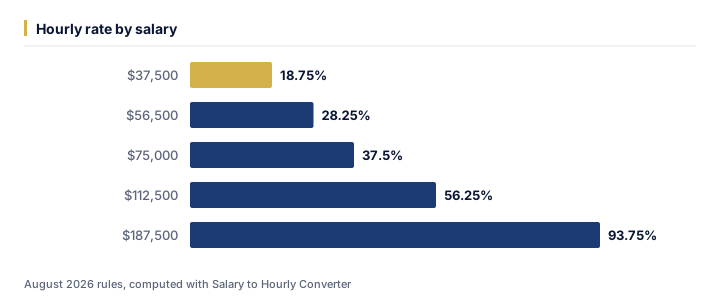
We ran 5 values of salary through the calculator and left every other input at its default. As of August 2026, the output was:
| Salary ($) | Hourly rate (%) | Monthly pay ($) | Biweekly pay ($) |
|---|---|---|---|
| 37,500 | 18.75% | 3,125 | 1,442.31 |
| 56,500 | 28.25% | 4,708.33 | 2,173.08 |
| 75,000 | 37.5% | 6,250 | 2,884.62 |
| 112,500 | 56.25% | 9,375 | 4,326.92 |
| 187,500 | 93.75% | 15,625 | 7,211.54 |
Running salary from $37,500 up to $187,500 moves hourly rate from 18.75% to 93.75% — a spread of 75%. That gap is the part a single headline rate never shows.
The same runs seen through monthly pay
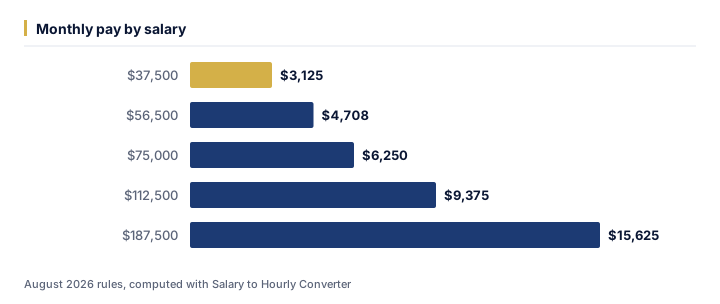
At $37,500, monthly pay works out to $3,125; at $187,500 it is $15,625. Looking only at hourly rate tends to understate how much the outcome shifts across that range.
One example, straight from the API
The middle row above (salary = $75,000) is not a rounded illustration — it is exactly what /api/v1/tools/salary-to-hourly-converter/calculate returns for that input, August 2026 rules:
{
    "tool": "salary-to-hourly-converter",
    "inputs": {
        "salary": 75000,
        "hoursPerWeek": 40,
        "weeksPerYear": 50
    },
    "result": {
        "hourly_rate": 37.5,
        "monthly_pay": 6250,
        "biweekly_pay": 2884.62,
        "weekly_pay": 1442.31,
        "daily_pay": 300,
        "hours_per_year": 2000
    }
}
Assumptions behind these figures
| Input | Value |
|---|---|
| Salary | $75,000 |
| Hours per week | $40 |
| Weeks per year | 50 years |
| As of | August 2026 |
| Method | identical to /tools/salary-to-hourly-converter |
Rates, thresholds and typical costs change over time; the numbers above are accurate as of August 2026, not a permanent guarantee. For your own situation, open the Salary to Hourly Converter and enter your real numbers — the calculator runs the same code that produced every figure on this page.