2026 Salary Trends Across Industries
Every year brings a different shape to the US labor market, and 2026 is no exception. After the 2022-2023 tech correction, the late-2024 hiring slowdown in white-collar work, and persistent shortages in healthcare and the skilled trades, salary growth is uneven by sector in ways that matter for anyone planning a job change.
This is an industry-by-industry tour of where salaries are moving in 2026, framed around what BLS data and industry reports broadly show. We're not citing precise predicted numbers because forward-looking salary forecasts are estimates, not facts — but the directional trends are well-documented and can guide your negotiation strategy.
This article is informational. Talk to a recruiter, a hiring manager in your target industry, or a compensation consultant before making a major career decision.
Technology: Cooled, but AI Roles Still Hot
Tech compensation cooled significantly from the 2021-2022 peak. The wave of layoffs that started in late 2022 reset expectations: the days of 30-40% bumps for job-hopping mid-level engineers are largely over, and signing bonuses at the senior level have shrunk in many places.
What hasn't cooled: AI/ML roles, infrastructure roles tied to AI deployment, and senior engineering roles at profitable, AI-adjacent companies. Industry reports show that machine learning engineers, applied AI researchers, and AI product roles continue to command premiums of 20-40% over comparable non-AI engineering roles at the same companies.
Outside of AI, mid-level software engineering salaries at large public tech companies in 2026 have largely flattened or grown 2-4% year-over-year. Equity refresh grants have shrunk at many employers, which means total compensation is growing slower than base salary — an important distinction we covered in [[how-to-calculate-total-compensation]].
Smaller companies and startups are paying less cash but offering more equity, betting on a recovery in private market valuations. Whether that bet pays off depends entirely on the specific company.
If you're a tech worker, the practical implication: don't expect a bidding war. Be ready to negotiate on specific levers — sign-on, equity refresh, level bump — rather than expecting a big base bump.
Healthcare: Acute Shortages, RN Salaries Up
Healthcare is the cleanest "shortage drives wages up" story in the 2026 labor market. BLS data and industry compensation surveys have shown consistent upward pressure on:
- Registered nurses (RNs): persistent shortages from aging demographics and post-pandemic burnout have pushed both base wages and shift differentials higher. Travel nursing rates have cooled from 2021-2022 peaks but remain elevated versus pre-pandemic norms.
- Nurse practitioners and physician assistants: scope-of-practice expansion in many states, plus primary care shortages, continue to push wages up.
- Specialty physicians: anesthesiologists, radiologists, and certain surgical subspecialties continue to see strong wage growth, particularly outside major metros.
- Medical assistants, techs, and aides: lower-paid but tight labor market, with wages growing faster than headline inflation in many regions.
What's not seeing big gains: hospital administrative roles, billing/coding (under automation pressure), and primary care physicians in saturated metros.
For nurses and allied health professionals considering a job change in 2026, the leverage is real — but it's heavily location-dependent. Rural and exurban facilities are paying significant premiums to attract clinical staff. Major-metro hospitals less so.
Finance: Steady Base, Bonuses Vary
Finance is in its usual rhythm: base salaries grow slowly, and the action happens in the bonus pool. The 2026 bonus pool size depends on the bank's revenue line and varies significantly by division.
Broadly:
- Investment banking: 2024-2025 saw cautious bonus pools after a slow M&A environment; expectations for 2026 depend heavily on dealflow recovery
- Sales & trading: more cyclical, with strong years in volatile markets and weak years when volume falls
- Private equity / hedge funds: top performers continue to outpace public markets; carry economics dominate above the analyst level
- Wealth management and financial planning: steady growth, with senior advisors earning increasingly via AUM-based fees
For someone entering or moving within finance in 2026, the base-vs-bonus math matters enormously. A $200,000 base at one shop can deliver less total comp than a $175,000 base elsewhere if the bonus culture is more aggressive. Use Bonus Tax Calculator to model what a quoted "350% of base" actually delivers after supplemental withholding.
Education: Modest Growth, Public Sector Lag
Education compensation has structural headwinds. Public K-12 teacher salaries are set by collective bargaining and state budgets, both of which move slowly. Growth has generally tracked inflation in most states, though several states (Florida, Texas, and others) have passed targeted teacher pay increases.
Higher education is in a more difficult spot. Tenure-track faculty salaries have been roughly flat in real terms for years at many institutions, while adjunct and contingent faculty earnings have not kept pace with cost-of-living changes. Administrative roles at universities have generally fared better, though the budget pressure on private colleges and smaller publics is mounting.
What's growing in education:
- Special education (chronic shortages drive premiums in many districts)
- STEM teachers in priority districts
- Career and technical education instructors, especially those who can bridge between industry and the classroom
- Educational technology / instructional design, partly driven by AI tooling rollouts
If you're considering a career move into or out of education, base salary alone undersells the comparison. Pension benefits, summers off, and job security in tenured/union positions translate into significant lifestyle value not captured in a salary number.
Skilled Trades: Shortage Premiums Strong
The skilled trades — electricians, plumbers, HVAC technicians, welders, elevator mechanics — are seeing some of the strongest wage growth in the US labor market. BLS data and industry reports consistently show:
- Multi-year wage growth above the broader labor market for journeyman-level tradespeople
- Severe shortages in certain regions, particularly in fast-growing Sun Belt metros and areas with heavy infrastructure spending
- Apprenticeship demand outpacing supply in many union locals
- Owner-operator economics that often deliver six-figure earnings for established plumbers, electricians, and HVAC techs running their own shops
The other side: these jobs are physically demanding, frequently include on-call obligations, and have real injury risk. The wage growth is real, but so is the lifestyle.
For someone weighing a trade career or trade business ownership in 2026, the underlying math has rarely been more favorable — but it requires apprenticeship time (typically 4-5 years) and licensing in most states. Use Salary to Hourly Converter to compare offered hourly rates to white-collar equivalents.
If you're considering moving from a trade salary to self-employment, 1099 vs W-2 Income Calculator helps model the self-employment tax and benefits gap.
Retail and Hospitality: Tied to Minimum Wage Moves
Retail and hospitality wages move with two forces: state and local minimum wage changes, and broad labor market tightness. Both have pushed entry-level wages up significantly since 2021.
In 2026:
- States with $15+ minimum wages (California, New York, Washington, Massachusetts, Connecticut, and others with statewide or major-metro $15-$20 floors) have largely absorbed the increases
- Federal minimum wage remains $7.25/hour, where it has been since 2009; the gap between federal and state floors is now the widest in modern history
- Tipped wages vary by state, with some states (CA, WA, MN, OR, MT, NV, AK) requiring full minimum wage plus tips and others maintaining a tip credit
- Mid-level retail management has seen modest wage growth but is under restructuring pressure from store closures and automation
The retail/hospitality wage premium for shift differentials, weekend work, and overnight schedules has expanded in tight markets but is starting to compress where labor supply has recovered.
For workers in these sectors, the practical leverage in 2026 is location-driven: a server in Seattle, San Francisco, or NYC can earn significantly more than the same role in lower-wage states, even after adjusting for cost of living. Run the comparison through Cost of Living Calculator before making a move.
Construction and Real Estate: Mixed by Subsector
Construction wages have been on a strong run, particularly in residential and infrastructure work tied to federal spending. Industry reports show steady growth in:
- Heavy civil and infrastructure trades
- Specialty contractors (mechanical, electrical, plumbing in commercial work)
- Project managers and superintendents on large jobs
Residential construction has been more cyclical, tied to home-building volume and mortgage rates. Real estate sales has had a much harder time: total transaction volume in many markets has been depressed by elevated mortgage rates, and commission-based agents have seen take-home pay decline.
Manufacturing: Reshoring Boom for Some Subsectors
US manufacturing has seen a wave of new investment driven by reshoring and federal industrial policy. Semiconductor, battery, EV, and certain advanced manufacturing subsectors have been hiring aggressively in specific metros (Phoenix, Columbus, Austin, parts of the Midwest).
For workers with relevant skills — process engineers, controls technicians, cleanroom operators — the local wage environment has tightened significantly. Other manufacturing subsectors (legacy automotive, traditional industrial) have seen more typical growth.
Government and Public Sector: Slow but Stable
Federal and state government wages typically grow with annual cost-of-living adjustments (COLAs) that lag private-sector wage growth in tight markets. The 2026 federal pay raise was set by executive action and Congressional action; rates vary by locality pay area.
The public-sector trade-off remains: lower cash compensation in exchange for stronger benefits (defined-benefit pensions in many states, retiree healthcare in some, more generous PTO, stronger job security). For roles where private-sector pay is volatile, public-sector total comp can be very competitive — especially when you annualize pension value, which most candidates underestimate.
The Cross-Industry Takeaways
A few themes cut across sectors:
- Shortages drive premiums. Where labor supply is constrained — clinical healthcare, skilled trades, specialty AI roles — wage growth outpaces the broader market.
- AI is changing the white-collar landscape unevenly. Roles closest to AI deployment are gaining; roles displaced or automated are losing.
- Geographic divergence is widening. Cost-of-living-adjusted wages now vary far more by metro than they did a decade ago, particularly in healthcare, trades, and retail.
- Equity comp is softening at many tech companies. Total comp growth is slower than base salary growth at companies where equity refresh budgets have shrunk.
- Bonus pools are volatile. In finance, sales, and consulting, the variable comp swing between a good year and a bad year is often 30-50% of total comp.
If you're planning a 2026 move, the framing question isn't "what's the average raise?" It's "where in the labor market is supply tight enough that employers compete?" Find that pocket and the negotiation math turns in your favor.
For your specific situation, run your current role through Salary to Hourly Converter and Take-Home Pay Calculator before any negotiation. Knowing your real hourly rate and take-home is the foundation of any conversation about whether a 2026 move is worth it.
Run the numbers
Everything below came out of this site's own Salary to Hourly Converter. The figures are not quoted from anywhere else: each row is one run of the same calculation the tool page performs, using August 2026 rules. Put the same inputs in and you will get the same output.
How the result moves with salary
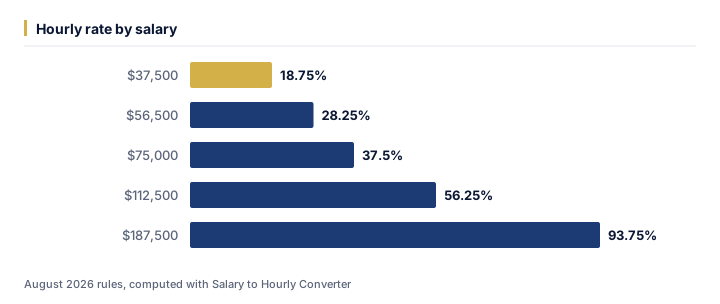
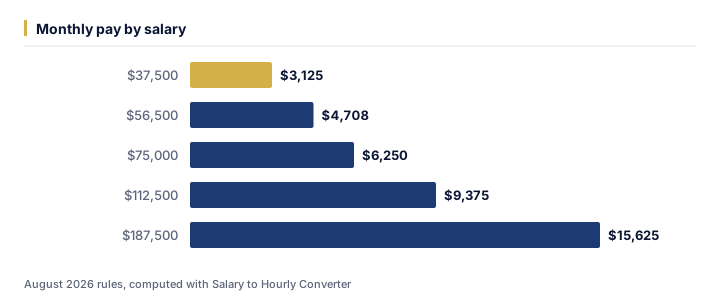
We ran 5 values of salary through the calculator and left every other input at its default. As of August 2026, the output was:
| Salary ($) | Hourly rate (%) | Monthly pay ($) | Biweekly pay ($) |
|---|---|---|---|
| 37,500 | 18.75% | 3,125 | 1,442.31 |
| 56,500 | 28.25% | 4,708.33 | 2,173.08 |
| 75,000 | 37.5% | 6,250 | 2,884.62 |
| 112,500 | 56.25% | 9,375 | 4,326.92 |
| 187,500 | 93.75% | 15,625 | 7,211.54 |
Running salary from $37,500 up to $187,500 moves hourly rate from 18.75% to 93.75% — a spread of 75%. That gap is the part a single headline rate never shows.
The same runs seen through monthly pay
At $37,500, monthly pay works out to $3,125; at $187,500 it is $15,625. Looking only at hourly rate tends to understate how much the outcome shifts across that range.
One example, straight from the API
The middle row above (salary = $75,000) is not a rounded illustration — it is exactly what /api/v1/tools/salary-to-hourly-converter/calculate returns for that input, August 2026 rules:
{
    "tool": "salary-to-hourly-converter",
    "inputs": {
        "salary": 75000,
        "hoursPerWeek": 40,
        "weeksPerYear": 50
    },
    "result": {
        "hourly_rate": 37.5,
        "monthly_pay": 6250,
        "biweekly_pay": 2884.62,
        "weekly_pay": 1442.31,
        "daily_pay": 300,
        "hours_per_year": 2000
    }
}
Assumptions behind these figures
| Input | Value |
|---|---|
| Salary | $75,000 |
| Hours per week | $40 |
| Weeks per year | 50 years |
| As of | August 2026 |
| Method | identical to /tools/salary-to-hourly-converter |
Rates, thresholds and typical costs change over time; the numbers above are accurate as of August 2026, not a permanent guarantee. For your own situation, open the Salary to Hourly Converter and enter your real numbers — the calculator runs the same code that produced every figure on this page.